

Historically, the distinction between liquid assets and equity holdings has been clearly defined by the concept of utility. While public equities, real estate, and fixed-income assets provide tangible returns or immediate liquidity, private venture capital holdings occupy a unique, often abstract, category of wealth. In recent years, however, the velocity of capital infusion into the artificial intelligence sector has redefined the landscape of paper wealth, as evidenced by the meteoric rise of the AI assistant startup, Instinct.
The rapid appreciation of private company valuations in the AI space reflects a broader trend of value creation occurring entirely within the private markets. For institutional and private investors alike, this shift necessitates a reassessment of traditional investment metrics, such as Multiple on Invested Capital (MOIC) and Distributions to Paid-In Capital (DPI), in an era where startups reach decacorn status in months rather than decades.
A Chronology of Unprecedented Funding
The ascent of Instinct, an AI-powered text interface, serves as a case study in the current hyper-acceleration of venture capital. Founded in April 2026 by former Sierra research scientist Noah Shinn, the company bypassed the traditional, multi-year gestation period typical of high-growth technology firms.
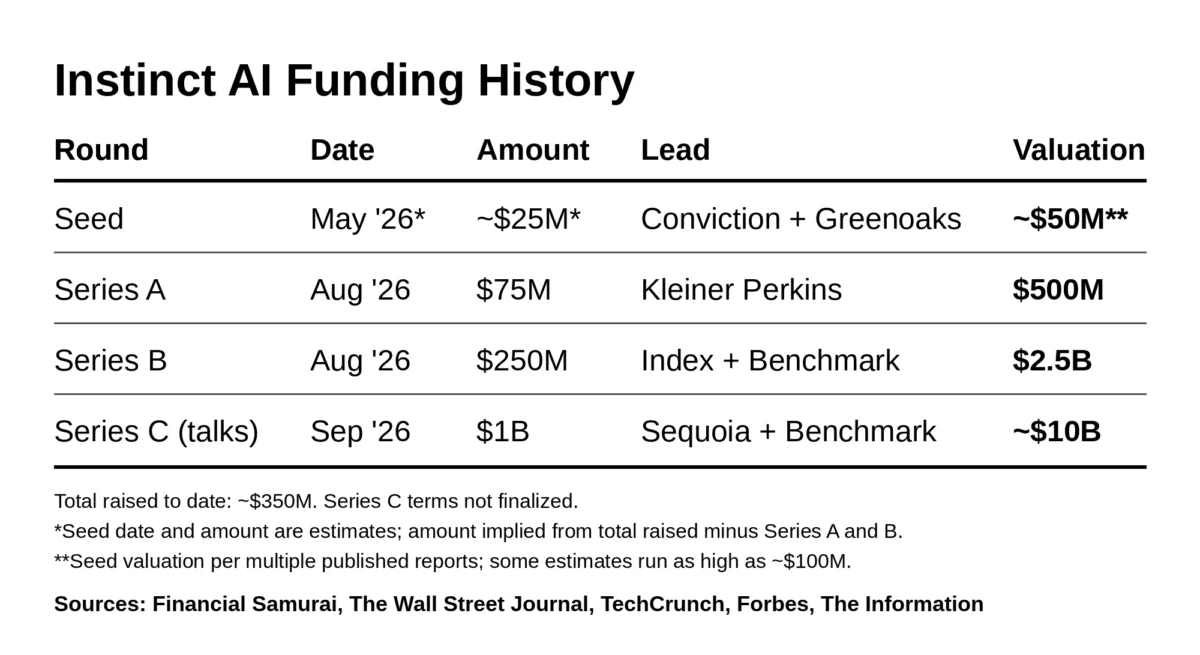
The company’s funding timeline provides a stark illustration of modern venture dynamics:
- April 2026: Instinct is officially registered. Seed funding is secured from Conviction and Greenoaks at a reported $50 million valuation.
- Early August 2026: Kleiner Perkins leads a $75 million Series A round, pushing the company’s valuation to $500 million.
- Late August 2026: Within three weeks of the Series A, the company secures a $250 million Series B round co-led by Index Ventures and Benchmark, valuing the firm at $2.5 billion.
- Q4 2026 (Projected): Industry reports indicate ongoing negotiations for a $1 billion capital injection at a $10 billion valuation, with major venture firms Sequoia and Benchmark reportedly in the lead.
This trajectory represents a potential 200x gross return for early-stage seed investors within a five-month window. Such a pace of valuation growth is historically anomalous, challenging conventional models of startup maturity and market penetration.
The Mechanism of Modern AI Valuation
The justification for these valuations rests on the assumption that Instinct will secure a dominant position in the "AI assistant layer" of consumer technology. By utilizing text messaging as the primary interface, Instinct circumvents the friction of proprietary application adoption, potentially capturing a massive user base. However, the company faces significant operational hurdles, including substantial compute constraints and the necessity for constant infrastructure scaling.

From an investor’s perspective, the disparity between "paper gains" and realized cash remains the central tension of the asset class. While a high-valuation mark on a portfolio provides a significant boost to a fund’s Total Value to Paid-In Capital (TVPI), it offers no immediate liquidity. For Limited Partners (LPs) in the funds backing Instinct, the current valuations—while indicative of market confidence—are contingent upon the eventual successful exit, either through an initial public offering (IPO) or a strategic acquisition.
Metrics of Private Equity: MOIC, TVPI, and DPI
Understanding the financial health of a venture-backed startup requires a firm grasp of specialized performance metrics. In the context of Instinct, these metrics delineate the difference between theoretical wealth and actualized returns.
- Multiple on Invested Capital (MOIC): This metric measures the gross return on an investment before fees and management carry. In the case of Instinct, assuming the $10 billion valuation round materializes, the dilution from successive funding rounds must be accounted for. After adjusting for the equity dilution associated with Series A, B, and the proposed $1 billion round, early investors are looking at a substantial, albeit theoretical, MOIC. When accounting for typical venture firm management fees and carried interest (often ranging from 20% to 35%), the net return to the investor is reduced, though it remains significantly higher than traditional equity benchmarks.
- Total Value to Paid-In Capital (TVPI): TVPI serves as the primary scorecard for fund performance. It represents the sum of distributed cash and the Net Asset Value (NAV) of the fund’s current holdings, divided by the total capital contributed by investors. Because valuations for private companies are often "marked" based on the most recent funding round, a significant surge in a company like Instinct can dramatically inflate a fund’s TVPI. However, it is critical to note that valuation marks often lag behind market sentiment.
- Distributions to Paid-In Capital (DPI): DPI is the only metric that accounts for realized cash. For an investor, DPI is the "gold standard," as it represents the capital actually returned. Until an exit occurs, the DPI for an investment in Instinct remains zero. This highlights the inherent illiquidity of venture capital: investors may hold millions in paper value, yet remain unable to convert those holdings into cash for secondary investments or personal expenditures.
Broader Implications for the Tech Ecosystem
The rapid valuation of AI firms like Instinct underscores a structural shift in the San Francisco venture capital landscape. As AI startups become the primary engine of local economic growth, the "fear of missing out" (FOMO) among investors has intensified. This competitive environment has led to a compression of funding cycles, where firms are willing to pay significant premiums to secure positions in companies that demonstrate early traction.
Furthermore, the reliance on AI for productivity has created a secondary demand for physical infrastructure. While software-based AI valuations continue to climb, institutional investors are increasingly looking toward the physical layer—data centers, power generation, and specialized hardware—as a means of hedging against the volatility of software-only investments. The constraints on power and physical permitting serve as a tangible reality check on the otherwise hyper-inflated AI software market.
Conclusion
The case of Instinct represents the intersection of high-conviction venture capital and the transformative potential of artificial intelligence. While the paper gains generated by such rapid valuation growth provide an optimistic signal for the health of the venture ecosystem, they also serve as a reminder of the fundamental difference between equity valuation and realized wealth.
For the broader market, the implications are clear: as AI continues to dominate capital allocation, the distinction between sustainable, revenue-driven growth and speculative valuation will become increasingly critical. For investors, the ability to maintain a disciplined approach to portfolio construction—balancing high-growth, illiquid venture assets with income-generating real assets—remains the most prudent strategy for navigating a period of rapid technological and financial evolution. Until a secondary market for such private holdings becomes more robust, or a liquidity event occurs, these AI-driven valuations will remain a testament to market sentiment rather than established capital.
