

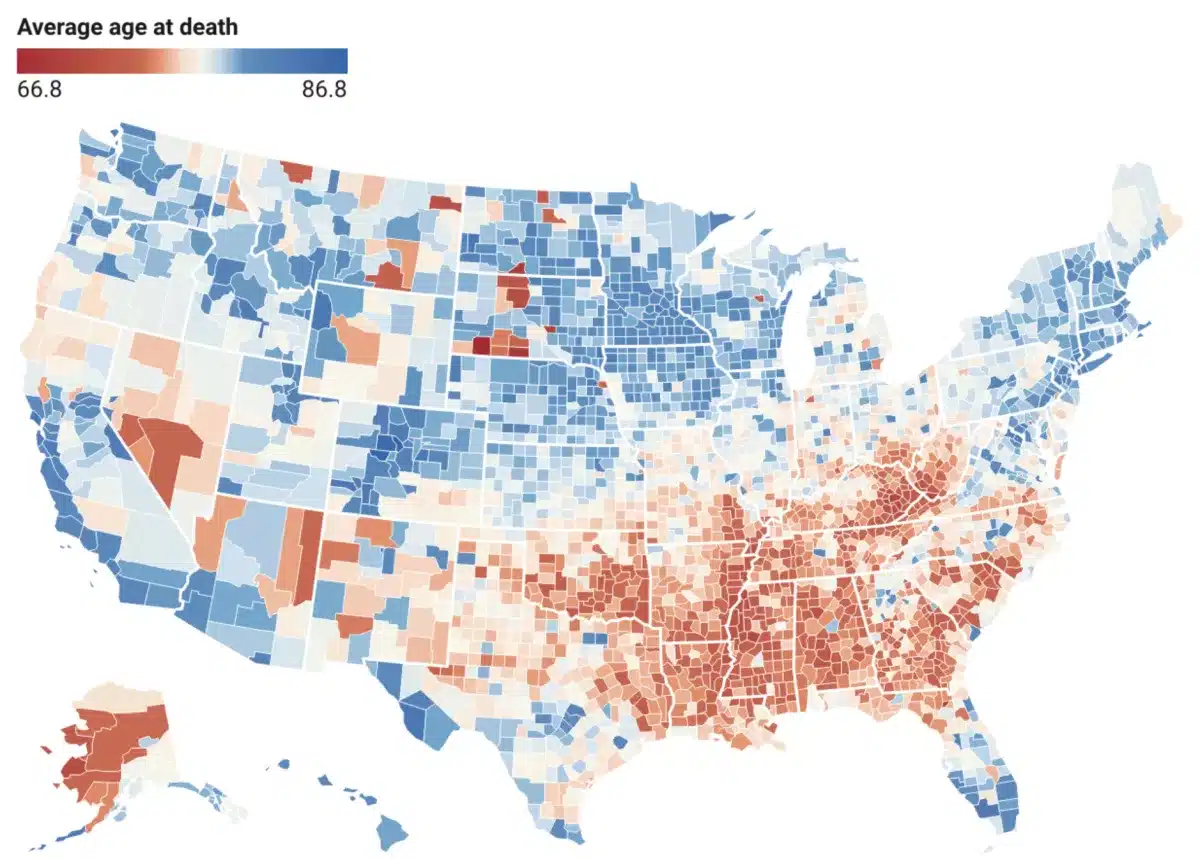
The relationship between geographic location, climate, and economic mobility has long been a subject of intense scrutiny among urban planners and financial analysts. Recent data from the Global Health Data Exchange suggests that Honolulu, Hawaii, maintains the highest median life expectancy in the United States, a statistic frequently attributed to its temperate climate, walkability, and lower stress environments. However, the decision to relocate for lifestyle purposes involves a complex calculus that pits the high costs of desirable climates against the wealth-building opportunities found in major metropolitan hubs.
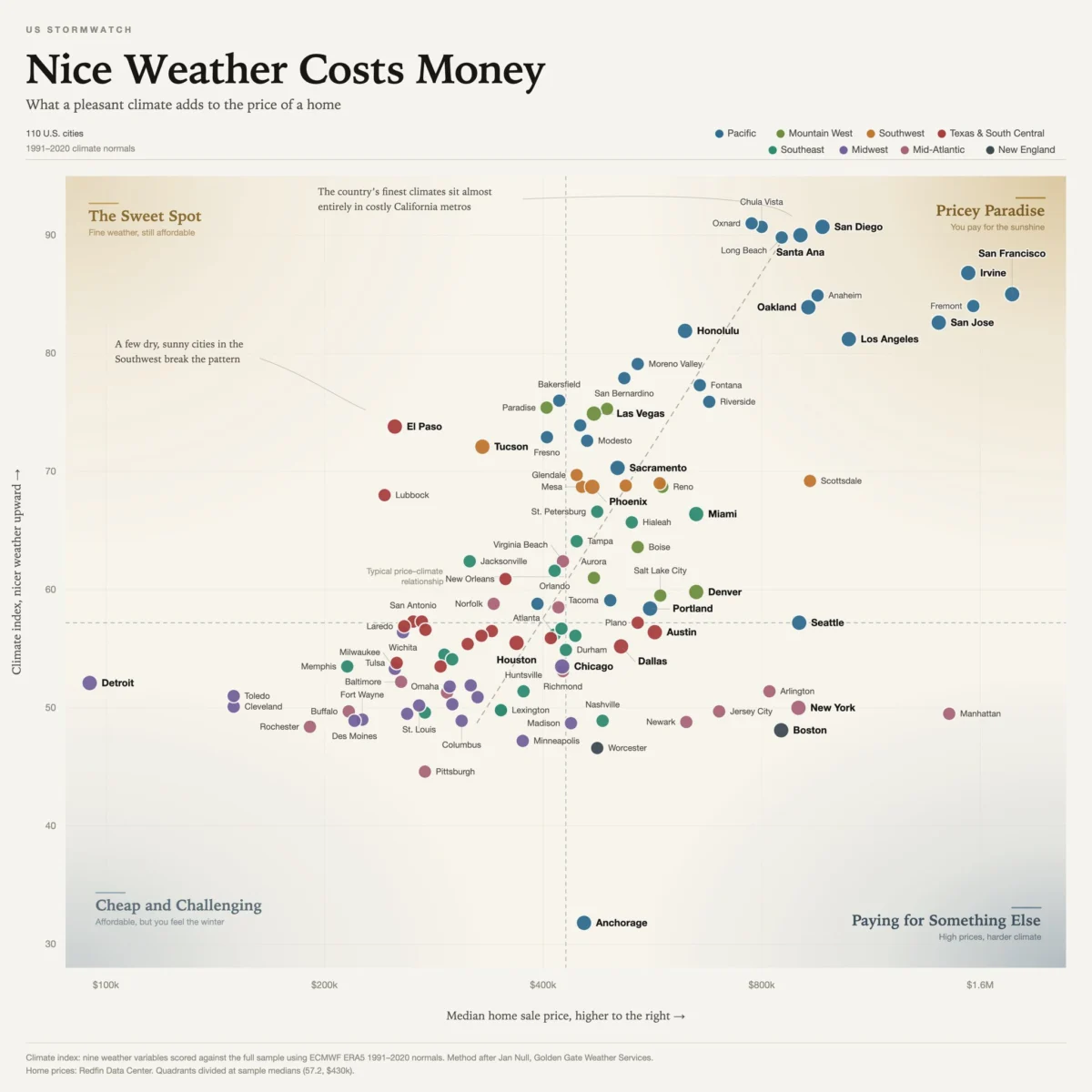
The correlation between climate and housing costs is stark. An analysis of 110 U.S. cities, plotted against a climate index derived from nine meteorological variables spanning 1991 to 2020, reveals that cities with superior weather conditions consistently command higher median home sale prices. This trend suggests that "ideal" weather is a luxury commodity with a finite supply, fundamentally altering the traditional understanding of real estate valuation.
The Economics of Climate and Cost of Living
For decades, the standard financial advice for those seeking to build wealth was to relocate to the most expensive city one could afford, under the assumption that high-cost areas—such as New York City or San Francisco—offered the highest concentration of high-paying jobs and professional networks. While this remains true regarding "opportunity density," recent shifts in remote work and migration patterns have highlighted that expensive cities are not merely hubs for employment; they are effectively selling a premium on climate.
In many coastal California cities, such as San Diego, Irvine, and San Francisco, residential real estate serves multiple functions beyond shelter. It acts as a year-round health and social center, where the ability to remain active outdoors for twelve months of the year serves as a "quality-of-life dividend." In contrast, residents of the Northeast or Midwest must contend with seasonal limitations that often restrict physical activity and social mobility for several months annually.

Chronology of Regional Real Estate Trends
The divergence in housing costs between the East and West Coasts became particularly pronounced in the early 2000s. Between 1999 and 2001, professionals relocating from Manhattan to San Francisco often noted that despite the high cost of the Bay Area, the actual price-per-square-foot often favored the West Coast. During this period, San Francisco saw a massive influx of technology-sector wealth, which created a sustained upward pressure on real estate.
By the mid-2010s, this trend stabilized into a "California Premium." Data from organizations such as Redfin indicate that cities in the upper-right quadrant of the climate-vs-cost matrix—including San Jose, Los Angeles, and Oakland—have remained largely immune to market corrections compared to less temperate regions. The scarcity of land, constrained by Pacific coastlines and mountain ranges, combined with restrictive zoning regulations, ensures that supply remains inelastic, thereby cementing high valuations.
Comparative Analysis: The Four Quadrants of US Housing
To understand the current housing landscape, analysts categorize cities into four distinct quadrants based on the climate index and median home prices:
- The High-Cost, High-Climate Quadrant: Primarily comprised of California coastal cities and select Pacific islands. These areas offer the highest quality-of-life dividends but require significant capital entry, often pricing out middle-income earners.
- The Moderate-Cost, High-Climate Quadrant: Including cities like Phoenix, Las Vegas, and Tucson. These regions offer favorable weather for the majority of the year, though they require adaptation to extreme summer heat. They are increasingly popular for those seeking a balance between lifestyle and affordability.
- The Low-Cost, Low-Climate Quadrant: Stretching across the Midwest and parts of the Rust Belt, including Detroit, Cleveland, and Milwaukee. While these cities face significant meteorological challenges, they offer high rental yields and the ability for middle-income households to achieve full homeownership at a younger age.
- The High-Cost, Low-Climate Quadrant: Primarily East Coast hubs like New York City, Boston, and Seattle. Here, the premium is paid not for the climate, but for institutional access, cultural density, and proximity to professional ecosystems.
Implications of the BURL Strategy
In response to these market dynamics, a growing number of investors are adopting the "Buy Utility, Rent Luxury" (BURL) strategy. This approach suggests that individuals do not need to conflate their primary residence with their investment portfolio.
Under the BURL framework, professionals may choose to rent in high-cost, high-climate cities to capture the lifestyle benefits and professional networking opportunities, while simultaneously deploying capital into "utility-grade" real estate in the heartland or Sunbelt regions. These utility properties—often found in the lower-cost quadrants—generate higher rental yields due to lower acquisition costs and steady demand. This separation of assets allows for geographic flexibility; one can enjoy the amenities of a coastal city without the financial burden of carrying a mortgage in a hyper-inflated market.
Professional Perspectives on Geographic Mobility
Economists and urban sociologists observe that the decision to move is rarely purely financial. The "roots" factor—the social and familial ties that anchor individuals to a specific location—often overrides purely mathematical arguments for relocation. For instance, many residents remain in Boston or New York despite the high cost of living and harsh winters because of the proximity to family and social institutions that have been cultivated over decades.
Furthermore, the "activation energy" required for relocation—the psychological and physical cost of moving one’s entire life—is a significant barrier. However, the data indicates a clear lifecycle approach to these decisions. Early in a professional’s career, the emphasis is placed on "career density," where the high costs of living are viewed as an investment in future earnings. As individuals approach financial independence, the focus shifts toward "lifestyle optimization," where the priority transitions to climate and environmental health.
Conclusion: The Future of Urban Selection
The freedom to move remains one of the most powerful tools in the American economic arsenal. As remote work becomes more ingrained in the modern economy, the requirement to live within a short commute of a corporate headquarters is diminishing. This is expected to put further pressure on the "climate premium," as individuals are no longer tethered to specific high-cost cities for the sake of employment.
Ultimately, the choice of where to reside is becoming an increasingly personal equation. While charts and indices can identify which cities offer the best meteorological conditions or the highest investment yields, they cannot quantify the value of community, family, and personal preference. As the U.S. demographic landscape continues to shift, the ability to successfully navigate the trade-offs between climate, cost, and opportunity will remain a defining characteristic of long-term personal and financial success.
