

The landscape of modern venture capital has shifted significantly, with companies opting to remain private for longer durations to capture maximum value before entering public markets. This trend has created a new class of "paper wealth," where valuations for high-growth startups escalate at unprecedented speeds. A prime example of this phenomenon is Instinct, an AI-driven messaging assistant that has seen its valuation surge from $50 million to a projected $10 billion in a matter of months. This rapid ascent underscores a broader transformation in how institutional and private investors evaluate liquidity, risk, and the psychological impact of unrealized gains.
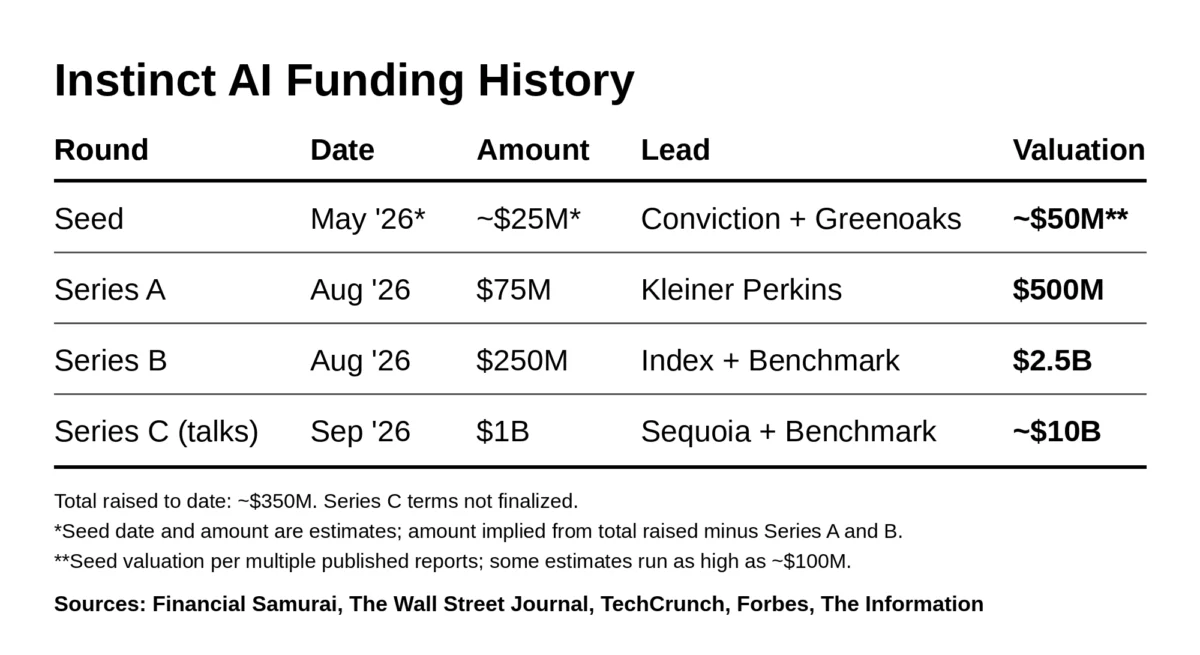
The trajectory of Instinct provides a granular look at the current state of artificial intelligence investment. Founded in April 2026 by former Sierra research scientist Noah Shinn, the company moved from a seed-stage entity to a potential multi-billion-dollar unicorn in less than half a year. The funding chronology is particularly illustrative:
- April 2026: Instinct registers as a corporate entity.
- May 2026: The company secures seed funding from Conviction and Greenoaks at a $50 million valuation.
- Early August 2026: Kleiner Perkins leads a $75 million Series A, pushing the valuation to $500 million.
- Late August 2026: Index Ventures and Benchmark co-lead a $250 million Series B, resulting in a $2.5 billion valuation.
- September 2026: Reports emerge of negotiations for a $1 billion Series C round, targeting a $10 billion valuation with interest from firms including Sequoia and Benchmark.
This pace of capital injection is historically anomalous. While venture capital has long been characterized by long-term horizons, the "AI boom" has compressed the timeline for scaling. Industry analysts suggest that the urgency surrounding such funding rounds is driven by the race to capture market share in the AI assistant layer, where the primary utility is seamless integration into daily text-based communication.
Understanding the Mechanics of Venture Valuation
For investors and Limited Partners (LPs), the distinction between "paper gains" and realized wealth is critical. In the venture capital ecosystem, several metrics are employed to quantify value before an exit event, such as an Initial Public Offering (IPO) or a corporate acquisition.
Multiple on Invested Capital (MOIC) represents the ratio of the total value of an investment relative to the capital initially deployed, calculated on a gross basis before fees and carried interest. In the case of Instinct, an early investor’s stake could theoretically see a significant MOIC increase, though these figures are subject to dilution from subsequent funding rounds. For instance, a series of 10% dilution events at the Series B and potential Series C stages would adjust the net returns for early backers.
Total Value to Paid-In Capital (TVPI) serves as a broader scorecard for fund performance, encompassing both distributed capital and the Net Asset Value (NAV) of remaining holdings. However, industry veterans emphasize that TVPI is essentially a measure of "funny money." The only metric that provides actual liquidity for investors is Distributions to Paid-In Capital (DPI), which measures cash returned to investors. As of the current development phase, Instinct’s investors have not realized a DPI, meaning that despite the massive valuation markups, the capital remains tied to the underlying asset.
The Psychological and Economic Implications of Unrealized Gains
The surge in valuation for private AI firms creates a unique psychological environment for capital allocators. Unlike public equities, where daily volatility can trigger emotional responses, private venture holdings provide a sense of stability, largely because they are not marked to market on a daily basis. This creates a "feel-good wealth effect," where investors derive satisfaction from the growth of their portfolio even when the assets are illiquid.
From an economic perspective, this phenomenon serves as a hedge against the Fear Of Missing Out (FOMO) prevalent in tech-centric hubs like San Francisco. As AI continues to dominate regional economic discourse, investing in venture capital allows participants to maintain alignment with the local economy. For many, this is viewed as a necessary strategy to stay competitive in an environment where wealth creation is increasingly decoupled from traditional salary-based employment.
Broader Market Context and Infrastructure Constraints

While the software layer of AI—exemplified by companies like Instinct—captures headlines due to rapid valuation growth, the underlying infrastructure presents a different set of challenges. AI models are fundamentally constrained by compute power, energy availability, and physical data center capacity.
Investment firms are increasingly bifurcating their strategies: allocating high-risk capital to software-based AI applications while simultaneously investing in the physical real estate and infrastructure required to support the AI buildout. Data centers, which require significant permitting and specialized power grids, are becoming the "real assets" of the AI era. Investors who prefer tangible utility often find these infrastructure projects to be a more stable, albeit slower-growing, counterpart to the high-velocity world of AI software startups.
Comparative Analysis with Public Markets
The preference for venture capital over public equities is a reflection of the "permanent underclass" fear, where investors worry that the most significant value creation occurs before a company reaches the public stock exchange. In the case of companies like Google, which maintain fortress-like balance sheets and consistent monopoly-style profits, the value is realized through long-term stability and dividends.
However, for startups like Instinct, the goal is not current profitability but the establishment of a dominant user interface. If an AI assistant becomes the primary vehicle for human-to-computer interaction, the potential revenue streams are vast. Yet, the risk remains substantial. Unlike established tech giants, nascent AI firms face intense competition from incumbents like Meta, which can leverage existing massive user bases to roll out competing services.
The Role of Limited Partners and General Partners
The success of a venture investment is highly dependent on the General Partners (GPs) who scout and win deals. The ability of a firm like Kleiner Perkins or Benchmark to secure an early stake in a high-growth company is a testament to their network and industry reputation. For LPs, committing capital to these funds is a leap of faith, but successful deals that result in astronomical valuations reinforce the credibility of the fund managers.
When a company like Instinct achieves a $10 billion valuation, it serves as a validation of the current venture funding model. However, it also highlights the disconnect between venture-backed private valuations and traditional valuation metrics such as Price-to-Earnings (P/E) ratios. Because many of these startups are pre-revenue or early-revenue, the market is pricing them based on future potential and market dominance rather than current financial performance.
Conclusion: The Reality of the AI Gold Rush
The rapid funding of Instinct serves as a microcosm of the current venture capital environment. It demonstrates how, in a landscape defined by AI innovation, capital is being deployed at record speeds to secure positions in the next generation of technology. While the paper gains generated by such rounds provide significant psychological and strategic value to investors, the lack of immediate liquidity remains a sobering reality.
For the average investor, the lesson is one of balance. While venture capital offers the potential for outsized returns and a hedge against the FOMO of a tech-driven economy, it is not a substitute for liquid assets. As the AI sector continues to mature, the focus will likely shift from purely valuation-based growth to the hard metrics of revenue, sustainability, and ultimately, the successful distribution of cash to investors. Until that time, the "funny money" of venture capital will remain a high-stakes, high-reward game, reflective of the broader volatility and promise of the digital age.
