

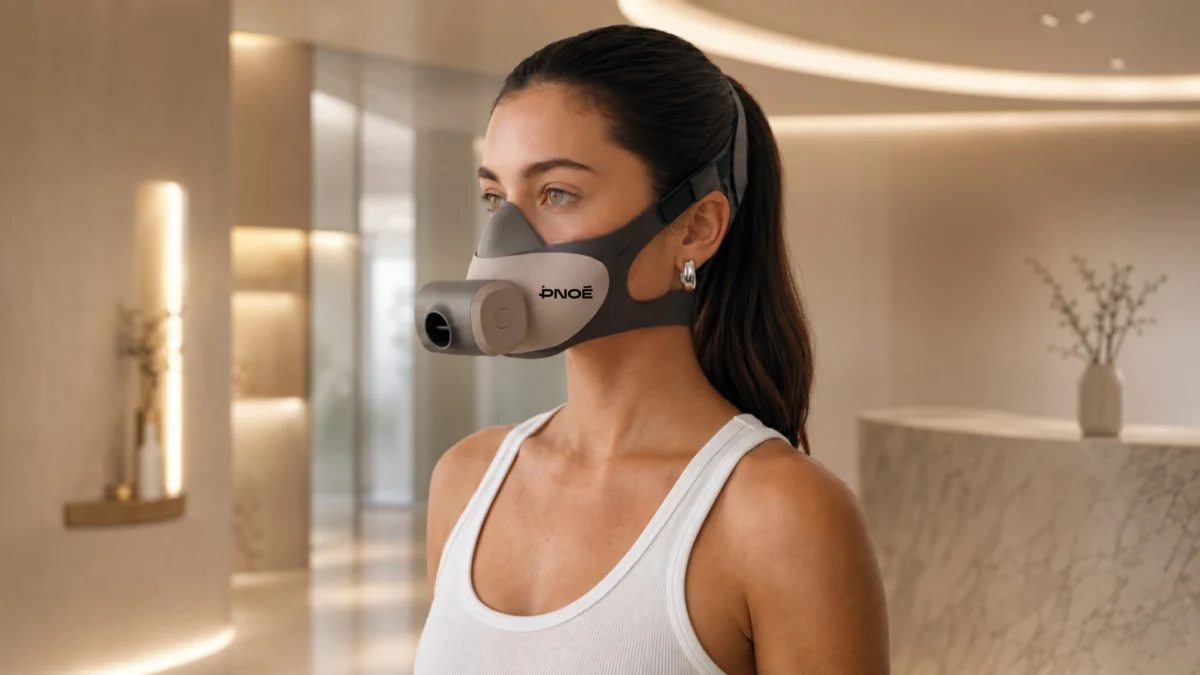
At first glance, the newest diagnostic hardware from health technology firm PNOĒ resembles a piece of cinematic sci-fi villain gear. Covering the nose and mouth and securing tightly around the back of the head, the mask bears an unmistakable visual resemblance to the facial apparatus worn by Bane, the hulking nemesis of Batman. Yet, the intended application of this device is decidedly clinical and benign. Rather than inducing terror, the mask measures oxygen consumption and carbon dioxide exhalation, translating raw respiratory data into personalized dietary, training, and longevity guidance.
Headquartered in Malden, Massachusetts, with primary operations in Athens, Greece, PNOĒ is preparing for the commercial rollout of its flagship device, the PNOĒ 2.0, slated for release on October 1. The defining technological evolution of this iteration lies in its self-administered testing capabilities. According to co-founder and chief executive officer Apostolos Atsalakis, the new design allows a user to enter a participating fitness facility, don the mask independently, press a start button, and sit quietly while breathing into the device for eight minutes.
This operational shift removes the previous requirement for a trained technician to oversee the testing procedure. By eliminating the need for specialized staffing, the self-service model opens commercial pathways for unattended fitness centers, boutique athletic clubs, and retail pharmacies to offer advanced metabolic assessments.
The Scientific Foundation of Metabolic Testing
The foundational science behind PNOĒ is rooted in established physiology rather than novel discovery. Metabolic testing, which involves analyzing exhaled gases to determine how efficiently the human body converts nutrients into cellular energy, has a history spanning more than a century. For decades, this methodology has served as the diagnostic benchmark for evaluating VO₂ max—the maximum volume of oxygen an individual can utilize during intense exertion—widely recognized by sports scientists as a premier indicator of overall cardiorespiratory fitness.
Despite its clinical utility, traditional metabolic analysis has historically relied on bulky, expensive apparatuses known as metabolic carts. These systems are predominantly confined to university sports science laboratories, elite athletic training centers, and hospital cardiology departments. Consequently, accurate respiratory diagnostics have largely remained the domain of professional athletes, Olympic hopefuls, and affluent participants in executive wellness programs.
PNOĒ, a decade-old enterprise, attempts to democratize this diagnostic tier by packing equivalent laboratory-grade accuracy into a portable, cloud-connected hardware package. Proprietary software then processes the respiratory metrics, translating complex physiological data into actionable lifestyle recommendations.
The device captures 23 distinct biomarkers during a standard session. Beyond VO₂ max, these metrics include the resting metabolic rate (RMR), which quantifies the baseline caloric expenditure of the body at rest, and metabolic flexibility, a measure of how efficiently the metabolism shifts between oxidizing dietary fats and carbohydrates. Atsalakis contends that these high-resolution biomarkers answer fundamental wellness questions that standard blood panels and routine physical examinations cannot adequately address, such as precise daily caloric requirements and optimal cardiovascular training zones.
Capitalizing on the Booming Longevity Market
The commercial timing of the PNOĒ 2.0 release aligns with a broader cultural and economic shift toward proactive health and human lifespan optimization. Over the past several years, VO₂ max has transitioned from an obscure physiological metric into a ubiquitous buzzword among the rapidly expanding longevity community. This surge in consumer interest is fueled by a growing body of epidemiological research directly correlating higher cardiorespiratory fitness levels with significantly reduced all-cause mortality.
Atsalakis views cardiorespiratory capacity as perhaps the strongest single predictor of human longevity, positioning his company’s diagnostic output as a definitive scorecard for the wellness industry. However, PNOĒ enters a crowded and competitive market segment. Major consumer technology brands, including Apple, Garmin, and Whoop, routinely estimate VO₂ max metrics using continuous optical heart-rate tracking and accelerometer data. Concurrently, direct-to-consumer hardware competitors like Lumen offer compact, breath-based devices designed to monitor daily metabolic fuel utilization.
Against these consumer-grade trackers, PNOĒ aims to stake out a rigorous middle ground, offering deeper clinical fidelity than a standard smartwatch while remaining significantly more accessible than a hospital-grade metabolic cart.
Engineering, Hygiene, and Regulatory Positioning
Developing a self-administered respiratory testing device required extensive industrial design. PNOĒ collaborated with Milan-based Design Group Italia, going through numerous iterative prototypes to engineer hardware that was simultaneously robust, simplified, and reliable enough for public use.
Furthermore, the design directly addresses post-pandemic consumer hygiene concerns regarding shared public equipment. The PNOĒ 2.0 separates the delicate electronic sensors from the physical silicone face mask and securing straps. Users share the high-cost central processing hardware while retaining or purchasing their own individual, hygienic masks for personal use.
Despite its clinical appearance and ambitions, PNOĒ maintains a conservative regulatory stance. The device has not received clearance or approval from the U.S. Food and Drug Administration (FDA) as a medical diagnostic tool. Consequently, the company explicitly avoids making medical claims or prescribing therapeutic interventions.
"We do not provide medical recommendations," Atsalakis stated. "It’s like a body composition device, like a scale. A doctor cannot prescribe medication based on our results."
Nevertheless, the long-term roadmap for the company includes potential expansion into clinical diagnostics. Medical researchers have long investigated whether volatile organic compounds and chemical signatures in human breath can serve as early warning biomarkers for systemic diseases, including various forms of oncology. Atsalakis acknowledges that while the company’s accumulating repository of metabolic data could eventually assist in flagging underlying health pathologies, full clinical diagnostic clearance remains years away due to stringent regulatory validation hurdles.
Chronology and Corporate Trajectory
The origins of PNOĒ trace back to Atsalakis’s doctoral research in advanced sensing technologies at the University of Cambridge. During his PhD studies, coinciding with the initial surge of consumer wearable technology, he became fascinated by the untapped diagnostic potential of human breath. He subsequently co-founded the venture alongside childhood friend Panos Papadiamantis, who currently serves as the company’s chief product officer.
The startup achieved early validation by participating in the prestigious Y Combinator Winter 2019 accelerator cohort—entering the market prior to the widespread cultural obsession with longevity. Since its inception, PNOĒ has secured approximately $22 million in total venture capital funding. This financing includes a recently closed $11 million investment round backed by specialized venture firms such as 50 Years, alongside notable tech figures like Google Maps co-founder Lars Rasmussen.
Business Model and Global Expansion
Rather than selling directly to individual consumers, PNOĒ operates exclusively on a business-to-business (B2B) distribution model. Enterprise clients purchase enterprise subscriptions that grant them access to the hardware, software analytics platform, staff training modules, and co-branded marketing materials. Atsalakis characterizes this comprehensive package as a turnkey "business in a box."
Subscription pricing ranges from $400 to over $1,000 per month, depending on the tier and volume of use. The platform integrates directly with the service offerings of health and fitness establishments, enabling a gym, luxury hotel, or medical spa to automatically recommend specific personal training packages, nutritional protocols, or recovery services based on the customer’s breath test results. Many client facilities deploy the metabolic assessment during initial member onboarding as a high-value differentiator.
The company’s enterprise client roster includes high-profile brands such as Equinox—where the technology is deployed across nearly all club locations—alongside luxury hospitality groups like Four Seasons, elite athletic organizations including Red Bull and the National Basketball Association (NBA), the Mount Sinai Health System, and med-spa franchise Restore Hyper Wellness.
Geographically, the United States accounts for roughly 85% of PNOĒ’s total revenue. Atsalakis describes the American market as "by far the most advanced market globally" for consumer longevity investments. In response to international demand, the company is actively scaling its operational footprint across Europe and establishing channel partnerships to enter markets in Latin America and Asia.
With a current workforce of 110 employees, PNOĒ reports that it has successfully achieved corporate profitability while sustaining annual revenue growth in excess of 100%. As the company prepares for its forthcoming Series B funding round—projected to launch within the next six to twelve months—its overarching objective remains clear: to normalize professional metabolic profiling and bring its distinctive testing mask to a rapidly expanding global audience.
