

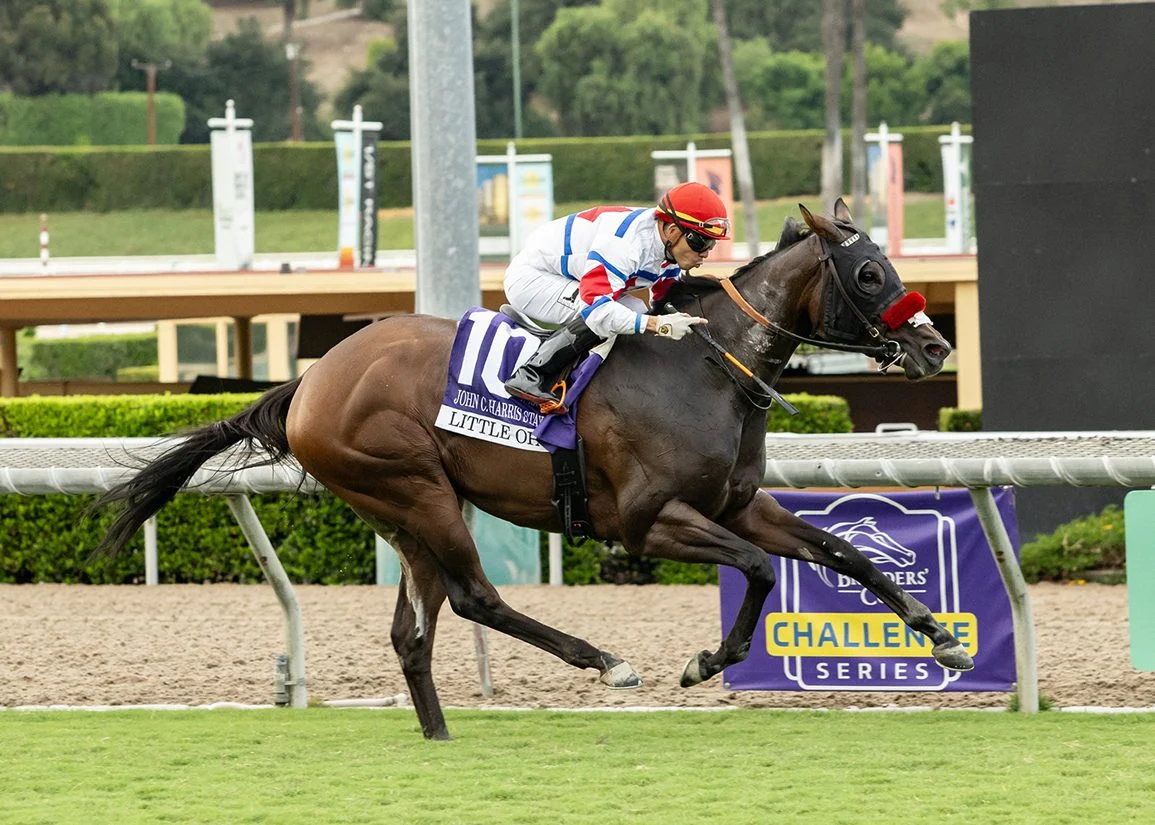
The world of Thoroughbred racing is often defined by the intersection of profound loss and sudden, exhilarating triumph. For breeder and owner Donald R. Dizney, the final week of September 2026 proved to be a microcosm of this bittersweet reality. Just days after the industry mourned the passing of First Dude, the beloved Double Diamond Farm stallion who served as a cornerstone of Florida’s breeding program for nearly two decades, a new star emerged to carry the legacy of the farm forward. On Saturday, September 26, the three-year-old filly Little Opal solidified her status as a rising force in the division, securing a commanding victory in the Grade III John C. Harris Stakes at Santa Anita Park.
The victory, which maintained the filly’s perfect career record, served as a poignant reminder of the enduring nature of the sport. While the passing of First Dude at age 19 marked the end of an era for Dizney’s Florida-based operation, the performance of Little Opal on the Southern California circuit suggested that the future of his breeding program remains as vibrant as ever.
A Dominant Performance at Santa Anita
Entering the John C. Harris Stakes, Little Opal carried the weight of high expectations. Sent off as the 6-5 favorite, the daughter of Caravaggio was tasked with proving that her two previous victories at Del Mar—both five-furlong sprints—were not merely flashes of brilliance, but indicators of a burgeoning talent.
Breaking from the widest post position in a ten-horse field, Little Opal displayed the tactical speed and composure typically seen in seasoned veterans. Under the guidance of jockey Emisael Jaramillo, she hustled to the front early, establishing a clear lead as the field navigated the track. She recorded an opening quarter-mile in 22 seconds flat, effectively dictating the tempo of the race. Despite pressure from challengers such as Come On Om, Mo’ Em Down, and Seeking Attention, Little Opal remained unbothered. She covered the half-mile mark in 44.34 seconds, maintaining her composure as the field turned for home.
Though she briefly drifted to the wrong lead during the final furlong, allowing a late-charging Day to Day to narrow the margin, Little Opal possessed the necessary heart to hold the line. She crossed the wire 1 1/4 lengths ahead of her nearest rival, stopping the clock at 1:12.76 for the 6 1/2-furlong distance. The win not only provided her with a first graded stakes victory but also served as a testament to the training regimen established by Doug O’Neill.
Tactical Insight from the Winner’s Circle
Trainer Doug O’Neill, who has been instrumental in the filly’s rapid development, addressed the decision to run the horse in the John C. Harris shortly after the race. "This stakes race is something we thought about a few months ago," O’Neill noted. "It was coming back a little quick from her last win, but Emisael knows her well, and he felt like she had good energy coming into this race. We got a great, cozy outside post, with not a lot of speed early on. Just a great ride and a great filly."
The strategic advantage of the outside draw cannot be overstated. By starting from the 10-hole, Jaramillo was able to monitor the pace of the race from the exterior, ensuring that Little Opal did not get caught in the congestion that frequently defines large-field sprint races. This calculated positioning allowed the filly to conserve energy in the early stages while maintaining control, a hallmark of a high-class runner.
Pedigree and Breeding Context
Little Opal’s success is deeply rooted in a pedigree that highlights both international influence and domestic excellence. Her sire, Caravaggio, has proven to be a global sensation, standing at Shizunai Stallion Station in Japan since 2023. Known for producing elite milers and sprinters, Caravaggio has sired multiple Group 1 winners, including Porta Fortuna (Ire) and Tenebrism. His impact on the American circuit has been equally profound, evidenced by the 2026 Grade I American Turf Stakes winner, Stark Contrast.
On the maternal side, Little Opal is out of Il Mulino, a mare acquired by Double Diamond Farm for $200,000 at the 2013 Keeneland September yearling sale. The family has been remarkably productive; Il Mulino is a half-sister to the dam of the Grade II John C. Mabee Stakes winner, Medoro. Furthermore, the family’s legacy is tied to some of the most notable names in the sport, including Kentucky Derby winner Giacomo and the successful WinStar stallion Nashville.
The fact that Little Opal is out of a mare by Elusive Quality—the sire of Quality Road—adds a layer of historical significance to her performance. The late Elusive Quality remains a titan in the stud book, having sired nearly 200 stakes winners out of his daughters. Little Opal represents the latest success in a lineage that continues to contribute significantly to the North American racing landscape.
A Chronology of Success
The progression of Little Opal’s career has been nothing short of meteoric. Her debut on July 24 at Del Mar signaled her potential, as she graduated in impressive fashion. She followed that performance with a win in an optional allowance race on September 4, again at Del Mar. In those two starts, she earned Beyer Speed Figures of 90 and 94, numbers that established her as a legitimate stakes-caliber contender well before her arrival at Santa Anita.
The transition from five furlongs to 6 1/2 panels in the John C. Harris Stakes represented a significant test for the three-year-old filly. Horses often struggle with the added distance, particularly when they are accustomed to shorter, more explosive bursts of speed. However, Little Opal handled the extra furlong and a half with relative ease, suggesting that she may have the stamina to compete in even longer races as her career progresses.
The Broader Impact of the Victory
The victory by Little Opal is significant for several reasons. Primarily, it provides Donald R. Dizney with a high-level success at a moment of transition for his breeding enterprise. Following the death of First Dude, the spotlight on the farm’s remaining stock has intensified. Little Opal is now the standard-bearer for a new generation of Dizney-bred horses, proving that the foundation established by the farm is producing high-quality, competitive athletes.
From an analytical standpoint, the victory also underscores the value of patient, long-term breeding strategies. The pedigree depth seen in Little Opal’s lineage is not an accident; it is the result of years of investment in high-quality mares and strategic matings. The fact that she is one of only four living foals from her dam—despite the challenges the mare has faced in breeding—makes her success even more meaningful for the farm’s staff and ownership.
Future Implications
With an unblemished 3-0-0 record and $156,600 in career earnings, the path forward for Little Opal is bright. The racing community will undoubtedly be watching to see if she can maintain her trajectory as she transitions from the restricted stakes level into higher-grade open company.
The successful outing at Santa Anita also cements the reputation of the O’Neill barn, which has consistently demonstrated an ability to prepare young horses for peak performances at the right time. For breeders and investors, the "A+" Werk Nick rating assigned to her pedigree will likely increase interest in her siblings and the descendants of her dam, Il Mulino, in upcoming bloodstock auctions.
As the 2026 racing season enters its final quarter, Little Opal stands out as one of the most promising young fillies on the West Coast. Her performance on Saturday was more than just a win; it was an affirmation of the resilience of both horse and breeder. In a sport where the turnover of stars is constant, Little Opal has announced herself as a name to be reckoned with, potentially filling the void left by the legends of the past while writing her own story on the track.
As she heads into her next engagement, the racing world will remain focused on whether she can continue to bridge the gap between regional promise and national prominence. For now, however, she has done exactly what was asked of her: she has won, she has stayed undefeated, and she has given the Dizney legacy a new reason to shine.
