

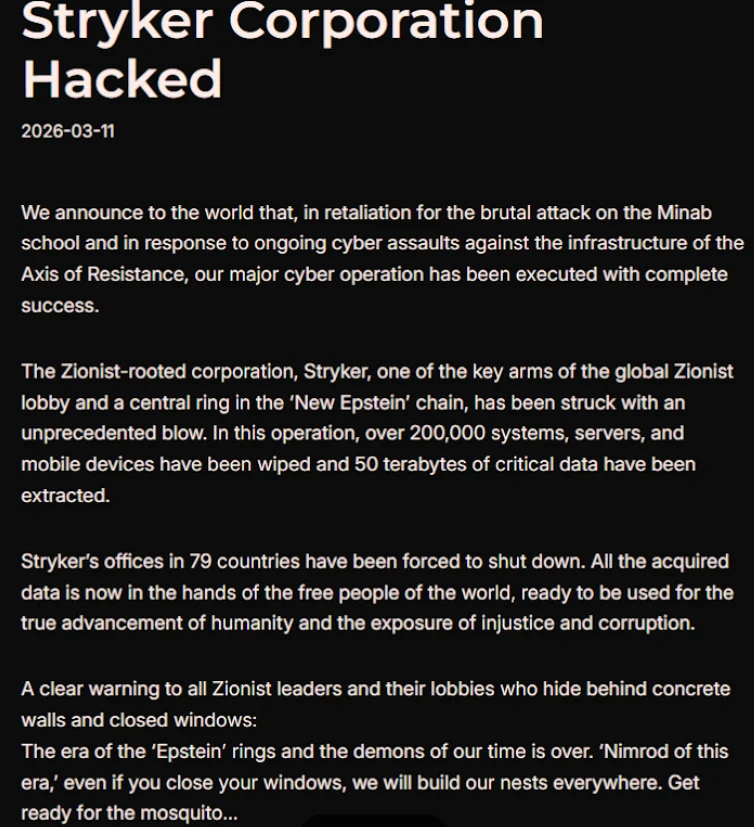
Stryker Corporation, a premier global medical technology firm, is currently grappling with a catastrophic cybersecurity breach that has reportedly paralyzed its operations across dozens of countries. The attack, characterized by a massive deployment of data-wiping commands, was claimed by an Iran-linked hacktivist collective known as Handala. The group asserts that the offensive was launched in direct retaliation for a February 28 missile strike in Iran, which has recently been attributed to the United States military. As of mid-March, the Kalamazoo, Michigan-based company, which reported $25 billion in global sales last year, is facing significant disruptions to its supply chain, internal communications, and critical healthcare services that hospitals rely on for emergency patient care.
The Scope of the Digital Onslaught
The scale of the disruption became apparent early on Wednesday when reports emerged from Ireland, Stryker’s most significant operational hub outside the United States. According to the Irish Examiner, more than 5,000 employees at the company’s Cork facilities were sent home after internal systems failed. Employees reported that virtually every device connected to the corporate network—including servers, desktop computers, and even personal mobile devices containing corporate software—had been rendered useless.
In a manifesto posted to the encrypted messaging platform Telegram, the Handala Hack Team claimed to have executed a "mass wipe" of more than 200,000 systems, servers, and mobile devices across Stryker’s global infrastructure. The group alleged that offices in 79 countries were forced to shut down. While Stryker’s official documentation lists operations in 61 countries with a workforce of 56,000, the discrepancy in numbers does not diminish the perceived severity of the event. At the company’s U.S. headquarters, a recorded voicemail message informed callers of a "building emergency," advising them to try again later, signaling a total breakdown of standard communication channels.
Technical Execution: Weaponizing Microsoft Intune
Initial investigations into the methodology of the attack suggest a sophisticated exploitation of administrative tools rather than a traditional malware infection. While "wiper" attacks typically involve software designed to overwrite data on a hard drive, evidence in the Stryker case points to the misuse of Microsoft Intune.
Intune is a cloud-based unified endpoint management service used by IT departments to manage mobile devices and computers. It allows administrators to enforce security policies, deploy apps, and, crucially, issue "remote wipe" commands to protect corporate data if a device is lost or stolen. Cybersecurity experts and anonymous sources close to the incident indicate that the attackers likely gained unauthorized access to Stryker’s Intune administrative console. From this central vantage point, they were able to broadcast a remote wipe command to every connected device globally.
This method is particularly devastating because it leverages legitimate, high-level system permissions to bypass traditional antivirus and endpoint detection software. Reports from employees indicate that personal phones with Microsoft Outlook installed were wiped clean, a side effect of the Intune "wipe" command which often factory-resets the entire device to ensure no corporate data remains. On many of these devices, the standard login screens were reportedly replaced or defaced with the Handala logo.
Geopolitical Motives and the Handala Persona
The timing and stated motivation of the attack place it firmly within the realm of modern geopolitical conflict. Handala stated that the strike was a response to a February 28 Tomahawk missile strike on an Iranian school that resulted in the deaths of at least 175 people, many of whom were children. This claim gained significant weight following a report by The New York Times, which confirmed that an internal military investigation identified the United States as responsible for the deadly strike.
Handala is not a new actor in the cyber landscape. Security researchers at Palo Alto Networks’ Unit 42 have identified the group as a persona maintained by "Void Manticore," a threat actor closely affiliated with Iran’s Ministry of Intelligence and Security (MOIS). Since surfacing in late 2023, Handala has primarily targeted Israeli infrastructure, including fuel systems and energy exploration companies. The group’s name itself is symbolic; "Handala" is a famous cartoon character created by Palestinian cartoonist Naji al-Ali, representing a ten-year-old refugee who serves as a symbol of resistance and national identity.
The manifesto against Stryker referred to the company as a "Zionist-rooted corporation." This characterization likely stems from Stryker’s 2019 acquisition of OrthoSpace, an Israeli-based medical technology company, for $220 million. By targeting Stryker, the Iran-backed group appears to be pursuing a dual agenda: retaliating against the U.S. government while simultaneously striking a corporation with ties to the Israeli economy.
Impact on the Healthcare Supply Chain and Emergency Services
The consequences of the Stryker outage extend far beyond corporate balance sheets, posing a direct threat to patient care. Stryker is a dominant force in the medical supply market, providing everything from orthopedic implants and surgical power tools to hospital beds and emergency transport equipment.
A healthcare professional at a major U.S. university medical system, speaking on condition of anonymity, described the situation as a "real-world supply chain attack." The professional noted that their institution is currently unable to order essential surgical supplies. "Pretty much every hospital in the U.S. that performs surgeries uses their supplies," the source added, highlighting the systemic vulnerability created by the outage.
Furthermore, the attack has disrupted "LIFENET," a critical Stryker-owned cloud-based platform. LIFENET allows paramedics and Emergency Medical Services (EMS) to transmit electrocardiograms (EKGs) from the field directly to hospital emergency departments. This capability is vital for patients experiencing a ST-elevation myocardial infarction (STEMI)—a serious type of heart attack—as it allows surgeons to prepare the catheterization lab before the patient even arrives.
In Maryland, the Institute for Emergency Medical Services Systems issued a memo alerting providers to the "global network disruption." Timothy Chizmar, the state’s EMS medical director, advised paramedics that if they are unable to transmit EKGs via LIFENET, they must revert to traditional radio consultations to describe their findings to physicians. While these workarounds exist, they inevitably introduce delays into time-sensitive medical emergencies.
Official Responses and Industry Vigilance
Despite the widespread reports of disruption, official statements from Stryker have been sparse, primarily citing a "building emergency" or "network disruption." This lack of transparency is common in the early stages of major cyber incidents as companies prioritize containment and forensic analysis.
John Riggi, the national advisor for cybersecurity and risk at the American Hospital Association (AHA), stated that the organization is actively monitoring the situation. "We are aware of reports of the cyber attack against Stryker and are actively exchanging information with the hospital field and the federal government to understand the nature of the threat and assess any impact to hospital operations," Riggi said. He noted that while direct operational disruptions to U.S. hospitals had not been confirmed in the initial hours, the situation remained fluid as hospitals evaluated their reliance on Stryker’s digital services and supply chain.
Broader Implications for Cybersecurity and National Defense
The Stryker incident serves as a stark reminder of the evolving nature of cyber warfare, where private corporations are increasingly viewed as legitimate targets in state-level disputes. The use of "wiper" tactics signifies a shift from the profit-motivated models of traditional ransomware groups to a model focused on pure destruction and psychological impact.
Several key themes emerge from this event that will likely shape cybersecurity discourse in the coming months:
-
The Vulnerability of Centralized Management: The apparent use of Microsoft Intune to facilitate the attack highlights a critical security paradox. The very tools designed to secure and manage thousands of endpoints can become the single point of failure if the administrative accounts are compromised. Organizations must move toward "zero trust" architectures where even administrative actions require multi-factor authentication and tiered approvals.
-
Supply Chain Fragility: The healthcare sector’s reliance on a handful of massive suppliers like Stryker creates a "too big to fail" scenario. A disruption at one company can lead to a cascade of canceled surgeries and delayed treatments across an entire nation.
-
Geopolitical Spillover: As kinetic conflicts (missile strikes and ground wars) continue, the digital front will expand. Corporations with significant government contracts or international footprints are increasingly on the front lines of these conflicts.
-
The Rise of State-Sponsored Hacktivism: The blurred lines between independent hacktivists and state intelligence agencies (like the MOIS) make attribution and retaliation difficult. These groups use the "hacktivist" label to provide plausible deniability for the states that support them.
As Stryker works to restore its systems and secure its global network, the medical community remains on high alert. The recovery process for a data-wiping attack of this magnitude is often measured in weeks or months, as every individual device must typically be manually re-imaged and verified. For the thousands of hospitals that rely on Stryker’s daily deliveries and digital heart-monitoring tools, the focus now shifts to contingency planning and the search for alternative suppliers in a market that has been suddenly and violently disrupted.
