

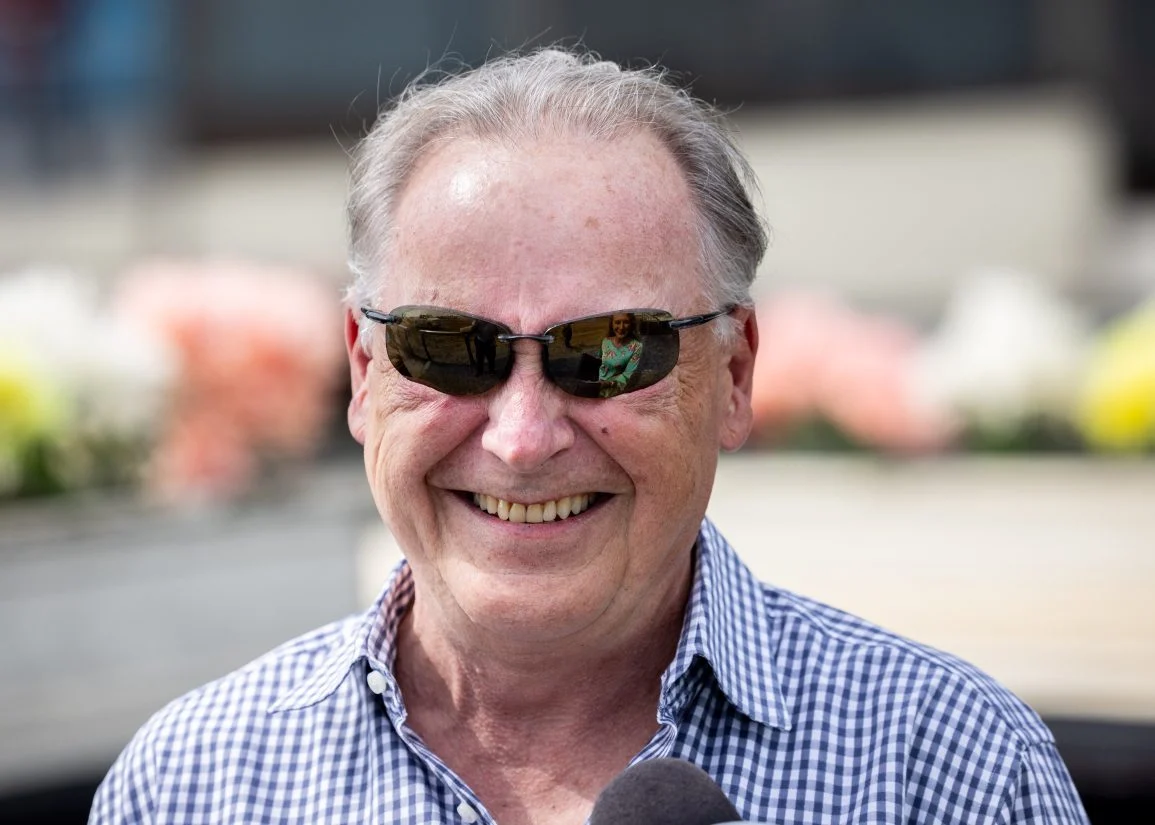
The landscape of professional horse racing in North America witnessed a significant milestone on Sunday as veteran trainer Rick Dutrow Jr. secured his 2,000th career victory. The achievement occurred during a high-stakes afternoon at Belmont Park, where Dutrow’s trainee, Long Pour, a son of Tom’s d’Etat, delivered a commanding performance in the seventh race of the nine-race card. Competing in a challenging 1 1/16-mile optional claiming event for New York-breds, the victory served as a testament to the trainer’s enduring career and his ability to remain competitive at the highest levels of the sport.
Dutrow, 67, began the Sunday race day at Belmont Park sitting at 1,998 career wins. His path to the milestone was swift, as he saddled Tapwrits Temper for a victory in the fourth race, narrowing the gap to a single win. By the time Long Pour crossed the finish line in the seventh race, Dutrow had officially cemented his place among a select group of North American trainers to reach the double-millennium mark.
A Legacy Defined by Horsemanship
The pedigree of Rick Dutrow Jr. is deeply rooted in the history of American Thoroughbred racing. He is the son of the late Richard Dutrow Sr., a legendary figure in the industry who amassed 3,665 career victories. The elder Dutrow was renowned for his work with notable horses such as King’s Swan, Lite the Fuse, and Fara’s Team. Having been exposed to the rigorous demands of the barn from the age of 16, the younger Dutrow developed a foundational understanding of equine physiology and temperament that would eventually define his own professional trajectory.
Dutrow Jr. officially initiated his training career in 1986, recording his first win with the horse Automatic at Aqueduct Racetrack on March 13. While his initial years were spent operating on a smaller scale, he emerged as a dominant force in the New York Racing Association (NYRA) circuit by 1995. Over the ensuing decades, his reputation grew not only for his training acumen but for his aggressive campaigning of horses and his ability to identify talent in the claiming market.
Chronology of Major Achievements
Dutrow’s career has been marked by high-profile successes that have solidified his status as an elite conditioner. His resume includes some of the most prestigious events in the sport:
- 2005: Captured the Breeders’ Cup Classic with Saint Liam and the Breeders’ Cup Sprint with Silver Train, the latter held at Belmont Park.
- 2007: Won the Breeders’ Cup Mile with the standout runner Kip Deville.
- 2008: Achieved the pinnacle of American racing by winning both the Kentucky Derby and the Preakness Stakes with Big Brown.
- 2012: Demonstrated versatility by winning the H. Allen Jerkens Memorial (formerly the King’s Bishop) with Willy Beamin just three days after the horse dominated the Albany Stakes.
- 2023: Following a 10-year hiatus from the sport, Dutrow made a high-profile return to the winner’s circle, securing victories in the Whitney Stakes and the Breeders’ Cup Classic with the formidable White Abarrio.
Throughout this period, Dutrow has earned over $104 million in career purses, a figure that reflects both the quality of the horses he has managed and his consistency in high-stakes environments.
The Human Element: Perspectives on a Master Trainer
The 2,000th victory was overseen at Belmont Park by Blake Dutrow, the trainer’s nephew and long-term assistant. While the elder Dutrow was absent from the track—maintaining his tradition of observing Sunday races from a distance—the atmosphere in the winner’s circle was one of collective accomplishment.
"It’s very special," Blake Dutrow noted following the race. "Thank you to all the horses along the way that have made it possible and the owners. The guy who owns this horse, Kenny Page, is a childhood friend of Rick’s that worked for my granddad; Michael Dubb is involved, it takes those kind of people to get to that number."
Michael Dubb, a prominent owner who has collaborated with Dutrow on numerous successes—including the notable claim of Sis City, who went on to win the Grade 1 Ashland Stakes—offered insight into what makes the trainer distinct. "If you looked up ‘hands-on horseman’ in the encyclopedia, his picture would come up," Dubb said. He emphasized that Dutrow’s success is predicated on an intuitive connection with the animals. According to Dubb, Dutrow does not merely train horses; he understands their individual personalities, quirks, and dispositions, allowing him to tailor training regimens to the specific needs of each horse.
Tony Dutrow, a successful trainer in his own right and Rick’s brother, echoed these sentiments regarding his sibling’s technical expertise. "I have an enormous amount of respect for him as a horseman," Tony Dutrow stated. "He sees things before they become problems. He’s still passionate about this game, and the best might be yet to come."
The Strategic Implications of a Career Milestone
The achievement of 2,000 wins serves as a milestone that highlights the resilience of the trainer’s career, particularly in light of his decade-long absence from the sport. The ability to return to the top tier of racing in 2023 and maintain that momentum into the current season underscores a level of institutional knowledge and adaptability that is rare in the high-pressure environment of Thoroughbred racing.
From a statistical perspective, reaching 2,000 wins places a trainer in an elite category. It indicates not only the volume of horses trained but the ability to maintain a sustainable business model that attracts high-caliber owners, such as the partnership behind Long Pour, which includes Michael Dubb, Sullivan Lane Stable, Daniel Slattery, Steven Speranza, and Crown Stable.
The implications of this milestone also extend to the stability of the New York circuit. As a primary figure at Belmont Park and Saratoga, Dutrow’s continued participation is viewed by many as a vital component of the region’s competitive landscape. His success with horses like White Abarrio and his long-term relationships with owners who have stuck with him through professional fluctuations have allowed him to rebuild his barn with impressive speed.
Looking Toward the Future
As the racing industry continues to evolve, with increased scrutiny on equine welfare and new regulatory standards, trainers like Dutrow are navigating a landscape that is vastly different from the one he entered in 1986. Yet, his recent return to form suggests that his methodology remains relevant.
The support system around him, including his brother Sydney "Chip" Dutrow and his nephew Blake, provides a foundation of continuity that is critical for managing a large stable. With the 2,000-win milestone now a part of his historical record, the focus for the Dutrow barn shifts back to the daily requirements of training and the pursuit of future Grade 1 successes.
In a sport where the spotlight is often short-lived, the 2,000-win threshold acts as a marker of longevity. It confirms that despite the volatility of the industry and the inherent difficulties of the profession, the core principles of horsemanship—observation, patience, and individual attention—remain the most effective path to the winner’s circle. For Rick Dutrow Jr., the Sunday victory at Belmont Park was more than just a number; it was a verification of a lifelong commitment to the Thoroughbred and a signal that, even after 2,000 wins, the pursuit of excellence continues.
