

The rapid ascent of the AI assistant platform Instinct has provided a stark case study in the current hyper-acceleration of venture capital funding cycles. Since its registration in April 2026, the company has progressed from a nascent startup to a multi-billion-dollar enterprise in less than six months. This trajectory reflects a broader shift in the technology sector, where private capital markets are increasingly front-loading value creation, often bypassing traditional public market exposure for retail investors.
Instinct, a text-based AI assistant that functions without the need for standalone application installation, was founded by Noah Shinn, a former research scientist at Sierra. The company’s funding history has shattered conventional expectations regarding the time required to scale from a seed-stage concept to a decacorn valuation.
A Chronology of Rapid Capital Infusion
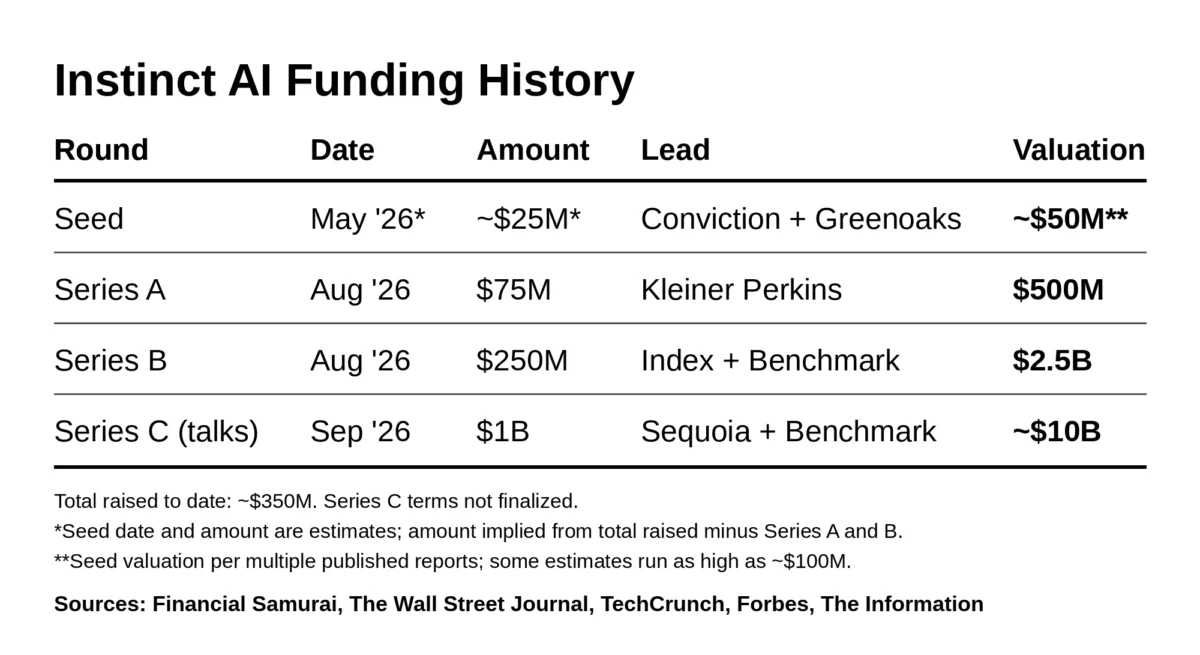
The speed at which Instinct secured successive funding rounds is historically unprecedented. In April 2026, the company successfully closed its seed round, backed by Conviction and Greenoaks, at a reported valuation of $50 million. The momentum accelerated dramatically by early August 2026, when Kleiner Perkins spearheaded a $75 million Series A financing, which elevated the firm’s valuation to $500 million.
The growth trajectory reached a new inflection point just three weeks later, in late August 2026, when Index Ventures and Benchmark co-led a $250 million Series B round. This round commanded a valuation of $2.5 billion, representing a 50-fold increase from the seed stage in a matter of months. As of September 2026, reports indicate that Instinct is in advanced negotiations to secure a $1 billion investment at a $10 billion valuation, with venture capital heavyweights Sequoia and Benchmark purportedly positioned to lead the financing.
Venture Capital Metrics and the Reality of Paper Gains
The discrepancy between the company’s valuation and its realized liquidity highlights the complex nature of private equity metrics. For Limited Partners (LPs) involved in these funding rounds, the valuation shifts are tracked through specific performance indicators, primarily Multiple on Invested Capital (MOIC) and Total Value to Paid-In Capital (TVPI).
MOIC serves as a measurement of the potential gross value of an investment compared to the initial capital deployed. In the case of Instinct, the rapid dilution inherent in successive high-value funding rounds requires a nuanced calculation. While a $10 billion valuation provides a significant theoretical markup, the dilution from successive $250 million and $1 billion rounds recalibrates the net return for early-stage investors. After accounting for the standard 20% to 35% carry—the performance fee collected by General Partners (GPs)—the net MOIC remains a speculative figure until a liquidity event, such as an Initial Public Offering (IPO) or an acquisition, occurs.
The distinction between TVPI and Distributions to Paid-In Capital (DPI) remains the most critical metric for investors. While TVPI reflects the mark-to-market value of holdings, DPI represents actual cash returned to investors. In the venture capital ecosystem, DPI is the only metric that facilitates tangible capital reallocation. For the majority of LPs involved in the Instinct trajectory, the current gains remain "paper gains," meaning the wealth exists as a valuation mark on a quarterly statement rather than as accessible liquidity.
Market Context and The Role of San Francisco
The success of Instinct is intrinsically tied to the resurgence of the San Francisco technology corridor. Following a period of market contraction between 2023 and 2025, the local economy has experienced a notable shift, characterized by a concentration of AI-focused talent and capital. This environment has fostered a "boom-loop" dynamic, where the influx of venture capital wealth is significantly outpacing regional inflation and housing cost increases.

The demand for AI infrastructure has also created a symbiotic relationship between software startups and physical asset providers. As AI models require increasing amounts of computational power, the physical limitations—specifically data center availability, electrical grid capacity, and municipal permitting—have become the new "binding constraints" for the industry. This has shifted investor interest toward physical real estate assets, such as data centers and energy infrastructure, as a hedge against the volatility of software-based paper valuations.
Implications for the Broader AI Sector
The valuation of Instinct at $10 billion underscores the market’s high confidence in the utility of text-based AI assistants. By removing the barrier of entry associated with downloading and managing multiple applications, Instinct aims to capture a significant share of the daily digital interaction market. If the company successfully secures its next round, it will be positioned to compete directly with legacy tech giants that are simultaneously deploying their own native AI assistants.
However, the rapid escalation of valuations carries inherent risks. The sustainability of such growth depends on the company’s ability to convert its high user engagement into meaningful revenue, while managing the substantial compute costs associated with large-scale AI operations. For institutional investors, the primary risk remains the "winner-take-most" nature of the AI industry. If an alternative platform, such as Meta’s "Muse" or other integrated competitors, achieves wider adoption, the valuation of independent players like Instinct could face significant downward pressure.
The Institutional Perspective
Industry analysts note that the involvement of firms like Sequoia and Benchmark in later-stage rounds acts as a validation signal for the entire ecosystem. For many LPs, the ability to gain exposure to these high-growth startups is limited by the "hyper-competitive" nature of top-tier venture funds. Consequently, many investors participate through diversified funds to mitigate the risk of individual company failure.
The psychological impact of these "paper gains" on the investment community cannot be overlooked. Even in the absence of immediate liquidity, significant markups in portfolio valuations provide institutional and private investors with increased confidence, which often influences broader capital allocation strategies. This phenomenon, often referred to as the "wealth effect," can influence behavior across other asset classes, including luxury goods and real estate.
Strategic Outlook
As the venture capital landscape continues to favor longer private tenures for successful companies, the divide between private and public market valuations will likely persist. For the individual investor, the Instinct case serves as a reminder of the distinction between speculative valuation growth and fundamental financial liquidity.
While the rapid funding rounds of 2026 have set a new benchmark for speed in the AI sector, the long-term viability of these companies will ultimately be measured by their ability to generate sustained, profitable revenue rather than the pace at which they can solicit capital. As the market enters the final quarter of 2026, all eyes remain on the pending $1 billion financing round, which will serve as a bellwether for the remaining interest in high-valuation AI software investments.
The integration of AI into daily workflows—reminding users of appointments, managing capital calls, and optimizing calendar efficiency—has moved beyond a niche use case and into a core utility. Whether these services can maintain their current market cap in the face of rising operational costs and intensifying competition remains the central question for the venture capital community moving into 2027. Investors are increasingly cautioned that until capital is distributed, the figures reported in valuation rounds remain a reflection of future potential rather than current, spendable wealth.
