

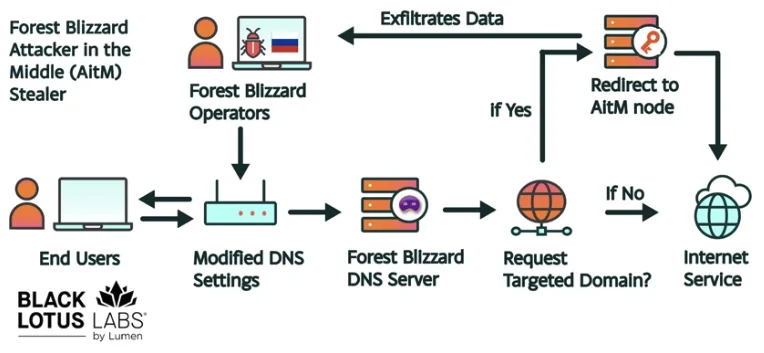
Cybersecurity researchers have uncovered a massive, stealthy espionage operation orchestrated by Russian military intelligence that leverages unpatched, consumer-grade internet routers to gain unauthorized access to Microsoft Office user accounts. The campaign, attributed to the threat actor known as Forest Blizzard, marks a significant shift in state-sponsored tactics, moving away from sophisticated malware toward the mass-scale manipulation of core internet infrastructure. By exploiting known vulnerabilities in older Small Office/Home Office (SOHO) devices, the hackers have successfully siphoned authentication tokens from more than 18,000 networks worldwide, bypassing traditional security measures like multi-factor authentication (MFA).
The Mechanics of the Forest Blizzard Campaign
According to a joint disclosure from Microsoft and Black Lotus Labs, the security arm of internet backbone provider Lumen, Forest Blizzard utilized a technique known as Domain Name System (DNS) hijacking. The operation did not require the installation of malicious software on the targeted computers or servers. Instead, the attackers identified and exploited vulnerabilities in the firmware of older routers, specifically those manufactured by Mikrotik and TP-Link. These devices, often reaching their end-of-life (EoL) status or lacking recent security updates, served as the primary entry point for the campaign.
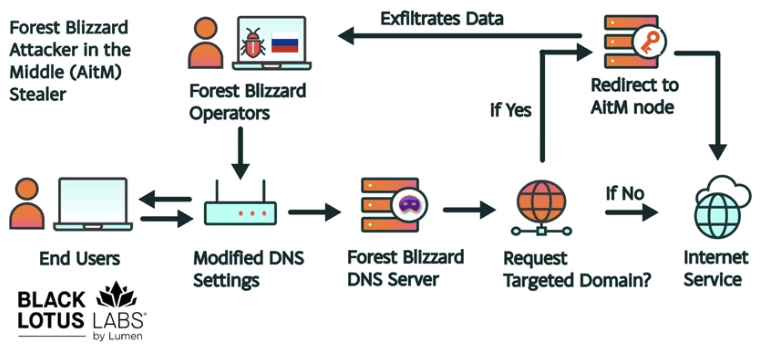
Once a router was compromised, the attackers reconfigured its DNS settings. DNS acts as the "phonebook" of the internet, translating human-readable web addresses into the IP addresses used by computers to locate servers. By pointing the routers toward attacker-controlled DNS servers, Forest Blizzard could intercept and redirect traffic at the network level. This allowed the group to execute "Adversary-in-the-Middle" (AiTM) attacks against users attempting to access Microsoft Outlook on the web.
The primary objective of this redirection was the harvesting of OAuth authentication tokens. Unlike passwords, which are used to initiate a session, OAuth tokens are generated after a user has already successfully authenticated, often including the completion of MFA. By capturing these tokens as they were transmitted over the compromised network, the Russian operatives could gain direct access to the victim’s email and cloud resources without ever needing to prompt the user for credentials or bypass a secondary security code. This method is particularly effective because it remains invisible to the end-user, who experiences no disruption in service or suspicious login prompts.
Profiling the Threat Actor: Forest Blizzard (APT28)
Forest Blizzard, more commonly known in the cybersecurity community as APT28 or Fancy Bear, is a highly sophisticated threat group directly linked to the General Staff Main Intelligence Directorate (GRU) of the Russian Armed Forces. The group has a long history of high-profile cyber-espionage operations aimed at advancing the geopolitical interests of the Russian Federation.
Historically, APT28 has been associated with some of the most impactful cyberattacks of the last decade. In 2016, the group was identified as the primary entity responsible for the breach of the Democratic National Committee (DNC) and the Democratic Congressional Campaign Committee (DCCC), as well as the compromise of the Hillary Clinton presidential campaign. Their activities have traditionally focused on government agencies, military organizations, and political entities.
The current campaign reveals an evolution in the group’s methodology. While they have previously used custom-built malware to maintain persistence on target networks, the shift to infrastructure-based DNS hijacking suggests a desire for greater scalability and stealth. By using "graybeard" methods—older, well-understood networking exploits—they can operate within the "noise" of legitimate internet traffic, making detection significantly more difficult for standard antivirus and endpoint detection systems.
Chronology of the Espionage Operation
The surveillance dragnet did not appear overnight but was the result of a calculated shift in tactics following public exposure.
- Early 2025: Targeted Malware Phase. In the early months of 2025, Forest Blizzard was observed using specialized malware to compromise a limited number of high-value routers. This phase was characterized by precision targeting of specific diplomatic and law enforcement entities.
- August 2025: Tactical Pivot. Following a detailed report by the United Kingdom’s National Cyber Security Centre (NCSC) regarding the group’s use of router-based malware, Forest Blizzard immediately altered its approach. Rather than abandoning the operation, the group abandoned the malware, switching to a more systemic, automated exploitation of DNS settings across thousands of vulnerable devices.
- December 2025: Peak Activity. By the end of the year, the operation had reached its zenith. Researchers at Black Lotus Labs identified over 18,000 compromised routers during this period. The scope had expanded from specific high-value targets to a broad surveillance dragnet encompassing thousands of consumer and small-business devices.
- March 2026: Regulatory Fallout. The scale of the threat contributed to a major policy shift in the United States, leading to new restrictions on the certification of foreign-made networking hardware.
- April 2026: Public Disclosure. Microsoft and Lumen released their findings, detailing the "Forest Blizzard" activity and warning organizations about the persistent risk posed by unpatched edge devices.
Statistical Impact and Target Demographics
The data provided by Microsoft and Lumen paints a picture of a global operation with a heavy focus on institutional intelligence. Microsoft identified more than 200 distinct organizations that were successfully targeted, along with 5,000 individual consumer devices. However, the total reach is estimated to be much larger, with the 18,000 compromised networks serving as conduits for data theft across various sectors.
The primary targets of this campaign included:
- Ministries of Foreign Affairs: Spying on diplomatic communications and international relations.
- Law Enforcement Agencies: Gaining insight into domestic and international investigations.
- Third-Party Email Providers: Using smaller providers as a stepping stone to reach larger, more protected targets.
- Critical Infrastructure Partners: Monitoring the communications of entities involved in national security and logistics.
The geographical distribution of the attacks was global, though there was a noticeable concentration in regions of strategic interest to the Russian GRU, including Europe, North America, and parts of the Middle East.
Regulatory Response and National Security Implications
The discovery of the Forest Blizzard campaign has catalyzed a significant response from the U.S. federal government. On March 23, 2026, the Federal Communications Commission (FCC) announced a drastic update to its "Covered List" of equipment deemed a threat to national security. In a landmark decision, the FCC stated it would no longer certify any consumer-grade internet routers produced outside of the United States.
The FCC’s rationale was rooted in the "untenable national security threat" posed by poorly secured foreign hardware. The commission warned that these devices present a severe cybersecurity risk that could be leveraged to disrupt critical infrastructure or harm U.S. citizens. While the policy allows for "conditional approval" from the Department of War or the Department of Homeland Security for certain manufacturers, it signals a fundamental shift toward a closed-loop supply chain for essential networking equipment.
Critics of the policy have noted that the availability of consumer routers will likely plummet in the short term, as very few manufacturers currently produce consumer-grade hardware within U.S. borders. However, proponents argue that the Forest Blizzard campaign proves that the "SOHO" market is currently the weakest link in the global security chain, acting as a massive, unmonitored staging ground for state-sponsored adversaries.
Analysis: The Enduring Risk of "Shadow Infrastructure"
The Forest Blizzard operation highlights a growing trend in cyber-espionage: the weaponization of the "Internet of Things" (IoT) and legacy hardware. As corporate networks become more hardened with advanced security stacks, attackers are moving "downstream" to the home and small office environments of employees.
The success of this campaign relies on three primary factors:
- Device Longevity: Routers are often "set and forget" devices. Many remain in service for a decade or more, long after the manufacturer has stopped providing security patches.
- Protocol Trust: The DNS protocol was designed for efficiency, not security. While DNSSEC (DNS Security Extensions) exists, it is not universally implemented, allowing hijacking to remain a viable threat.
- Token-Based Authentication Weaknesses: While OAuth tokens improve user experience by reducing login prompts, they create a single point of failure if intercepted. Because they represent a "pre-authenticated" state, they are the "crown jewels" for modern hackers.
The fact that Forest Blizzard was able to pivot so quickly from malware to DNS hijacking after being exposed in August 2025 demonstrates the agility of the GRU’s cyber units. It also underscores the futility of relying solely on malware signatures for defense.
Future Outlook and Recommendations
The exposure of this operation serves as a critical warning for both organizations and individual consumers. Cybersecurity experts recommend that users of Mikrotik, TP-Link, and other SOHO routers immediately check for firmware updates or replace devices that have reached their end-of-life status. Furthermore, organizations are encouraged to implement "Zero Trust" architectures that do not rely solely on session tokens but instead continuously verify the identity and health of the connecting device.
As the geopolitical landscape remains volatile, the use of infrastructure-level attacks is expected to increase. The Forest Blizzard campaign has demonstrated that by controlling the very "pipes" of the internet, state-backed actors can achieve a level of persistent, quiet access that traditional hacking methods can no longer guarantee. The battle for cybersecurity has moved beyond the desktop and the server, firmly embedding itself in the hardware that connects the world.
