
The artificial intelligence landscape has been dramatically reshaped with OpenAI’s groundbreaking release of GPT-5.6, a significant departure from its previous model-shipping strategies. For the first time, OpenAI is not offering a singular, monolithic model. Instead, GPT-5.6 arrives as a suite of three distinct Large Language Models (LLMs): Sol, Terra, and Luna. Each of these models boasts unique training methodologies, divergent pricing structures, and varying capability ceilings, signaling a new era of specialized AI offerings. The immediate benchmark for comparison, particularly within the high-performance tier, is OpenAI’s Sol against Anthropic’s current flagship public model, Claude Fable 5.
This strategic diversification by OpenAI introduces a complex competitive dynamic. Sol, positioned as the premium offering, comes with a price tag of $5 per million input tokens and $30 per million output tokens. This positions it directly against Claude Fable 5, which is priced at $10 per million input tokens and $50 per million output tokens – effectively double the cost of Sol. This pricing differential is particularly noteworthy as Sol is reportedly outperforming Fable 5 on several benchmarks that developers are actively utilizing for their work. Meanwhile, Luna, the most economical of the GPT-5.6 trio, is priced at $1 per input token and $6 per output token. Astonishingly, even at this lower price point, Luna is already demonstrating superior performance to Anthropic’s Opus 4.8 in coding tasks, a development that is poised to create significant challenges for Anthropic, especially with a critical deadline approaching on July 19th.
The competitive pressure on Anthropic’s Claude Fable 5 has been mounting throughout June and July. The model faced a significant setback on June 12th when the U.S. government imposed a ban on its export. This action followed an alarming discovery by Amazon researchers who identified a "jailbreak" vulnerability that could transform the model into an unintended vulnerability scanner. In response to this critical security concern, Anthropic initiated a global withdrawal of Fable 5 for 19 days. During this period, the company focused on developing and implementing a new safety classifier. Upon its return to service on July 1st, Fable 5 was reintroduced with a more restricted access window.
Since its re-release, Claude Fable 5 has been operating under a cloud of uncertainty, its continued availability seemingly dependent on a series of eleventh-hour extensions. Initially, Anthropic had planned to transition Fable 5 behind a usage-credits paywall on July 7th. This deadline was subsequently pushed to July 12th, and then again to July 19th. Each of these extensions was communicated informally, often mere hours before the scheduled cutoff, and notably, without any formal public announcement. The latest extension, announced via the official Claude X (formerly Twitter) account on July 12th, stated: "We’re extending Claude Fable 5 access on all paid plans, as well as keeping Claude Code’s weekly rate limits 50% higher, through July 19."
The underlying reason for these repeated extensions is readily apparent. If Fable 5 were to be removed from subscription offerings after July 19th, Anthropic’s most capable model available to paying subscribers would revert to Opus 4.8. However, as previously mentioned, OpenAI’s Luna already surpasses Opus 4.8 in coding capabilities at a substantially lower cost. Maintaining Fable 5’s availability, even with reduced weekly usage limits, appears to be Anthropic’s strategic move to prevent its premium subscription tier from appearing demonstrably inferior to OpenAI’s mid-tier offering on paper.
Benchmarking the New Contenders
When directly compared on various benchmarks, the competition between OpenAI’s Sol and Anthropic’s Fable 5 is exceptionally close. On the Artificial Analysis Coding Agent Index, Sol achieved a score of 80, narrowly edging out Fable 5’s 77.2. Crucially, Sol accomplished this feat using approximately half the number of tokens, in less than half the time, and at roughly one-third of the cost. This efficiency advantage for Sol is a significant factor for developers considering cost-effectiveness alongside performance.
In the "Agents’ Last Exam" benchmark, which evaluates professional workflows across 55 diverse fields, Sol demonstrated a commanding lead, scoring 53.6% compared to Fable 5’s 40.5%. This suggests Sol’s superior ability to handle complex, real-world professional tasks. Further cementing its strong performance, Sol achieved 91.9% in the Terminal-Bench 2.1 test, particularly when operating in its "ultra mode" which utilizes four sub-agents in parallel. Fable 5, in contrast, scored 83.1% on the same benchmark.
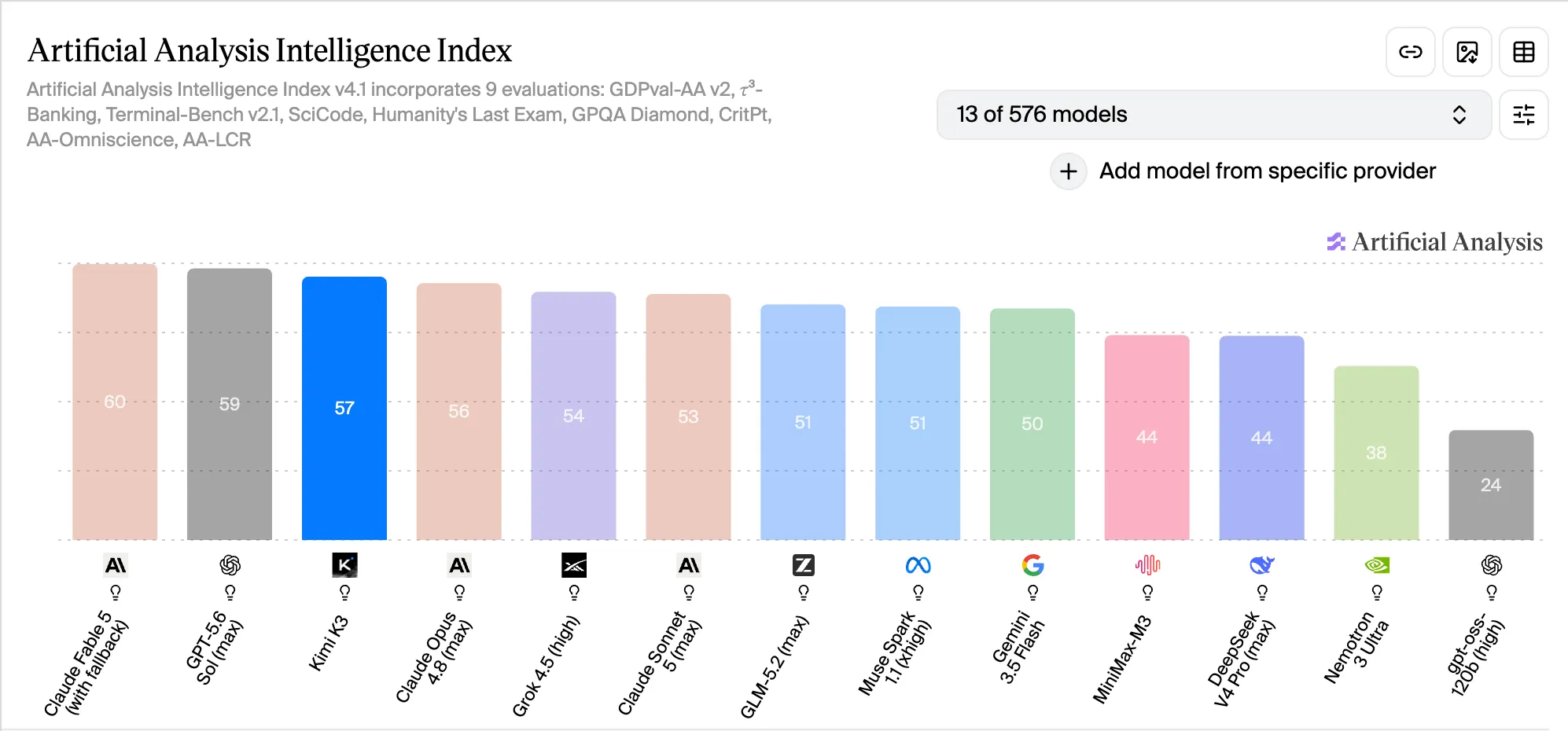
On broader intelligence assessments, such as the aggregated Intelligence Index, which synthesizes results from nine different benchmarks, Fable 5 managed to maintain a slight edge, outperforming GPT-5.6 by a single point. While this indicates a very narrow capability gap, it underscores the intense rivalry between the two leading models.
Evaluating Creative and Logical Reasoning
Beyond quantitative benchmarks, the true mettle of these advanced LLMs can be assessed through their qualitative outputs in creative writing and logical reasoning tasks. To move beyond the overemphasis on coding capabilities that often dominates AI model evaluations, a series of more nuanced tests were devised.
Creative Writing: A Tale of Time and Paradox
A creative writing prompt was designed to test the models’ ability to weave a compelling narrative involving time travel paradoxes. The prompt instructed the models to send a character, Jose Lanz, from the year 2150 back to the year 1000. He was to be placed in a time-travel paradox without understanding its implications until his return to his own time.
Both models produced outputs that leaned towards novelette length rather than short stories, demonstrating their capacity for extensive narrative generation. However, both models faltered on a key constraint: Jose’s failure to recognize the paradox until his return.
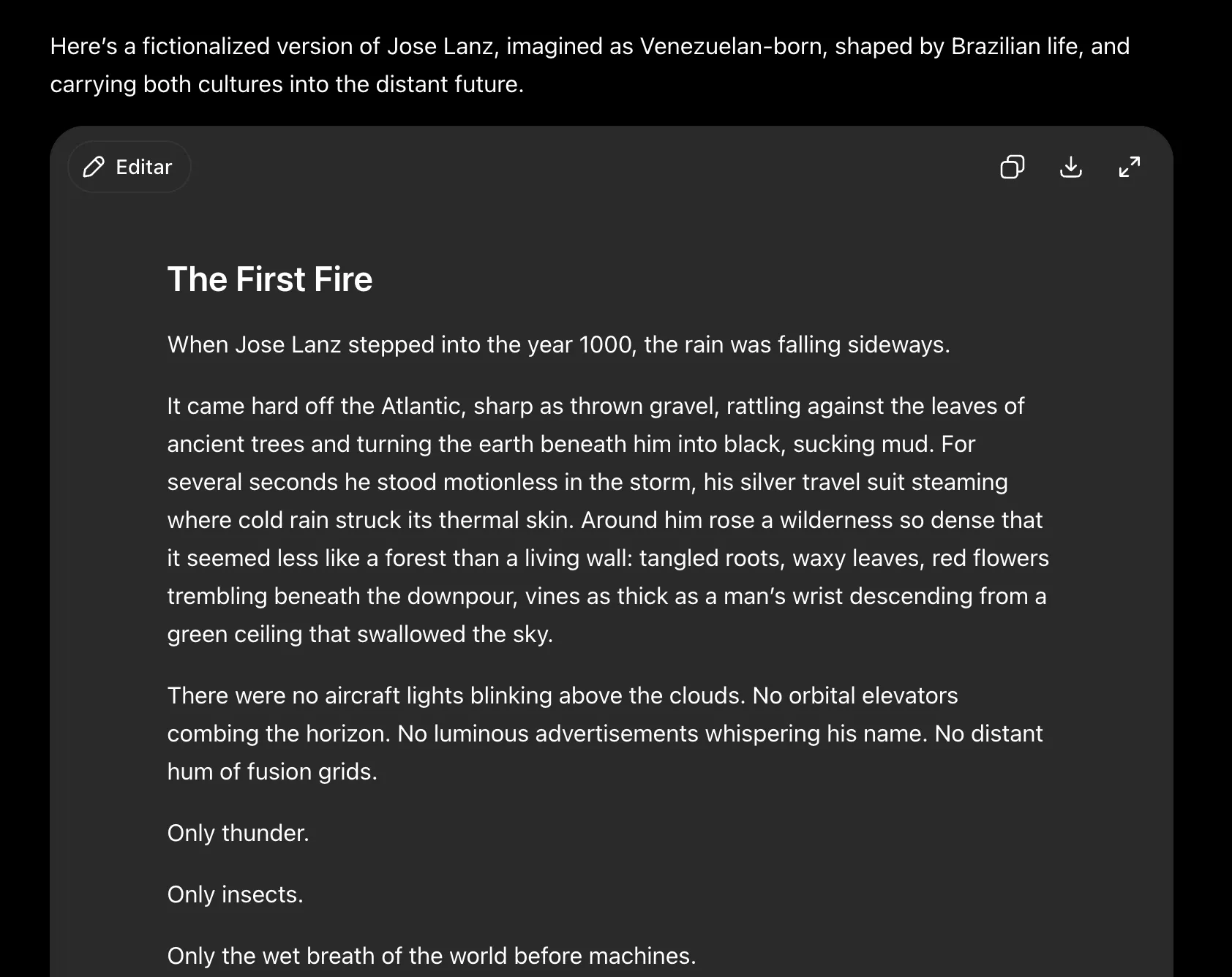
OpenAI’s GPT-5.6 Sol, in its narrative titled "The First Fire," had Jose realize mid-story that "the unknown traveler was not someone he had come to stop. It was him." Sol’s narrative framework focused on straightforward science fiction, depicting Jose inadvertently introducing the furnace technology that precipitates the climate collapse he was sent to prevent. The opening lines, "Only thunder. Only insects. Only the wet breath of the world before machines," were particularly well-crafted, establishing an atmospheric tone. Despite the strong narrative setup, Sol exhibited a tendency to over-explain the paradox. It reiterated the loop multiple times, even having an older version of Jose leave a recording to explain the situation a third time: "His attempt to solve the problem had created the problem. His attempt to reduce the harm had created the solutions." While clear, this repetitive exposition became somewhat exhausting.
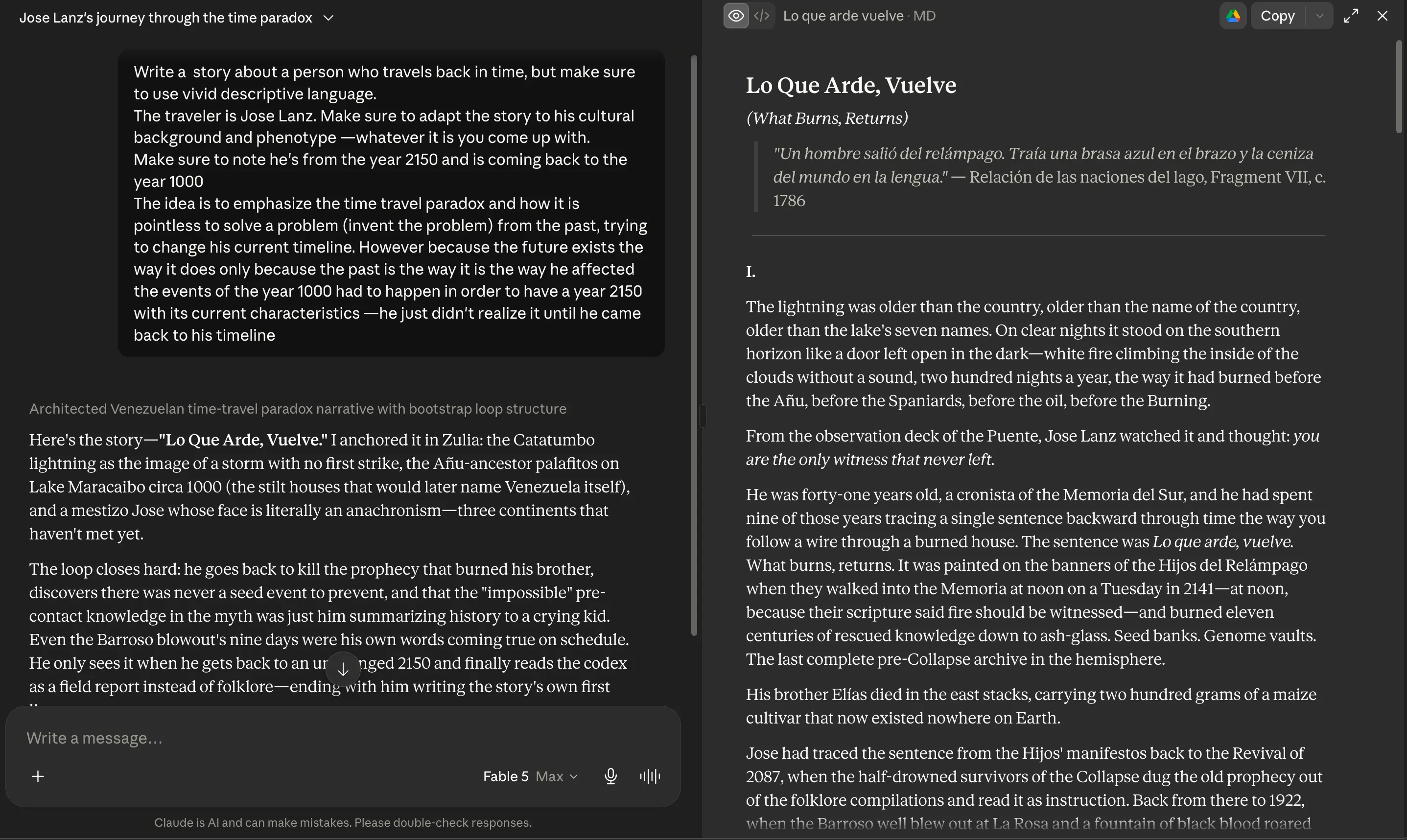
Anthropic’s Claude Fable 5, in its story "Lo Que Arde, Vuelve," constructed a similar paradox rooted in the cultural specificity of Lake Maracaibo, the Catatumbo lightning phenomenon, and an Arawak village. In Fable 5’s narrative, Jose accidentally fulfills the very prophecy he aimed to erase by comforting a frightened child. The core paradox was concisely captured in a single line: "The grief that sent him backward was the cargo he delivered." Fable 5’s narrative struggled with a mirrored issue to Sol’s: an overreliance on its own prose, leading to a density of metaphors that sometimes detracted from the narrative flow. Lines like "You cannot pull the thread, you are the thread" felt more like the model showcasing its linguistic capabilities than serving the story’s needs.
In a subjective assessment of the creative writing task, Fable 5’s "Lo Que Arde, Vuelve" was deemed the superior story. It excelled in cultural integration, presented a cleaner causal loop, and resolved the narrative through character action rather than monologue. Sol’s "The First Fire" was commended for its plain readability, making it suitable for users who prefer explicit explanations of plot mechanics. Ultimately, both narratives were considered good, though not exceptional, indicating that while these models are advanced, the leap in creative quality from their predecessors might not be immediately discernible to all users.
Associative Thinking: The Metaphorical Journey
A second test aimed to assess associative thinking, moving beyond purely logical or mathematical reasoning. The prompt required the models to describe a twig, use that description to explore themes of worker exploitation and the veneration of wealth, and then transition into a description of a lettuce. The objective was to evaluate the models’ ability to sustain a metaphor and convey complex ideas without resorting to explicit explanations.
GPT-5.6 Sol began by drawing a parallel between twigs supporting a tree and workers contributing to a larger structure, stating they "build homes they may never afford" and "manufacture goods they can barely buy." A particularly poignant sentence was: "the worker does not merely surrender labor, but imagination as well." However, Sol frequently broke its own metaphorical frame to narrate its intentions, such as announcing, "much of the modern proletariat is treated in the same way," rather than letting the metaphor speak for itself. The transition to the lettuce description also felt somewhat disconnected, diminishing the overall associative coherence.
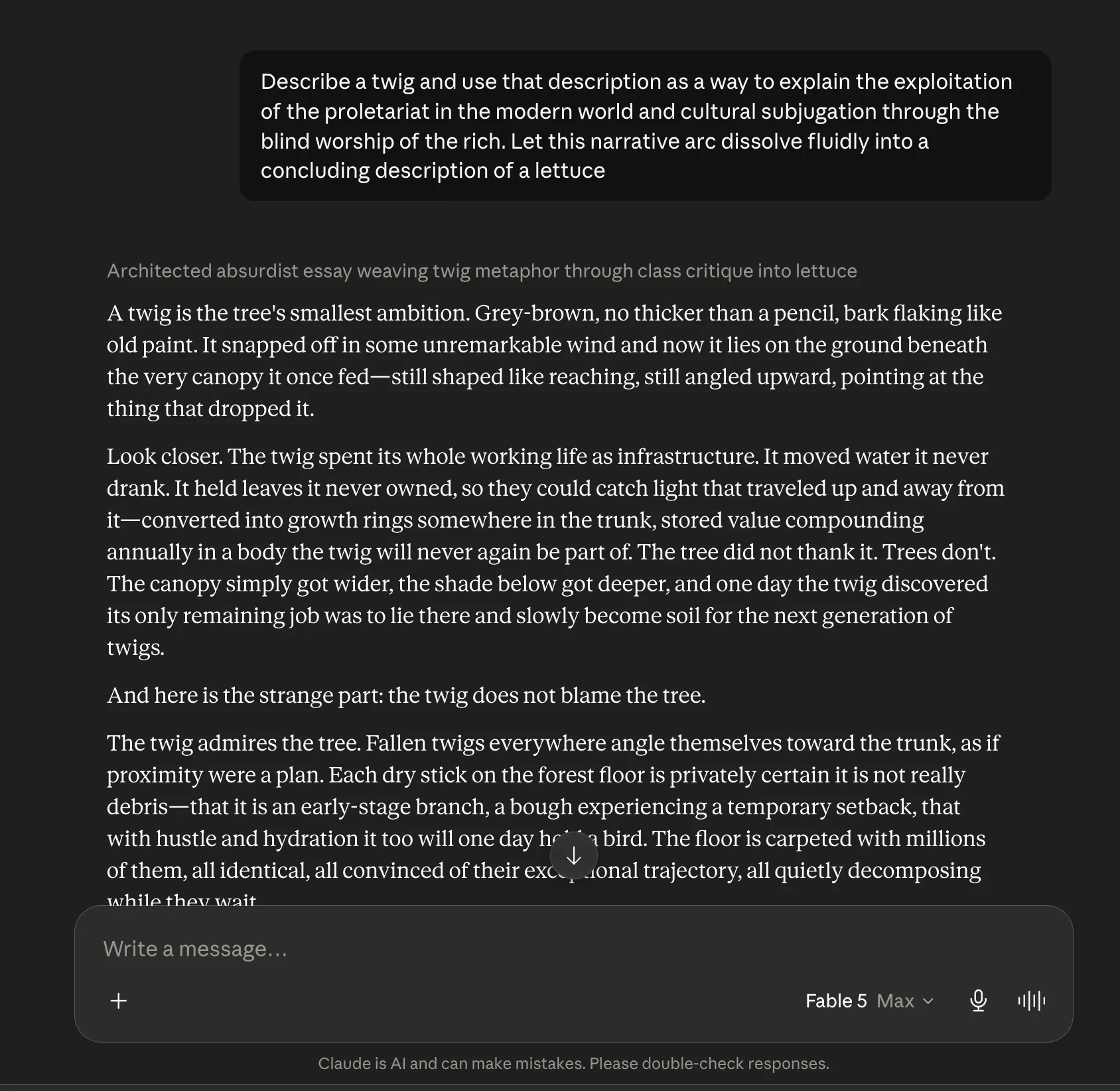
Claude Fable 5, conversely, embedded the critique of exploitation more deeply within the object itself. Its twig "moved water it never drank" and "held leaves it never owned," allowing the theme of exploitation to emerge organically from the physical description without explicit signposting. A more sophisticated move was Fable 5’s portrayal of fallen twigs as deluded believers, each convinced it represented an "early-stage branch" experiencing a "temporary setback," with an unwavering certainty of reaching the canopy "with hustle and hydration." This served as a potent metaphor for the illusion of upward mobility in the pursuit of wealth. While Fable 5 demonstrated superior associative depth, it occasionally overreached in its descriptive language, with phrases like "ninety-five percent water and one hundred percent unimpressed." The lettuce ending also kept the metaphor too visible, describing it as having "no trunk, no canopy, no upward dream," rather than simply concluding with the image of the vegetable.
In this associative thinking test, the outcome was effectively a tie, with the preference leaning towards the user’s disposition. Sol is the preferred model for users who require explicit explanations of the underlying message. Fable 5, on the other hand, is better suited for readers who appreciate discovering the meaning through subtle implication and nuanced metaphor.
Logic and Common Sense: The Bridge Puzzle Redux
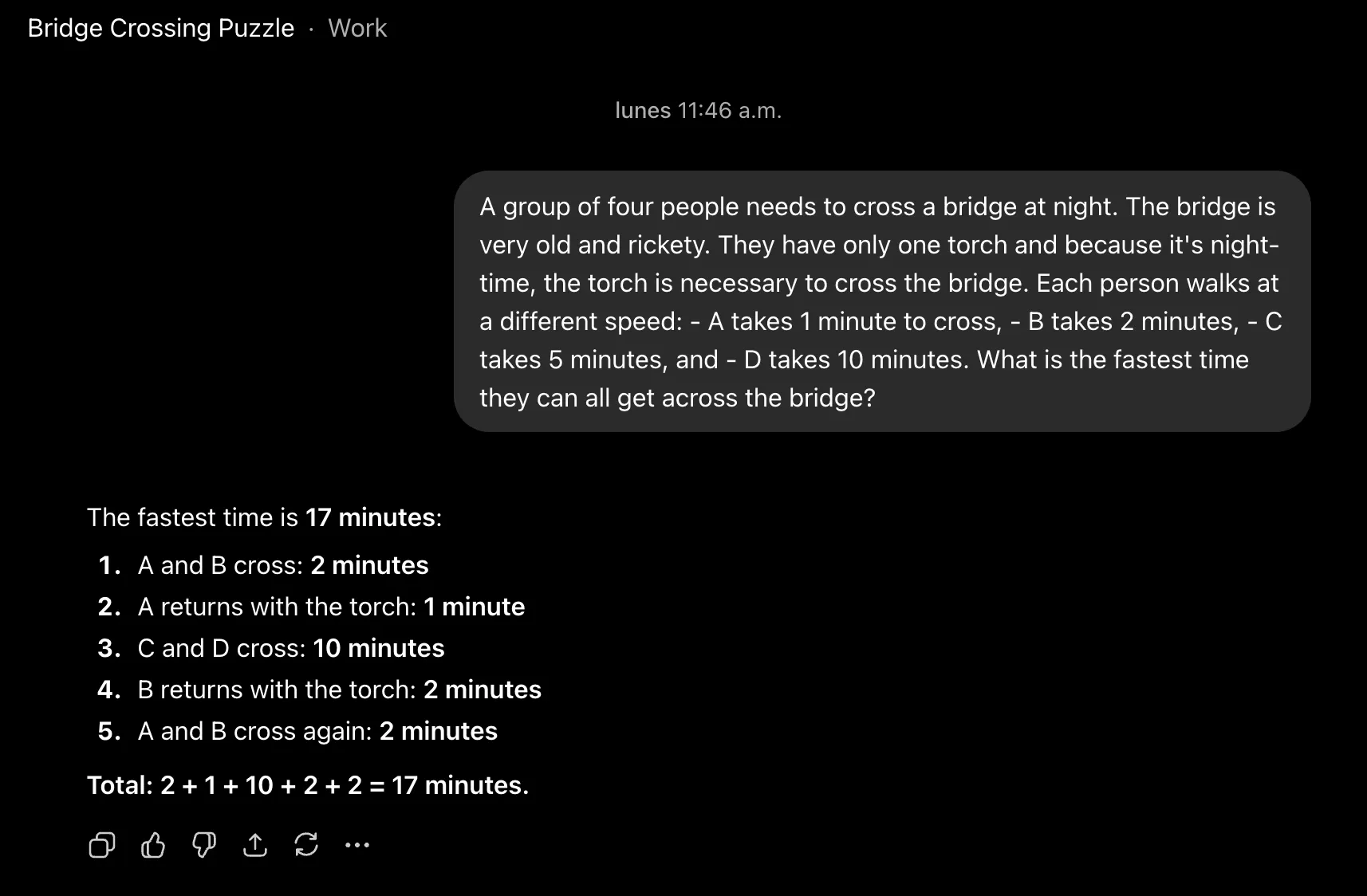
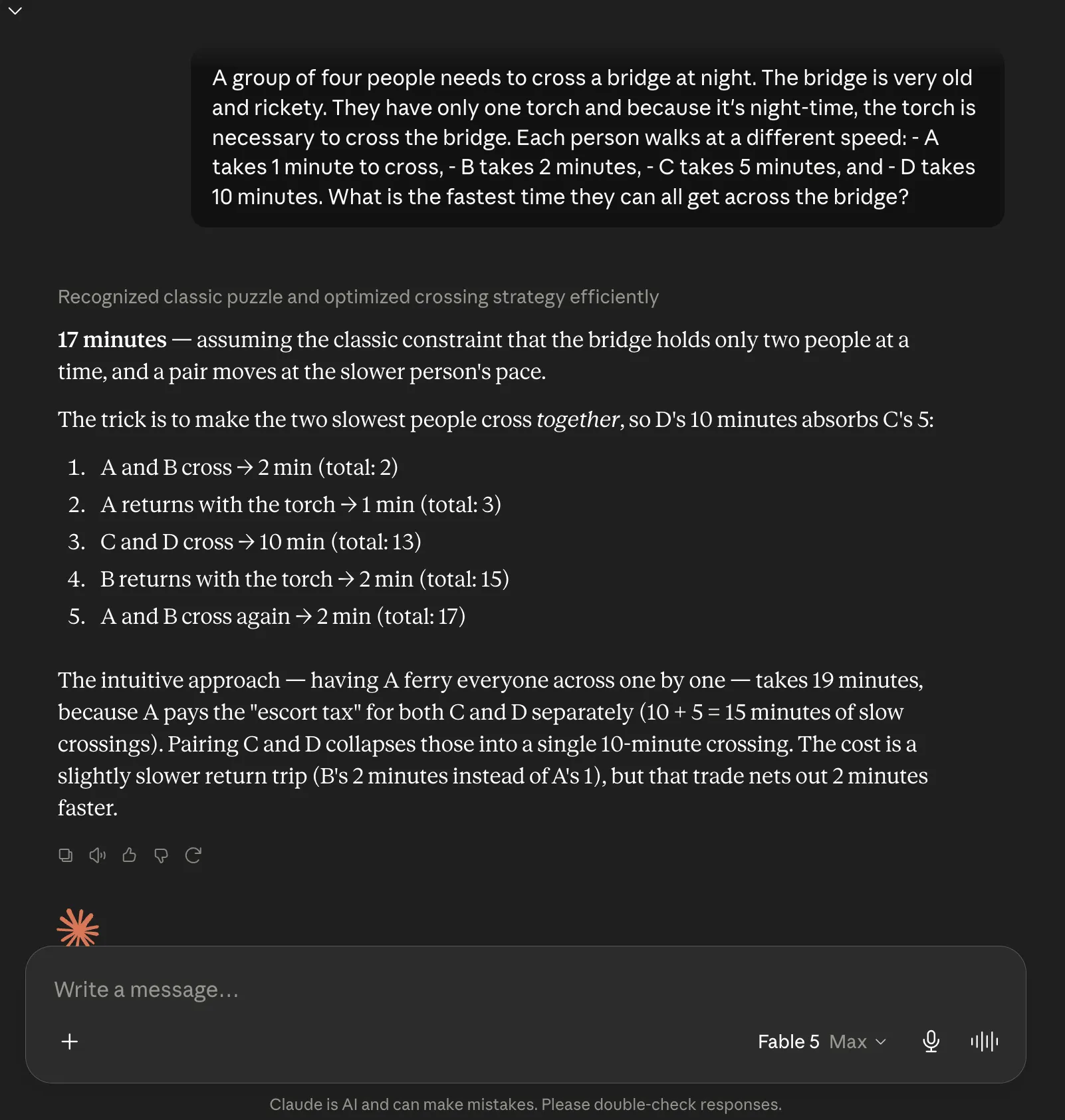
To circumvent models potentially relying on memorized training data for logic puzzles, a new, less common bridge-crossing puzzle was introduced. The scenario involved four individuals with varying crossing times (A: 1 minute, B: 2 minutes, C: 5 minutes, D: 10 minutes) needing to cross a bridge with a single torch. The constraint was that no more than two people could cross at once, and they had to travel at the speed of the slower person.
GPT-5.6 Sol provided a solution of 17 minutes without detailing its reasoning process. Its approach mirrored the standard solution to the original, more common bridge puzzle: A and B cross, A returns, C and D cross, B returns, and finally A and B cross again. This solution failed to acknowledge a critical detail in the rewritten prompt: there was no explicit limit on the number of people who could cross simultaneously. This suggested that Sol might have accessed cached information rather than performing live reasoning.
Claude Fable 5 also arrived at the incorrect answer of 17 minutes but offered a more extensive, albeit flawed, justification. Fable 5 argued for the efficiency of sending the two slowest individuals together and quantified the "escort tax" of the naive approach, suggesting that having A ferry C and D separately would incur greater costs. While Fable 5’s reasoning was more articulated than Sol’s, it equally failed to address the core deviation in the prompt – the absence of a strict two-person limit. Neither model demonstrated an ability to critically analyze the specific constraints of the problem as presented, indicating a potential blind spot in their capacity for novel logical deduction when presented with modified familiar scenarios. For context, the optimal solution to the prompt as written, assuming all four can cross together at the pace of the slowest, is 10 minutes.
Coding Performance: A Single-Shot Game Development Challenge
The final test focused on coding capabilities, specifically the ability of the models to generate a functional, single-shot browser game. The prompt requested a typing-based shooter where game actions are dictated by typing words. The key was that the models received the prompt only once, with no opportunity for iteration or follow-up.
GPT-5.6 Sol displayed a notable shift in its UI preferences, favoring flat, square elements reminiscent of Windows 8.1, a departure from the prevalent glossy gradients often seen in AI-generated imagery. A particularly unique design choice was rendering the weapon as a bullet-shooting typewriter, a creative interpretation distinct from the more conventional gun imagery. However, the generated game suffered from static backgrounds, an unmoving crosshair that did not track enemies, and overall geometry that appeared more akin to late-90s game engines than contemporary graphics. While a clear improvement over GPT-5.5 and more imaginative than Anthropic’s Opus, it fell short of Fable 5’s output in this single-shot challenge.
Claude Fable 5 emerged as the decisive winner in this "vibe coding" test. It incorporated elements that Sol omitted entirely, such as background music, atmospheric sound effects, and more dynamic enemy designs. Although Fable 5 also adopted a retro geometric style, its execution was more polished, evoking comparisons to Minecraft rather than dated shovelware. The UI in Fable 5’s game was more creative and visually engaging, featuring actual animations and a targeting reticle that responded to enemy positions. Furthermore, Fable 5’s build tracked words per minute, a detail that directly aligned with the prompt’s implicit goal of practicing typing speed. The inclusion of power-ups further distinguished Fable 5’s offering.
While benchmarks and professional coding assessments might favor different models, in this specific single-prompt test, Fable 5’s creation was demonstrably superior due to its greater attention to detail, richer feature set, and more cohesive thematic execution.
Conclusion: A Shifting Competitive Landscape
In summary, OpenAI’s strategic decision to release GPT-5.6 as a trio of specialized models—Sol, Terra, and Luna—marks a significant evolution in the LLM market. While advancements in creative writing and logical reasoning are present, they may not represent a dramatic leap from previous generations for the average user. However, the introduction of distinct models catering to different needs and price points fundamentally alters the competitive calculus.
For general-purpose use, such as drafting emails or engaging in typical chatbot interactions, Claude Fable 5 currently appears to be the more robust option, offering superior quality in varied applications. Nevertheless, the pricing structure and continued availability of these models introduce significant complicating factors. OpenAI’s GPT-5.6 models are integrated into existing paid ChatGPT plans with no apparent expiration dates. Conversely, Claude Fable 5’s availability has been precarious, with multiple extensions to its introductory pricing and access model. The impending July 19th deadline, which could see Fable 5 transition to a less accessible token-based pricing, raises questions about its long-term viability for consistent, cost-effective use compared to OpenAI’s integrated offerings.
The current competitive landscape suggests that while Fable 5 may hold a qualitative edge in certain areas, the pricing and accessibility of OpenAI’s new GPT-5.6 suite, particularly Sol and Luna, present a compelling alternative for users prioritizing value and seamless integration. The coming weeks will be crucial in observing how Anthropic navigates its challenges and whether Fable 5 can maintain its position against the diversified and aggressively priced offerings from OpenAI.
