

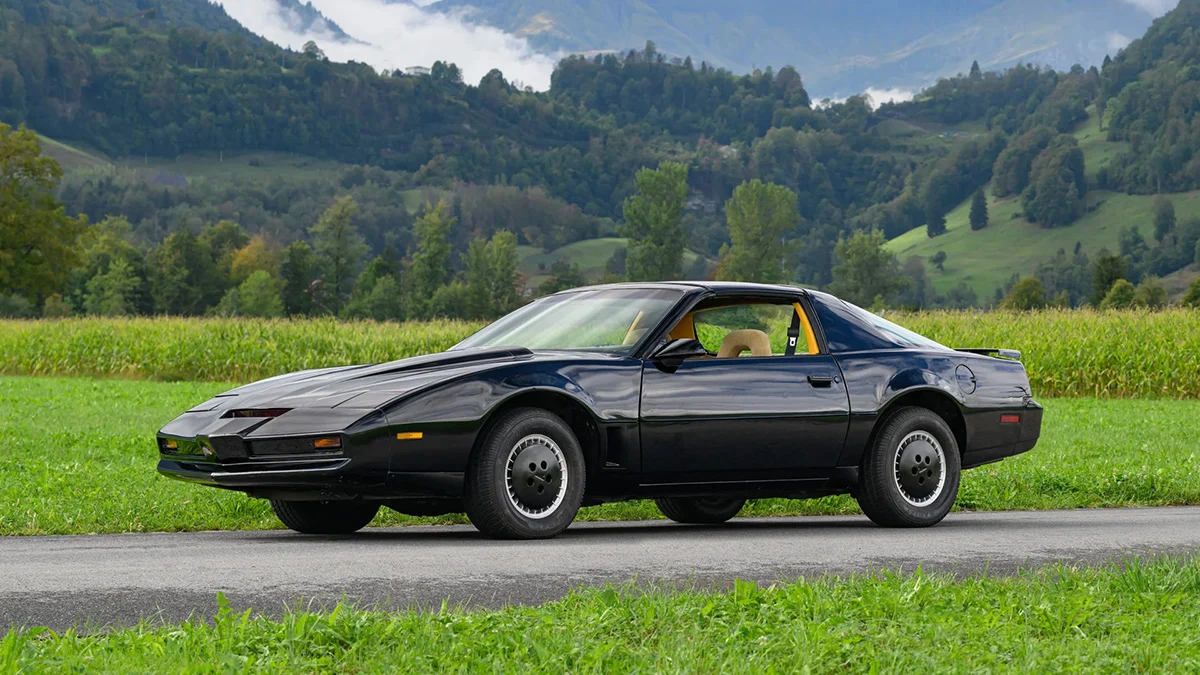
One of the most recognizable and culturally enduring automobiles in television history is preparing to cross the auction block, offering enthusiasts and pop-culture collectors a rare chance to own a piece of 1980s television nostalgia. The vehicle in question is a heavily customized 1982 Pontiac Firebird Trans Am built as an official promotional tour car for the smash-hit NBC series Knight Rider. Headed to the auction catalog of Broad Arrow Auctions for its upcoming Zurich sale, the automobile carries a pre-sale estimated value ranging between $300,000 and $600,000, reflecting both its Hollywood provenance and its extensive history as a promotional ambassador for the show’s star, David Hasselhoff.
While the vehicle never appeared in an actual episode of the sci-fi adventure series, its significance to the global phenomenon of Knight Rider is substantial. During the height of the show’s international popularity in the mid-1980s, this specific replica accompanied Hasselhoff across Europe and North America, appearing at high-profile television broadcasts, promotional tours, concerts, and public exhibitions. As bidding approaches, the vehicle offers a fascinating glimpse into television marketing history, celebrity branding, and the enduring allure of automotive icons from the golden age of network television.

Main Facts and Vehicle Provenance
The car slated for auction is far more than a standard modified Firebird. Originally commissioned by Vienna Profile Promotions, which served as Hasselhoff’s management firm during the peak of Knight Rider’s broadcast run, the vehicle was crafted to mirror the on-screen persona of K.I.T.T. (Knight Industries Two Thousand) down to the smallest detail.
The build quality of the automobile is verified by official documentation. Built by Thomas J. Oberhaus of Hollywood Productions, the car comes with a formal certificate of authenticity. Furthermore, its historical legitimacy has been thoroughly vetted by experts; the vehicle is officially recorded in the Knight Rider Historians registry and underwent a detailed physical inspection by noted K.I.T.T. historian A.J. Palmgren in Switzerland in 2007.
The interior and exterior specifications meticulously recreate the aesthetic of the television car from its first two seasons. Most notably, the cabin features the signature gullwing-style steering wheel and an intricate, fully illuminated electronics suite designed to replicate the futuristic dash of the fictional artificial intelligence. Mechanically, the car is operational—it runs and drives—though potential buyers should note that its specialized modifications and lack of modern safety equipment mean it is not street-legal for public roadways.

It is also important for collectors to distinguish this vehicle from other memorabilia previously associated with the actor. This particular K.I.T.T. tour car has been under the care of its current, unnamed private owner since 1999. Consequently, it is distinct from a separate replica that Hasselhoff personally auctioned off earlier in the decade, adding a distinct layer of exclusivity for serious automotive collectors who track verified screen-culture artifacts.
Background Context: The Cultural Phenomenon of Knight Rider
To understand the value and appeal of the Broad Arrow auction lot, one must examine the profound cultural footprint left by Knight Rider during its original broadcast era. Premiering on NBC in September 1982, the series was created and produced by television mastermind Glen A. Larson. The premise followed Michael Knight, a modern-day knight error portrayed by David Hasselhoff, who fought crime alongside an advanced, self-aware, indestructible super-car powered by an artificial intelligence system.
Though the concept sounds campy by modern standards, the dynamic between Hasselhoff’s character and K.I.T.T.—whose distinctive, dryly humorous voice was provided by veteran actor William Daniels—resonated deeply with audiences worldwide. The show captured the burgeoning public fascination with computing technology, artificial intelligence, and futuristic gadgetry just as the personal computer revolution was beginning to take shape.

Knight Rider ran for four successful seasons, producing 90 episodes before concluding in 1986. Its syndication in the 1990s introduced the series to an entirely new generation of viewers, cementing its status as a pop-culture touchstone. The intellectual property proved so durable that it subsequently spawned multiple television movies, spin-off series, and attempted reboots in later decades. However, the original pairing of Hasselhoff and the sleek, black 1982 Pontiac Firebird remains the definitive version of the franchise in the public consciousness.
Chronology of the Tour Car
The journey of this specific 1982 Pontiac Firebird Trans Am spans more than four decades, transitioning from a marketing tool into a museum-grade collectible:
- 1982–1983: The base Pontiac Firebird Trans Am is acquired and subsequently modified by Thomas J. Oberhaus of Hollywood Productions to replicate the television star car, featuring season-one and season-two interior electronics and exterior styling.
- Mid-1980s: Owned and utilized by Vienna Profile Promotions, David Hasselhoff’s management firm at the time. The car travels extensively across Europe and international markets, serving as a primary promotional vehicle for Hasselhoff’s public appearances, television spots, and concert tours.
- 2007: The vehicle is officially inspected in Switzerland by recognized K.I.T.T. historian A.J. Palmgren, further solidifying its provenance and documentation within the enthusiast community.
- 1999–Present: The car is acquired by its current private consignor, remaining carefully preserved in a private collection for over two decades.
- October 2026: Broad Arrow Auctions formally announces the inclusion of the vehicle in its upcoming Zurich sale, scheduling the auction block appearance for Saturday, November 7.
Market Implications and Collector Valuation
The decision by Broad Arrow Auctions to offer the K.I.T.T. tour car with an estimated hammer price between $300,000 and $600,000 highlights the robust and growing market for television and film-related automotive memorabilia. Over the past fifteen years, screen-used and officially sanctioned promotional vehicles from iconic 20th-century franchises have transitioned from niche hobbyist items into serious alternative asset classes for high-net-worth collectors.

Market analysts note that vehicles tied directly to primary actors from globally recognized shows command significant premiums. While cars that actually appeared on screen during filming typically achieve the highest valuations, officially sanctioned promotional vehicles that toured alongside the stars during the apex of a show’s popularity occupy a close second tier. Because Hasselhoff himself was actively associated with this specific chassis during his international promotional campaigns, the vehicle bridges the gap between a standard replica and a primary historical artifact of the production.
Furthermore, the geographic location of the upcoming sale—Zurich, Switzerland—is strategically chosen to appeal to European collectors. Knight Rider achieved massive television ratings across Europe during the 1980s, often surpassing its domestic U.S. popularity in certain territories. Given that the car spent a significant portion of its early life touring European capitals alongside Hasselhoff, returning it to the continent for public auction is expected to generate intense regional bidding competition.
Conclusion and Outlook
As the auction date of November 7 approaches, attention within the collector car community will undoubtedly focus on whether the final sale price lands within Broad Arrow’s projected $300,000 to $600,000 window. Regardless of the final hammer price, the offering serves as a vivid reminder of television’s golden age of mechanical icons—an era when a modified American muscle car equipped with blinking red dashboard lights and a witty artificial voice could capture the imagination of millions around the globe. For the eventual winning bidder, acquiring this piece of television history secures not merely a classic Pontiac, but a rolling monument to 1980s pop culture.
