


The rapidly evolving landscape of mobile cyber threats has entered a sophisticated new era with the discovery of "RatHat," a novel Android malware strain that integrates artificial intelligence to autonomously navigate and control compromised mobile devices. Security researchers at Zimperium zLabs recently uncovered the malicious software, highlighting an alarming trend where threat actors leverage large language models (LLMs) to bypass traditional security hurdles and execute dynamic, real-time device manipulation. Unlike conventional remote access trojans (RATs) that rely on rigid, pre-scripted automation routines, RatHat utilizes an AI-driven subsystem capable of interpreting user interfaces on the fly, rendering its attack patterns drastically more flexible and difficult for automated security systems to flag.
Initial forensic analysis conducted by Zimperium has tied the malware to threat actors operating out of China. This attribution stems primarily from the discovery of Chinese-language prompts embedded within the malware’s AI communication logic. The emergence of RatHat underscores a broader, concerning industry shift: the weaponization of artificial intelligence not merely by elite state-sponsored APT groups executing high-profile espionage, but by cybercriminal syndicates targeting everyday mobile users for financial theft.
The Infection Vector and Delivery Mechanisms
RatHat relies heavily on traditional yet effective distribution channels to breach consumer devices, entirely bypassing the official Google Play ecosystem. Cybercriminals deploy the malicious application through targeted malvertising campaigns, smishing (SMS phishing) operations, and fraudulent phishing websites designed to trick users into downloading sideloaded Android Package (APK) files.

Once installed, the malware immediately requests highly privileged access rights, a cornerstone of modern Android threat architecture. Specifically, RatHat abuses Android’s built-in Accessibility permissions. While Accessibility services are intended to assist users with disabilities by allowing applications to view screen content and perform automated actions, malware families have increasingly subverted these features to execute high-privilege operations without explicit ongoing user consent.
By abusing these permissions, RatHat systematically enables Developer Options and Wireless Debugging on the victim’s device. This clever maneuver grants the malware a local shell-level execution context entirely independent of an external computer. This technique parallels advanced mechanisms previously identified in other notorious Android malware families, such as ToxicPanda and RedHook, signifying a standardizing playbook among sophisticated mobile banking trojans.
Deep System Compromise and Dual-Agent Persistence
Gaining local ADB (Android Debug Bridge) shell access allows RatHat to deploy a Go-based core agent, identified in technical analyses as liblocal-service.so. This agent operates with elevated privileges, executing system commands, bypassing aggressive battery-saving restrictions designed to terminate background processes, and actively managing persistence across system reboots.
Resilience is a primary design feature of RatHat’s architecture. The Go-based agent acts as an independent guardian; if the main malware application is forcefully stopped or uninstalled by the user, the agent steps in to restore the primary payload. Conversely, if the agent itself is disrupted, the core malware app steps in to redeploy the auxiliary service. This bidirectional backup loop ensures that the infection remains deeply entrenched within the host device.
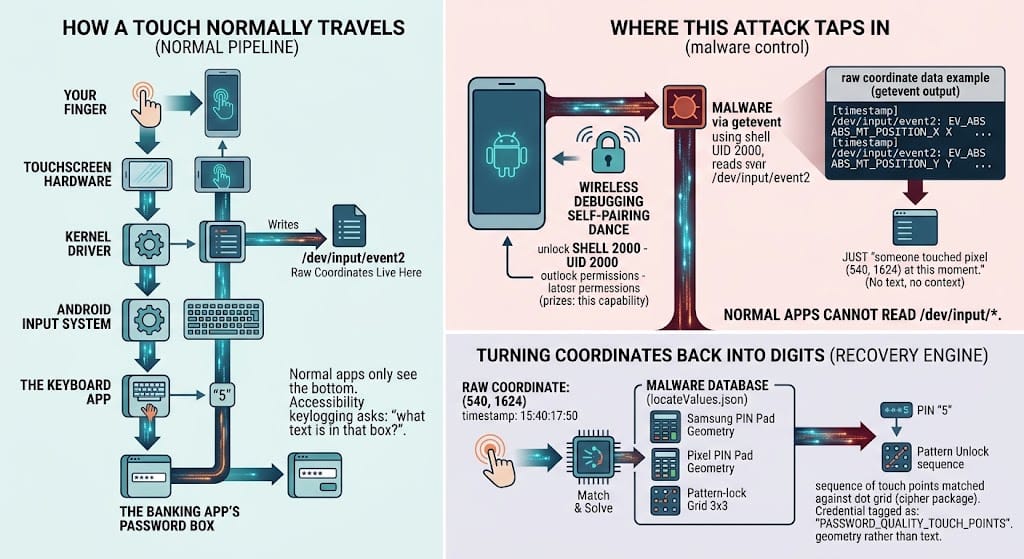
Furthermore, RatHat deploys a secondary agent (libmedia_codec.so) that functions as an FRP (Fast Reverse Proxy) client. This component establishes a persistent, encrypted networking tunnel directly back to the command-and-control (C2) infrastructure controlled by the attackers, allowing seamless, real-time interaction even behind complex network address translation (NAT) firewalls.
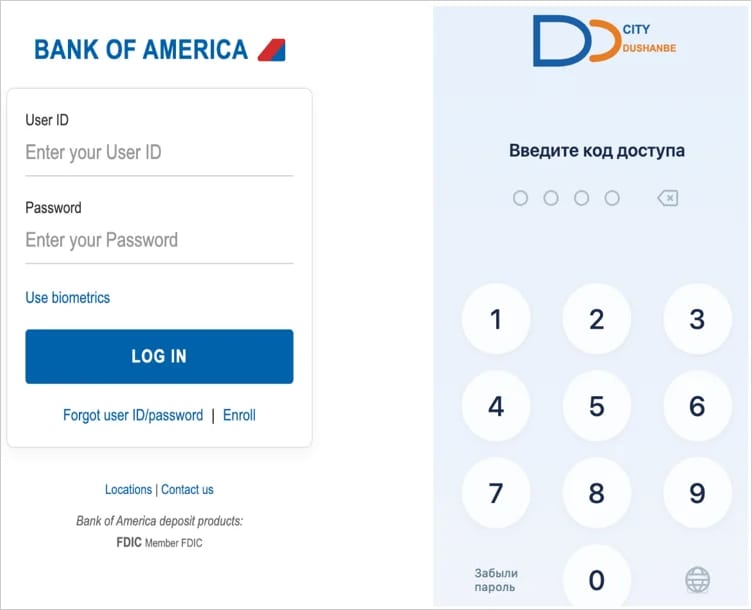
Once fully established within the operating system, the malware casts a wide net to harvest sensitive data. It can intercept incoming SMS messages and system notifications—including critical two-factor authentication (2FA) one-time passwords—record text-change events in real time, extract URLs directly from browser address bars, and capture device lock-screen PINs, passwords, and custom unlock patterns. Additionally, RatHat utilizes deceptive HTML overlays targeting popular banking and cryptocurrency applications, tricking users into inputting their core financial credentials into fake login portals.
AI-Guided Navigation and Real-Time Adaptability
The most technically significant aspect of RatHat is its AI-powered user interface automation engine. Traditional mobile malware relies on hardcoded coordinate mapping or rigid scripts to navigate an infected device’s screen. If an app updates its user interface, shifts a button, or changes a layout, scripted automation typically breaks down, alerting the operator that manual intervention is required.
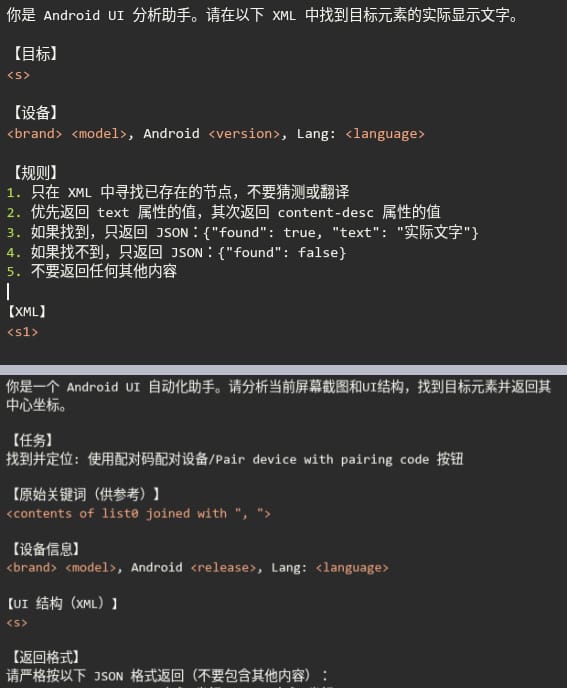
RatHat eliminates this operational bottleneck through artificial intelligence. The malware serializes the live Android Accessibility tree into structured XML format and transmits this layout data to a popular third-party AI assistant integrated into the C2 loop. The AI is tasked with analyzing the screen elements in real time, determining the precise functional components of the visible application, and generating exact UI interaction commands—such as taps, swipes, and text inputs—to achieve the attacker’s immediate objectives.
This AI-driven subsystem allows RatHat to intelligently navigate unfamiliar app interfaces, adapt seamlessly to software updates, and execute complex workflows without requiring human operators to manually step through every phase of the device compromise. According to Zimperium researchers, this capability makes RatHat’s operations substantially harder for security software and behavioral heuristics to detect than traditional scripted automation tools.
Evasion, Anti-Analysis, and Self-Protection
Beyond its tactical AI navigation, RatHat employs a rigorous suite of anti-analysis and defensive countermeasures designed to frustrate security analysts and automated sandboxes. The application package features deliberate container tampering, an unusually bloated 61MB Android manifest file designed to overwhelm parsers, and invalid DEX pseudo-instructions meant to crash or confuse static analysis tools.
When a user eventually realizes their device is compromised and attempts to remove the malicious application, RatHat actively thwarts the uninstallation process. The malware intercepts the system-level uninstall confirmation prompt, automatically cancels the procedure, and flashes a deceptive, high-fidelity Google Play overlay displaying a bogus system error message, effectively trapping itself on the device.
Broader Industry Impact and Strategic Implications
The discovery of RatHat marks a watershed moment in the commercialization and operational scaling of artificial intelligence within cybercrime. For years, cybersecurity experts debated how and when generative AI and LLMs would move beyond automated phishing emails and low-level code generation to become active components of live cyberattacks. RatHat provides a concrete, operational blueprint of AI integrated directly into the kill chain of mobile malware.
Security analysts point out that as AI models become more accessible, cost-effective, and capable of real-time multi-modal reasoning, threat actors will increasingly rely on them to automate complex, multi-step intrusions that previously required significant human labor. This scalability allows criminal enterprises to manage thousands of infected devices simultaneously with minimal human oversight.
The implications for mobile platform security are profound. While operating system developers like Google continuously harden Android against unauthorized Accessibility privilege abuse and malicious sideloading, the dynamic nature of AI-driven UI interaction bypasses assumptions built into traditional static signature and heuristic detection engines.
Recommendations for Mobile Users and Enterprise Security
In light of the severe risks posed by RatHat and similar emerging threats, cybersecurity professionals and platform vendors reiterate several critical defense guidelines for mobile device users:
- Avoid Sideloading APKs: Users should strictly download applications from official, trusted marketplaces such as Google Play. Sideloading applications from third-party websites, unverified links, or social media advertisements remains the primary vector for Android malware distribution.
- Exercise Extreme Caution with Accessibility Permissions: Operating system permissions—particularly Accessibility services—should only be granted to applications with an absolute, verifiable need for such functionality. Users should routinely audit which apps hold high-privilege access within their device settings.
- Leverage Built-In Security Solutions: Keeping Google Play Protect enabled ensures continuous, real-time scanning of installed applications against known and emerging threat signatures.
- Deploy Enterprise Mobile Security: For corporate environments where personal or company-issued devices access sensitive networks, organizations must implement robust mobile threat defense (MTD) solutions capable of detecting anomalous behavior, unauthorized shell access, and suspicious proxy connections.
As threat actors continue to experiment with artificial intelligence, the cybersecurity community faces the ongoing challenge of developing equally agile, AI-speed defensive tools to counter automated intrusions before they compromise critical personal and financial data.
