


The cybersecurity landscape has reached a new inflection point with the emergence of Dolphin X, a sophisticated remote access trojan (RAT) that integrates artificial intelligence to streamline the exploitation process. Traditionally, cybercriminals operating at scale have faced a significant logistical hurdle: the sheer volume of data harvested from thousands of infected machines often exceeds their capacity to process it manually. Dolphin X seeks to resolve this "data fatigue" by employing an AI-powered profiling engine designed to automatically score, rank, and categorize victims, ensuring that threat actors focus their resources on the most lucrative targets first.
This new malware strain was first identified and analyzed by Daniel Kelley, a researcher at Varonis Threat Labs. The malware surfaced on prominent cybercrime forums, where a vendor operating under the pseudonym "Kontraktnik" began promoting it as a comprehensive, "all-in-one" solution for remote surveillance and credential theft. Unlike standard information stealers that simply exfiltrate data, Dolphin X functions as a sophisticated management platform, offering a level of operational efficiency previously reserved for state-sponsored threat actors.
Technical Architecture and Feature Set
The Dolphin X operator panel is a testament to the increasing professionalization of the malware-as-a-service (MaaS) ecosystem. Varonis researchers noted that the platform boasts 329 distinct features organized into ten functional categories. These categories range from traditional credential harvesting and file management to advanced surveillance and system manipulation.
The malware’s builder allows operators to customize their payloads, tailoring the infection to specific environments. During the analysis of the operator panel, researchers found that the tool is designed to be highly modular. It targets a staggering array of applications, claiming compatibility with over 300 different software suites. This includes:

- Web Browsers: Comprehensive support for nine major Chromium and Gecko-based browsers, allowing for the extraction of saved passwords, cookies, and autofill data.
- Cryptocurrency Assets: The malware targets 100 different cryptocurrency wallet extensions and 65 desktop-based crypto wallets, reflecting the continued focus on liquid digital assets.
- Security Tools: It specifically identifies and compromises 10 major password managers, which often serve as the "keys to the kingdom" for both personal and corporate identities.
- Development and Cloud Infrastructure: Perhaps most concerning for enterprise environments is the malware’s ability to target more than 30 cloud command-line interface (CLI) tools and exfiltrate sensitive files such as
.envconfigurations and SSH keys.
By targeting developer credentials and cloud access tokens, Dolphin X positions itself as a precursor to large-scale corporate breaches and supply chain attacks. The theft of .env files, which often contain API keys, database credentials, and environment-specific secrets, can allow an attacker to pivot from a single infected workstation to a company’s entire cloud infrastructure.
The AI Profiler: Automating the Triage Process
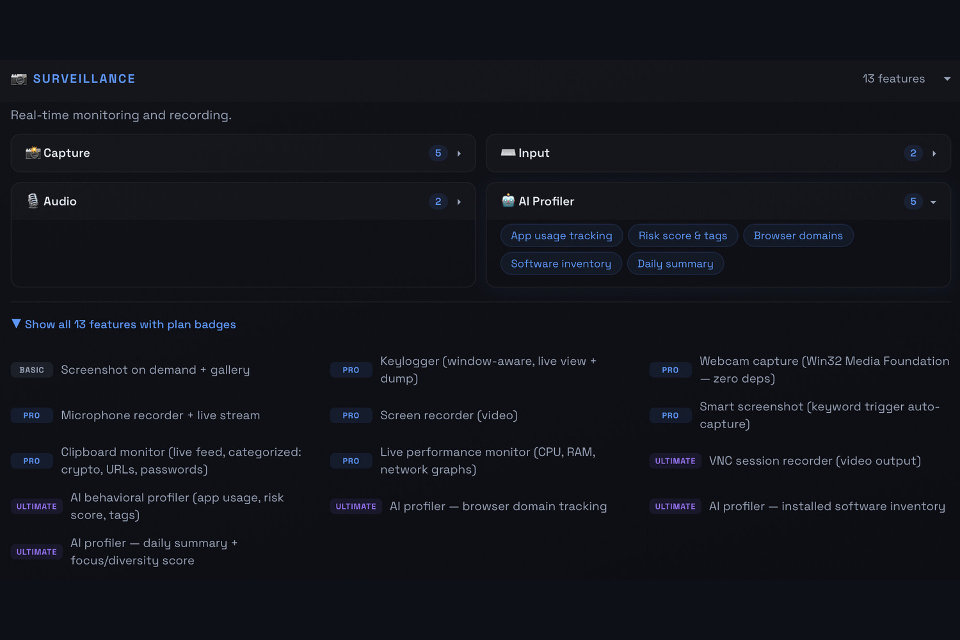
The most distinctive characteristic of Dolphin X is its "AI Profiler," a feature located within the surveillance tab of the operator panel. The developer describes this component as an "AI behavioral profiler" capable of tracking application usage, generating risk scores, and providing daily summaries of infected hosts.
In the context of modern cybercrime, an "Initial Access Broker" (IAB) or a malware operator may manage a "botnet" consisting of tens of thousands of infected computers. Identifying which of these computers belongs to a high-ranking executive, a systems administrator, or a developer with access to production servers is a time-consuming process. The AI Profiler automates this triage.
According to the Varonis analysis, the profiler processes a variety of data points to generate its rankings, including:
- Application Usage Frequency: Monitoring which software the victim uses most frequently to determine their professional role.
- Domain History: Analyzing browser history to identify high-value corporate portals or financial institutions.
- Installed Software Inventory: Identifying specialized tools (such as AWS CLI or SAP) that indicate a high-value environment.
- Risk Factors: A proprietary scoring system that flags machines likely to yield high financial or strategic returns.
Varonis researcher Daniel Kelley confirmed the presence of specific technical strings within the operator panel that facilitate this workflow. These include commands such as Auto-Start AI Profiler, ProfilerStart, ProfilerGetData, and variables like risk_score and categoryusage. While the specific AI engine or Large Language Model (LLM) powering these assessments remains unconfirmed due to the researchers’ decision to analyze the panel and traffic rather than executing a live agent, the infrastructure for automated data processing is clearly operational.

Chronology of Discovery and Market Entry
The timeline of Dolphin X’s emergence follows a pattern typical of high-tier malware development.
- Initial Sighting: In early 2024, "Kontraktnik" began teasing a new "next-generation" RAT on closed-access cybercrime forums, promising features that would "revolutionize" victim management.
- Public Advertisement: By mid-2024, full advertisements for Dolphin X appeared, highlighting the AI Profiler as its primary unique selling point (USP).
- Analysis Phase: Varonis Threat Labs acquired the Dolphin X operator panel and builder shortly after its wider release. Researchers conducted an isolated analysis, focusing on the network traffic generated by the panel and the internal logic of the builder.
- Verification: During the analysis, researchers verified the extensive list of 300+ target applications by examining the panel’s configuration files and the technical strings embedded in the software.
- Reporting: The findings were released in July 2024, warning the security community about the shift toward automated, AI-driven victim prioritization.
Industry Context: The Rise of AI in the Underground
The introduction of Dolphin X is not an isolated event but part of a broader trend where artificial intelligence is being weaponized to lower the barrier to entry for complex cyberattacks. In recent months, the security community has observed the rise of tools like SpamGPT, which uses AI to craft hyper-realistic phishing emails, and autonomous AI agents capable of navigating a network after an initial breach.
Historically, the "triage" phase of an attack was the bottleneck. A threat actor might steal a million credentials but only have the "man-hours" to check a few thousand. By integrating AI, Dolphin X allows even low-skilled "script kiddies" to operate with the efficiency of a sophisticated criminal enterprise. This democratization of high-level targeting capabilities poses a significant threat to global cybersecurity.
Industry experts suggest that the use of AI in malware like Dolphin X represents the "industrialization" of cybercrime. "We are moving away from the era of ‘spray and pray’ toward a model of ‘automated precision,’" noted one independent threat intelligence analyst. "When the malware itself can tell the attacker, ‘This computer belongs to a DevOps engineer at a Fortune 500 company,’ the time-to-compromise drops significantly."
Broader Implications for Enterprise Security
The capabilities of Dolphin X highlight several critical vulnerabilities in modern enterprise defense strategies. The targeting of .env files and SSH keys is particularly noteworthy. As organizations move toward cloud-native architectures, the local workstation of a developer becomes a high-value gateway. If a RAT can identify and prioritize these machines automatically, the window for detection and response shrinks.
Furthermore, the "AI Profiler" suggests that traditional "Indicator of Compromise" (IoC) based defenses may no longer be sufficient. If malware can change its behavior or prioritization based on the environment it finds itself in, defenders must shift toward "Indicator of Behavior" (IoB) monitoring.
Official Responses and Defensive Recommendations:
While no specific government agency has issued a dedicated alert for Dolphin X as of this writing, the features of the malware align with recent warnings from the FBI and CISA regarding the use of AI in cyberattacks. Security firms, including Varonis, recommend several layers of defense to mitigate the risk posed by such advanced RATs:
- Strict Credential Management: Since Dolphin X targets password managers and browser-saved credentials, organizations should enforce the use of enterprise-grade credential vaults that require multi-factor authentication (MFA) for every access request.
- Environment Variable Protection: Developers should be discouraged from storing secrets in plaintext
.envfiles on local machines. Instead, secret management services (like AWS Secrets Manager or HashiCorp Vault) should be utilized. - Endpoint Detection and Response (EDR): Advanced EDR solutions are necessary to detect the behavioral anomalies associated with Dolphin X, such as the unauthorized scanning of the filesystem for sensitive configuration files.
- Network Segmentation: To prevent the "pivot" that Dolphin X facilitates, critical cloud infrastructure and production environments should be strictly segmented from general corporate networks.
Conclusion: A New Era of Automated Threats
Dolphin X serves as a harbinger of a more efficient and dangerous era of cybercrime. By utilizing AI to solve the operational challenges of data management, the developers of Dolphin X have created a tool that maximizes the "Return on Investment" for attackers. The focus is no longer just on how many machines can be infected, but on how quickly the most valuable data can be identified and exploited.
As Varonis researcher Daniel Kelley concluded, the primary purpose of the AI Profiler is to help operators triage victims in a world where data is abundant but time is limited. As AI continues to evolve, it is a certainty that more malware families will adopt similar automated profiling features, forcing a corresponding evolution in the defensive technologies used to protect global digital infrastructure. The battle between AI-driven attackers and AI-enhanced defenders has officially begun.
