

The U.S. Cybersecurity and Infrastructure Security Agency (CISA) has issued a critical warning to government agencies and private sector organizations regarding a high-severity vulnerability in Apache ActiveMQ that is currently being exploited by malicious actors in the wild. The vulnerability, tracked as CVE-2026-34197, represents a significant risk to the security of enterprise communications and data integrity. On Thursday, CISA officially added the flaw to its Known Exploited Vulnerabilities (KEV) Catalog, a move that triggers mandatory remediation actions for Federal Civilian Executive Branch (FCEB) agencies under Binding Operational Directive (BOD) 22-01.
Apache ActiveMQ is widely recognized as the most popular open-source, Java-based message broker, serving as a critical piece of middleware that facilitates asynchronous communication between various applications and services. Because it sits at the heart of many complex enterprise architectures, managing the flow of data across disparate systems, any compromise of the ActiveMQ service can have cascading effects across an entire organization’s digital infrastructure.
The 13-Year-Old Bug Discovered by AI
The discovery of CVE-2026-34197 has sent shockwaves through the cybersecurity community, not only because of its severity but because of the circumstances surrounding its identification. The security flaw had remained undetected in the ActiveMQ codebase for 13 years, highlighting the persistent challenge of "technical debt" and legacy code in even the most scrutinized open-source projects.
The vulnerability was brought to light by Naveen Sunkavally, a researcher at Horizon3.ai. In a modern twist on vulnerability research, Sunkavally utilized the Claude AI assistant to help analyze the codebase and identify potential injection points. This discovery underscores a shifting paradigm in cybersecurity, where artificial intelligence is increasingly being leveraged by both defenders and attackers to find deep-seated flaws that traditional automated scanners and human reviews might overlook.
According to Sunkavally’s technical analysis, the vulnerability stems from improper input validation within the broker’s management components. Specifically, the flaw allows an authenticated threat actor to execute arbitrary code via injection attacks. While the requirement for authentication provides a slight barrier to entry compared to unauthenticated remote code execution (RCE) flaws, the risk remains high. In many enterprise environments, internal credentials can be compromised through phishing or credential stuffing, giving attackers the foothold they need to exploit this ActiveMQ vulnerability and move laterally through the network.
Technical Analysis and Exploitation Vectors
CVE-2026-34197 is categorized as a high-severity flaw due to its potential for remote code execution. When an attacker successfully exploits this vulnerability, they can gain the same level of permissions as the user running the ActiveMQ service. In many legacy or poorly configured installations, this could mean full administrative access to the underlying server.
The Apache Software Foundation, which maintains the project, released patches for the vulnerability on March 30, 2026. The fixes were implemented in ActiveMQ Classic versions 6.2.3 and 5.19.4. Horizon3 researchers have warned that organizations should treat this update as a high priority. The warning is predicated on the fact that ActiveMQ has historically been a frequent target for real-world attackers. Because it is a Java-based application, it is susceptible to well-known post-exploitation techniques, such as the use of Java deserialization exploits or the deployment of web shells.
Horizon3’s research team specifically pointed out that signs of exploitation could be identified by a careful audit of ActiveMQ broker logs. Organizations are encouraged to search for suspicious broker connections that utilize the brokerConfig=xbean:http:// query parameter combined with the internal transport protocol known as "VM." These indicators are characteristic of attempts to inject malicious configurations into the message broker’s runtime environment.
Global Exposure and the Threat Landscape
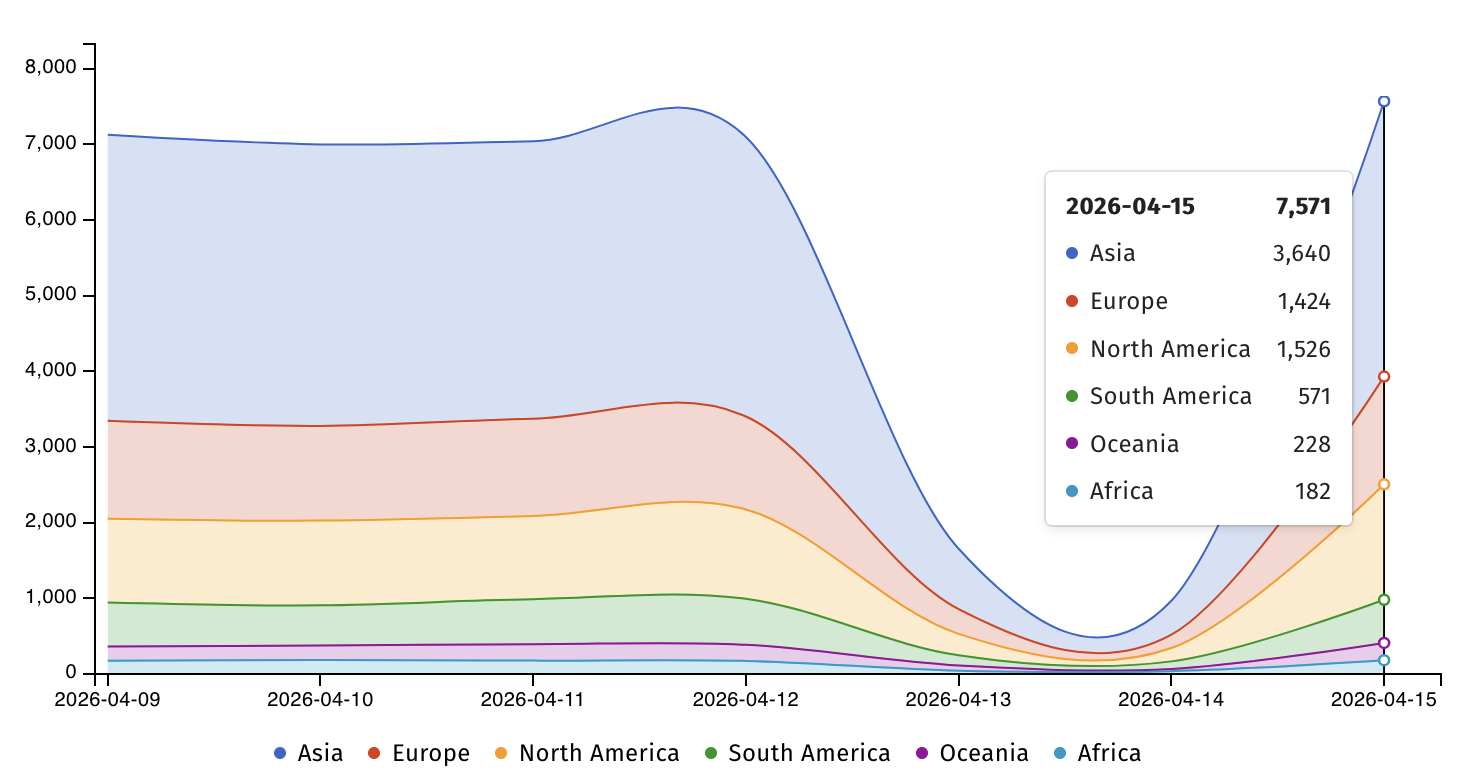
The scale of the potential attack surface is substantial. Shadowserver, a prominent threat monitoring service, is currently tracking more than 7,500 Apache ActiveMQ servers that are exposed to the public internet. While not every exposed server is necessarily vulnerable—some may have already been patched or reside behind protective firewalls—the sheer volume of internet-facing message brokers provides a target-rich environment for opportunistic hackers.
Geographically, these servers are distributed globally, though concentrations are often found in regions with high densities of enterprise data centers and cloud service providers. The exposure of these systems is particularly concerning because message brokers often handle sensitive data, including personally identifiable information (PII), financial transactions, and proprietary business logic. If an attacker gains control of a broker, they can intercept, modify, or delete messages, potentially disrupting critical business processes or facilitating large-scale data breaches.
CISA’s warning emphasized that this type of vulnerability is a "frequent attack vector for malicious cyber actors" and poses "significant risks to the federal enterprise." By adding the CVE to the KEV catalog, CISA is signaling that the threat is no longer theoretical; there is documented evidence of active exploitation.

Mandatory Federal Response and Private Sector Guidance
Under the mandates of Binding Operational Directive (BOD) 22-01, federal agencies are required to remediate vulnerabilities listed in the KEV catalog within specific timeframes. For CVE-2026-34197, CISA has set a deadline of April 30, 2026. This two-week window reflects the urgency of the situation and the perceived risk to national security and government operations.
While CISA’s directives are legally binding only for Federal Civilian Executive Branch agencies, the agency strongly urged private-sector defenders to follow suit. CISA recommended that all organizations prioritize patching their ActiveMQ installations and conduct a thorough review of their network security posture.
The agency’s official guidance states: "Apply mitigations per vendor instructions, follow applicable BOD 22-01 guidance for cloud services, or discontinue use of the product if mitigations are unavailable." This "patch or perish" approach highlights the severity of the RCE potential associated with this bug.
Historical Context: ActiveMQ Under Fire
This is not the first time Apache ActiveMQ has been in the crosshairs of cybercriminals. CISA previously tagged two other ActiveMQ vulnerabilities as being exploited in the wild: CVE-2023-46604 and CVE-2016-3088.
The history of CVE-2023-46604 is particularly instructive for current defenders. That vulnerability was exploited as a zero-day flaw by the TellYouThePass ransomware gang. Ransomware actors frequently target middleware like ActiveMQ because it allows them to paralyze an organization’s internal communications, making the recovery process significantly more difficult and increasing the pressure on the victim to pay the ransom. The fact that CVE-2026-34197 is now seeing similar active exploitation suggests that sophisticated threat groups, including ransomware affiliates and potentially state-sponsored actors, are once again looking to exploit the foundational role that message brokers play in modern IT.
Broader Implications for Enterprise Security
The exploitation of CVE-2026-34197 brings several broader cybersecurity themes to the forefront. First is the concept of "hidden" vulnerabilities in ubiquitous open-source software. The fact that a bug could exist for 13 years in a project as widely used as ActiveMQ suggests that many other critical flaws likely remain buried in legacy code across the software ecosystem.
Second is the role of AI in the evolving arms race between attackers and defenders. While Naveen Sunkavally used AI for defensive research, the same tools are available to malicious actors. The ability of AI to parse massive amounts of code and identify logical inconsistencies or validation errors means that the pace of vulnerability discovery is likely to accelerate. Organizations must adapt by employing similarly advanced tools for code auditing and threat detection.
Finally, the situation serves as a reminder of the importance of the "principle of least privilege." Because CVE-2026-34197 requires authentication, the risk can be mitigated by ensuring that only necessary users have access to the ActiveMQ management console and that robust multi-factor authentication (MFA) is enforced across the board. Furthermore, isolating message brokers within secure network segments—rather than exposing them directly to the internet—can prevent many external exploitation attempts.
Conclusion and Immediate Actions
As the April 30 deadline approaches for federal agencies, the cybersecurity community is on high alert. The combination of an aging, high-severity bug and the involvement of AI in its discovery makes CVE-2026-34197 a landmark case in recent security history.
Organizations using Apache ActiveMQ should take the following immediate steps:
- Inventory: Identify all instances of Apache ActiveMQ Classic within the environment, including those embedded in third-party software packages.
- Patch: Immediately update to ActiveMQ Classic versions 6.2.3, 5.19.4, or later.
- Audit: Review broker logs for the specific indicators of compromise (IoCs) identified by Horizon3, focusing on suspicious
brokerConfigparameters. - Restrict Access: Ensure that ActiveMQ management interfaces are not internet-facing and are protected by strong authentication and network access control lists (ACLs).
The active exploitation of this vulnerability is a stark reminder that even the most trusted components of an IT stack require constant vigilance and rapid response when flaws are uncovered. With 7,500 servers still potentially in the line of fire, the race between administrators and attackers is well underway.
