

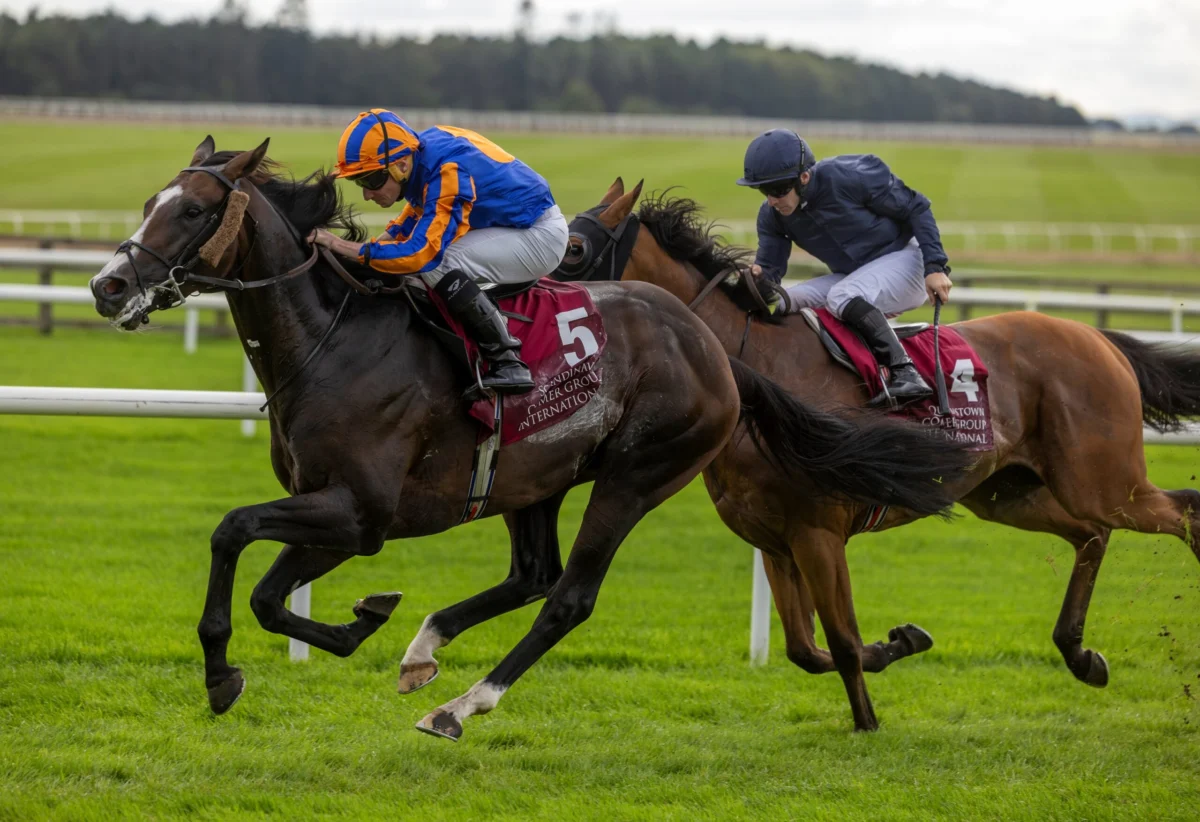
Scandinavia has reaffirmed his status as the preeminent stayer in European racing by clinching a gritty, workmanlike victory in the Comer Group International Irish St. Leger (G1) at the Curragh. While questions lingered regarding the physical condition of the Aidan O’Brien stable—which has been navigating a low-grade infection throughout the midsummer period—the Kentucky-bred son of Justify proved that class is indeed permanent. Under the guidance of champion jockey Ryan Moore, the stayer overcame both a resilient field and a challenging track to secure his eighth consecutive victory, cementing his legacy as one of the most formidable long-distance athletes of the modern era.
The victory at the Curragh was not merely a singular achievement but the latest chapter in a remarkable 2024 campaign that has seen the horse transition from a talented prospect to a generational stayer. With this win, Scandinavia joins an elite group of dual St. Leger winners, having previously captured the Doncaster Classic last year.
A Season Defined by Consistency
The narrative surrounding Ballydoyle in recent months has been one of tactical adjustment. Following a stellar spring that saw the stable dominate the Classics and deliver peak performances through Royal Ascot, the midsummer slump threatened to derail the momentum of the season. Aidan O’Brien openly addressed the atmospheric infection that had plagued his yard, explaining the inconsistent form of some of his runners. Yet, through this volatile period, Scandinavia remained the stable’s anchor.
His 2024 season reads like a roadmap of endurance excellence. The journey began with a hard-fought victory in the Ascot Gold Cup, where he narrowly defeated Trawlerman. That performance was followed by a definitive statement at the Goodwood Cup, where he left the field in his wake. By the time he arrived at the Curragh, he was already considered the horse to beat, though the heavy track conditions and the lingering health concerns of the yard provided a narrative of vulnerability that the race itself would eventually test.
The Race Narrative: A Tactical Grind
The Irish St. Leger, a race steeped in history and prestige, demands more than just raw speed; it requires the tactical patience that defines the best stayers. As the gates opened, the race unfolded as a strategic battle between the stablemates. Queenstown, serving as a pace-setter, dictated the tempo for much of the contest, ensuring the race was run at a stamina-testing clip.
For the casual observer, the middle stages of the race may have appeared lackluster as Scandinavia lingered behind his stablemates. However, those familiar with the horse’s specific physiology recognized the setup. Ryan Moore, ever the master of tempo, allowed the horse to settle. It was not until the final furlong that the urgency of the race truly manifested. Queenstown, showing remarkable heart, refused to surrender the lead easily, and the late-surging Jan Brueghel—returning to the track after a three-month hiatus—threatened to disrupt the order.
In the final 200 meters, Scandinavia responded to Moore’s call. He pulled away from the pack with a rhythmic, powerful stride, eventually crossing the line two lengths ahead of Queenstown, with Jan Brueghel a further three-quarters of a length back. The result was a dominant 1-2-3 sweep for the O’Brien yard, a testament to the depth of the stable’s staying division even when operating under sub-optimal health conditions.
Post-Race Analysis and Official Responses
Speaking from the winners’ enclosure, Aidan O’Brien expressed a mix of relief and professional admiration for his charge. "He is a great horse," O’Brien remarked. "He has an unbelievable amount of stamina, a big, high-cruising stamina. Ryan said he really only kicks in after a mile and six furlongs, which is very unusual. The ground today was probably as soft as he wants it because he is such a good mover; he really needs firm footing to showcase his best."
Ryan Moore, reflecting on his own tactical decisions, took a measure of accountability for the labor-intensive nature of the win. "I was always very happy with him and probably should have asked him for his effort a bit sooner," Moore admitted. "He went to sleep on me a little bit, but he is a serious stayer. When you ask him, he finds. He doesn’t know how to run a bad race."
The immediate future for Scandinavia remains the subject of internal debate at Ballydoyle. While bookmakers have shortened his odds for the Long Distance Cup at Ascot, O’Brien is wary of over-campaigning. "He has had a very busy year," O’Brien noted. "I trained him hard for the Gold Cup. He floats on fast ground, and I don’t want to abuse him by running him on heavy ground in France for the Cadran. We will consult with the owners and decide if he has done enough for the year."
The Strategic Outlook for the Stable
The performance of the supporting cast provides a clear roadmap for the remainder of the season. Queenstown, having proven his capability in the soft ground, is a prime candidate for the Prix du Cadran. Meanwhile, Jan Brueghel, who demonstrated a promising turn of foot despite the lack of recent competitive action, is being eyed for a potential trip to Ascot for the two-mile distance.
This strategic diversification allows O’Brien to manage his equine assets without over-relying on a single horse. The success of the O’Brien family, including the dominant performance of Joseph and Donnacha O’Brien in other races on the card, highlights the continued influence of the family dynasty on Irish racing.
Broader Implications for the Staying Division
The Irish St. Leger serves as a benchmark for the staying division in Europe, and Scandinavia’s continued dominance raises questions about the current lack of challengers to his throne. As a Kentucky-bred son of Justify, he represents a fascinating cross-pollination of American speed and European stamina. His ability to adapt to the varied requirements of the Gold Cup, the Goodwood Cup, and the St. Leger underscores a versatility that is rarely seen in modern distance racing.
From a statistical standpoint, the win is a milestone. Securing eight consecutive victories at the Group 1 level is a feat that places Scandinavia in the annals of legendary stayers. The race also reinforced the importance of the Comer Group International’s sponsorship, which has helped sustain the prestige of the St. Leger as the ultimate test for the long-distance athlete.
Conclusion
As the season enters its final quarter, the question for racing enthusiasts is not whether Scandinavia can win, but how much more he has left to offer. He has navigated a season marked by stable-wide health challenges, changing ground conditions, and the tactical pressure of being the target for every other trainer in the field.
The Irish St. Leger victory was a victory of composure. By holding his nerve and waiting for the right moment to strike, Scandinavia once again proved that he possesses the heart of a champion. Whether he retires to the paddocks as a finished product or returns for an Ascot campaign in 2025, his place in the history of the sport is secure. For Aidan O’Brien and the entire Ballydoyle team, the result at the Curragh was a reaffirmation of their methods—proving that even when the path is difficult, excellence finds a way to prevail.
