
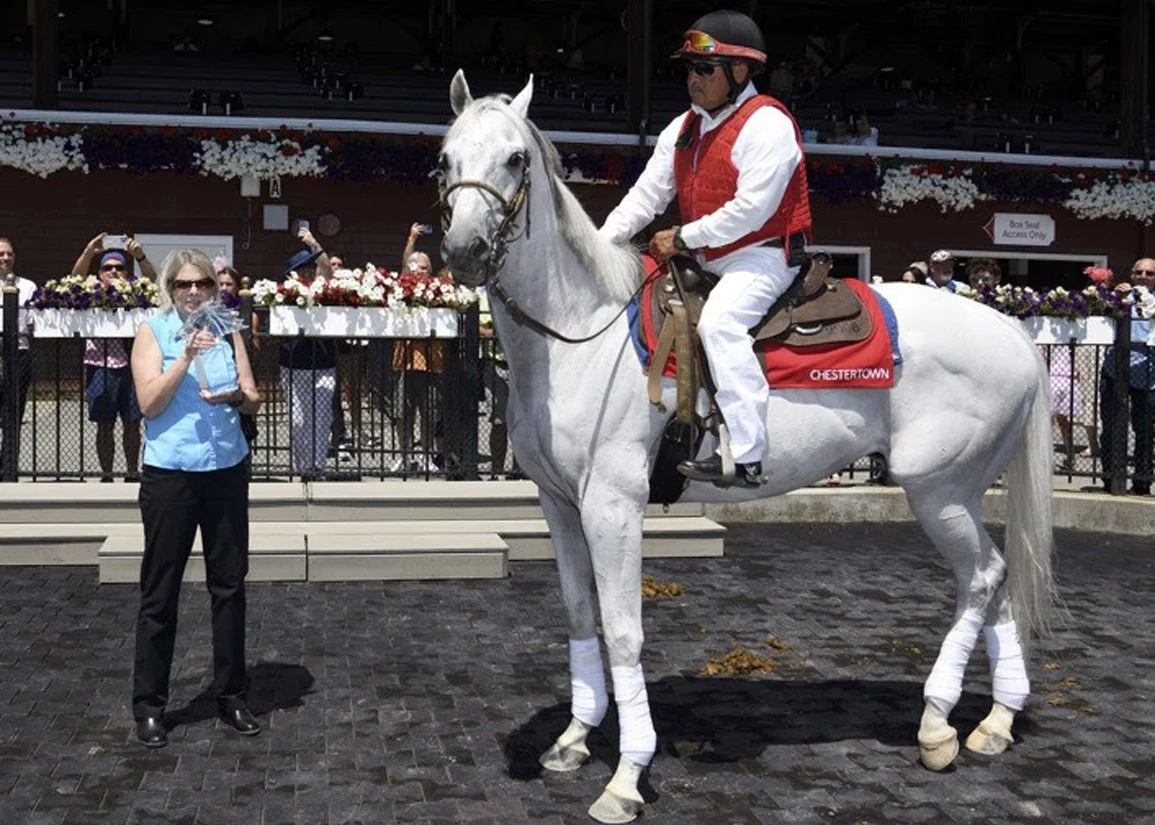
The atmosphere at Saratoga Race Course on Friday, July 24, 2026, was one of celebration and reflection as the racing community gathered for the annual New York Thoroughbred Aftercare Day. The highlight of the afternoon’s festivities was the presentation of the Down Broadway Award, an honor bestowed upon the New York Retired Racehorse of the Year. This year, the accolade was awarded to Chestertown, a regally bred son of Tapit whose journey from a record-breaking auction prospect to a vital member of the New York Racing Association (NYRA) outriding team serves as a testament to the industry’s commitment to post-racing transitions.
The Down Broadway Award carries significant weight within the New York circuit. It is named in honor of Down Broadway, the very first Thoroughbred to be retired through the TAKE THE LEAD program in 2013. Since its inception, the program—spearheaded by the New York Thoroughbred Horsemen’s Association (NYTHA)—has facilitated the retirement of hundreds of horses, ensuring they find suitable second careers in various equestrian disciplines. Chestertown’s recognition marks a full-circle moment for a horse that has spent nearly his entire life in the spotlight of the Empire State’s racing scene.
A Pedigree of Distinction and a Record-Breaking Start
Chestertown’s story began long before he stepped onto the track as a competitor. Bred by the influential duo of Chester and Mary Broman, he was born at their Chestertown Farm, located just a short distance from the Saratoga grandstand. His pedigree was the stuff of dreams for any breeder: he was sired by the legendary Tapit, a multi-time leading sire in North America, and produced by Artemis Agrotera, a Grade 1-winning mare who captured both the Frizette Stakes and the Ballerina Stakes.
When Chestertown was consigned as a 2-year-old by Becky Thomas’s Sequel Bloodstock at the 2019 OBS March Sale, he ignited a bidding war. The hammer eventually fell at $2 million, setting a then-record for the highest price ever paid for a New York-bred at public auction. The purchase was made by a high-profile partnership led by West Point Thoroughbreds, Robert Masiello, and Siena Farm.
Reflecting on those early days, Becky Thomas recalled the horse’s immense potential and the challenges that came with his high-octane personality. “I think he was supremely talented, and very, very smart,” Thomas said during the ceremony. “He was a very high-energy horse. Aftercare is near and dear to me—we still have Freud here at the farm—and it takes a lot of people willing to do the work and a lot of money to support that.”
Racing Career and the Transition to Aftercare
On the racetrack, Chestertown proved to be a consistent and formidable competitor. While he may not have reached the Grade 1 heights of his dam, he carved out a successful career as a quintessential New York campaigner. Over the course of several seasons, he secured five career victories and earned over $400,000 in purses. One of his most memorable performances came at Saratoga in 2020, where he captured the Albany Stakes, a premier event for state-bred sophomores.
However, as is the case with all athletes, the time eventually came for Chestertown to transition away from competitive racing. Unlike many high-priced auction purchases that are retired to stud, the decision was made to find a role that suited Chestertown’s physical capabilities and mental acuity. This led him to the doorstep of the NYRA outriding team, a group responsible for the safety and order of the track during morning training and afternoon racing.
The theme of this year’s Aftercare Day, "A Salute to Racetrack Ponies," provided the perfect backdrop for Chestertown’s award. Racetrack ponies, often referred to as the "unsung heroes" of the backstretch, perform a variety of essential tasks, including escorting high-strung racehorses to the starting gate and apprehending loose horses during emergencies.
The Demands of the Outrider Life
Transitioning from a racehorse, whose primary goal is to run as fast as possible, to an outrider pony, who must remain calm under pressure and provide a steadying influence, is no small feat. It requires a rigorous retraining process and a specific temperament.
Miguel Gutierrez, NYRA’s head outrider, was the primary architect of Chestertown’s second career. Gutierrez noted that when he evaluates a horse for his team, he specifically looks for former Thoroughbred racehorses because of their unique combination of speed and intelligence.
“When I’m looking for a horse to be an outrider’s pony, it’s important that he be a Thoroughbred, an ex-racehorse,” Gutierrez explained. “I need to know a horse can be fast for at least a quarter-mile. That’s my priority. If a horse gets loose, I need the speed to catch them safely.”
Beyond raw speed, the mental transition is the most difficult hurdle. Chestertown had to learn to "pony" other horses—walking alongside them while they are mounted—and to remain stationary amidst the chaos of a busy track. Gutierrez reported that the gray gelding has exceeded expectations.
“His temperament has improved a lot,” Gutierrez added. “He’s been ponying good and doesn’t kick; that’s very important. He’s learned the ropes of the new job and has become a dependable partner for the team.”
Industry Leadership and the Importance of Aftercare
The success of Chestertown’s transition highlights the evolving landscape of Thoroughbred aftercare in North America. For decades, the fate of retired racehorses was often a point of concern for animal welfare advocates and industry stakeholders alike. However, the establishment of organizations like TAKE THE LEAD and the Thoroughbred Aftercare Alliance (TAA) has created a standardized, well-funded infrastructure for rehoming.
Tom Bellhouse, Executive Vice President of West Point Thoroughbreds, emphasized that seeing a horse like Chestertown continue to work at the track is a source of pride for the ownership group. West Point Thoroughbreds has long been a vocal supporter of aftercare initiatives, often baking retirement costs into their partnership models.
“With Chestertown working here, our partners get a chance to see him every morning,” Bellhouse said. “It provides a sense of closure and satisfaction to know that he is still a part of the Saratoga community. We are all united to make sure retired racehorses have happy and healthy lives beyond the racetrack.”
The financial commitment required for aftercare is substantial. Programs like TAKE THE LEAD rely on a combination of per-start fees from owners, contributions from jockeys, and donations from breeding farms and sales companies. In New York, the aftercare ecosystem is particularly robust, with NYRA and NYTHA collaborating to ensure that no horse is left without a safety net when their racing days conclude.
Broader Implications for the Sport
The recognition of Chestertown as the Retired Racehorse of the Year serves as a powerful piece of public relations for a sport that has faced increasing scrutiny regarding equine safety and welfare. By highlighting the successful "second acts" of high-profile horses, the industry demonstrates that a Thoroughbred’s value does not end at the finish line.
From a data perspective, the growth of the aftercare sector is evident. Since 2013, the TAKE THE LEAD program has processed over 1,000 horses into accredited retirement facilities. Furthermore, the diversification of second careers—ranging from outriding and fox hunting to therapeutic riding and show jumping—has expanded the market for retired Thoroughbreds, ensuring they remain in demand even after their athletic peak on the turf or dirt.
Chestertown’s role as an outrider pony is particularly symbolic. In his first career, he was the athlete being protected and guided. In his second career, he has become the protector. His presence on the track every morning at Saratoga serves as a living monument to the versatility of the breed.
Chronology of a Champion’s Journey
- 2017: Chestertown is born at Chestertown Farm, New York, sired by Tapit out of Artemis Agrotera.
- March 2019: Sold for $2 million at the OBS March Sale, setting a record for a New York-bred 2-year-old.
- August 2020: Wins the Albany Stakes at Saratoga, marking his most significant career victory.
- 2023: Officially retired from racing after a successful multi-year campaign with five wins.
- Late 2023 – 2025: Undergoes intensive retraining under Miguel Gutierrez to become a NYRA outrider pony.
- July 24, 2026: Named the recipient of the Down Broadway Award on New York Thoroughbred Aftercare Day.
Conclusion
As the sun began to set over the Adirondacks on Friday, the ceremony concluded with Chestertown standing calmly in the winner’s circle—the same spot he occupied after his Albany Stakes win years prior. While he no longer carries a jockey in silk colors, his new uniform as an outrider pony is no less prestigious.
The story of Chestertown is a reminder that the Thoroughbred industry’s responsibility to its athletes is a lifelong commitment. Through the cooperation of breeders like the Bromans, trainers, owners like West Point Thoroughbreds, and aftercare advocates, the sport is building a future where every horse can find a purposeful and dignified life after the final wire. For Chestertown, the "Retired Racehorse of the Year" title is not just an award; it is a celebration of a new beginning in the very place where his journey started.
