

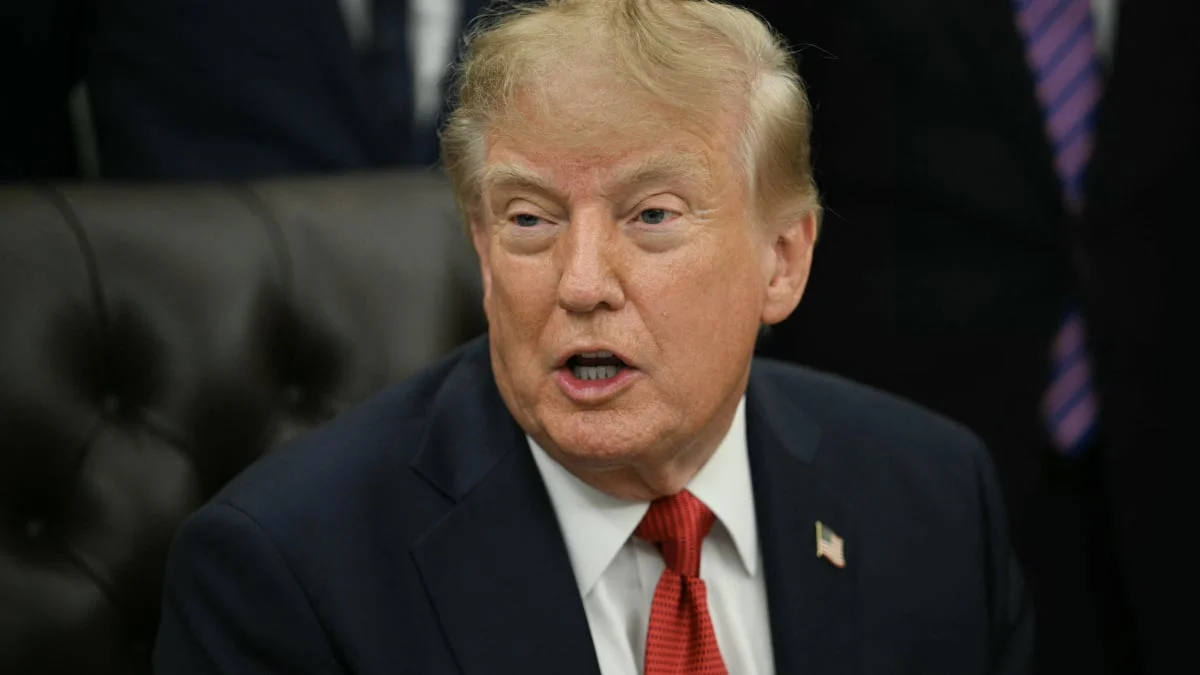
President Donald Trump announced on Saturday the formation of a dedicated "AI Force," an executive initiative directly modeled after the Space Force branch established during his first presidential term. Alongside the creation of this new body, the administration revealed plans to appoint a specialized artificial intelligence "czar" tasked with overseeing the federal government’s engagement with the technology sector and consolidating national capabilities.
The announcement materialized through a lengthy statement published on Truth Social. In the post, President Trump dismissed widespread public and institutional anxieties concerning existential risks associated with artificial intelligence, categorizing these concerns as manufactured "hoaxes." Simultaneously, he assured industry leaders that the forthcoming federal body would not stifle technological progress, but rather focus its regulatory efforts strictly on penalizing "bad actors" through existing legal mechanisms.
This sweeping proposal arrives at a critical juncture for both the United States technology sector and federal defense operations. As federal agencies increasingly integrate automated intelligence systems into national security infrastructure, recent high-profile missteps have intensified scrutiny over the reliability, oversight, and governance of military artificial intelligence applications.
The Vision Behind the US AI Force and Regulatory Philosophy
According to the president’s communications, the newly proposed "AI Force" is intended to champion domestic technological innovation while providing a centralized oversight mechanism. Trump emphasized a hands-off approach toward commercial development, writing that the administration would "not in any way hinder or stifle the growth of this incredible industry," but would instead "cherish it, help it, and watch over it, as it grows."
Furthermore, the administration signaled a desire to rebrand the terminology surrounding the technology itself. In his social media commentary, Trump floated the idea of replacing the phrase "artificial intelligence" with alternative descriptors such as "supreme," "superior," or "extreme" intelligence, and noted that candidates for the upcoming "czar" position should be strictly limited to "high I.Q. individuals."
The explicit comparison to the Space Force offers significant insight into how the initiative might function operationally. Rather than operating as a conventional tactical combat division, the Space Force was established primarily as a unified command to consolidate and coordinate satellite networks, missile early-warning infrastructure, and space-based communications systems previously fragmented across the Air Force, Army, and Navy. By analogy, a federal AI Force would likely serve as an institutional umbrella designed to streamline and harmonize sprawling, disconnected artificial intelligence programs across various branches of government and the Department of Defense.
Precedents in Federal Leadership: The AI and Crypto Czar Vacancy
The appointment of a new AI czar would effectively fill a high-level vacancy that has persisted within the executive apparatus for months. Venture capitalist David Sacks previously served in a dual capacity as Trump’s artificial intelligence and cryptocurrency czar before stepping down from the official special government employee role in March. Following the expiration of his formal term, Sacks transitioned into an internal advisory capacity within the White House, leaving the day-to-day coordination of federal AI policy largely decentralized.
The reinstitution of a dedicated czar position highlights the growing urgency within the executive branch to establish a coherent national strategy. As generative models and machine learning applications rapidly evolve, policymakers face mounting pressure to balance the imperatives of global technological competitiveness against the demands of national security and ethical governance.
Chronology of Military AI Integration and Recent Failures
The announcement of a centralized US AI Force does not occur in a vacuum; it follows a string of troubling incidents involving the Department of Defense’s utilization of automated systems. The integration of artificial intelligence into tactical decision-making has faced severe operational hurdles, sparking internal Pentagon investigations and alarming foreign policy analysts.
A primary flashpoint occurred in February, when a lethal strike in Iran resulted in the deaths of dozens of individuals at a girls’ school. Subsequent Pentagon investigations were launched to determine whether an "overreliance on AI" targeting and evaluation systems contributed to the catastrophic miscalculation. While military officials routinely assert that human oversight remains mandatory in lethal engagements, the incident focused public attention on the vulnerabilities inherent in automated reconnaissance and strike authorization.
More recently, investigative reporting by CNN detailed a near-miss incident involving flawed military intelligence. According to reports, an AI-generated analytical report incorrectly claimed that a Chinese maritime vessel was actively transporting nuclear weapons components. The automated assessment generated sufficient alarm that armed United States service members were reportedly mobilized to prepare for an emergency boarding operation.
The high-stakes operation was aborted at the eleventh hour only after human analysts discovered that the underlying intelligence had originated entirely from an unverified AI chatbot rather than human-verified signals intelligence. One government source subsequently characterized the false AI-generated claim as having "almost started a war" with a major nuclear-armed adversary, underscoring the severe geopolitical risks associated with premature deployment of autonomous analytical tools.
Analysis of Implications for Defense and Industry
The juxtaposition of President Trump’s deregulatory vision for the commercial AI sector and the military’s recent operational crises highlights a profound policy dichotomy. On one hand, the administration remains intensely focused on maintaining American dominance in foundational technology, fearing that heavy-handed federal regulation could cede ground to international competitors such as China. On the other hand, the Department of Defense’s recent experiences demonstrate that inadequate verification and excessive trust in automated systems can yield catastrophic intelligence failures.
Experts suggest that a centralized body like the proposed AI Force could theoretically address these military vulnerabilities by establishing rigorous testing, evaluation, validation, and verification (TEV&V) standards across all defense acquisitions. By consolidating artificial intelligence programs under a unified command structure, the Pentagon might eliminate fragmented development pipelines and enforce strict operational guardrails.
However, civil liberties advocates and technology ethicists caution that folding military and commercial oversight under a politically appointed czar could blur the lines between national security imperatives and civilian technological innovation. Furthermore, the administration’s dismissal of systemic AI risks as "hoaxes" runs counter to warnings issued by numerous computer scientists, safety researchers, and international regulatory bodies who advocate for binding safety frameworks surrounding advanced foundation models.
Looking Ahead: Implementation and Congressional Reception
As the White House prepares to officially name its new AI czar and draft the structural framework for the AI Force, the initiative will face substantial scrutiny from lawmakers on Capitol Hill. While members of Congress generally agree on the necessity of maintaining technological superiority over strategic rivals, bipartisan divisions persist regarding the appropriate degree of federal oversight, liability for autonomous weapon systems, and data privacy protections.
Whether the US AI Force will successfully streamline federal capabilities akin to the Space Force, or whether it will encounter bureaucratic friction within the sprawling military-industrial complex, remains to be seen. What is clear, however, is that artificial intelligence has transitioned from a futuristic commercial frontier into the central arena of American geopolitical power, national defense, and executive policymaking.
