

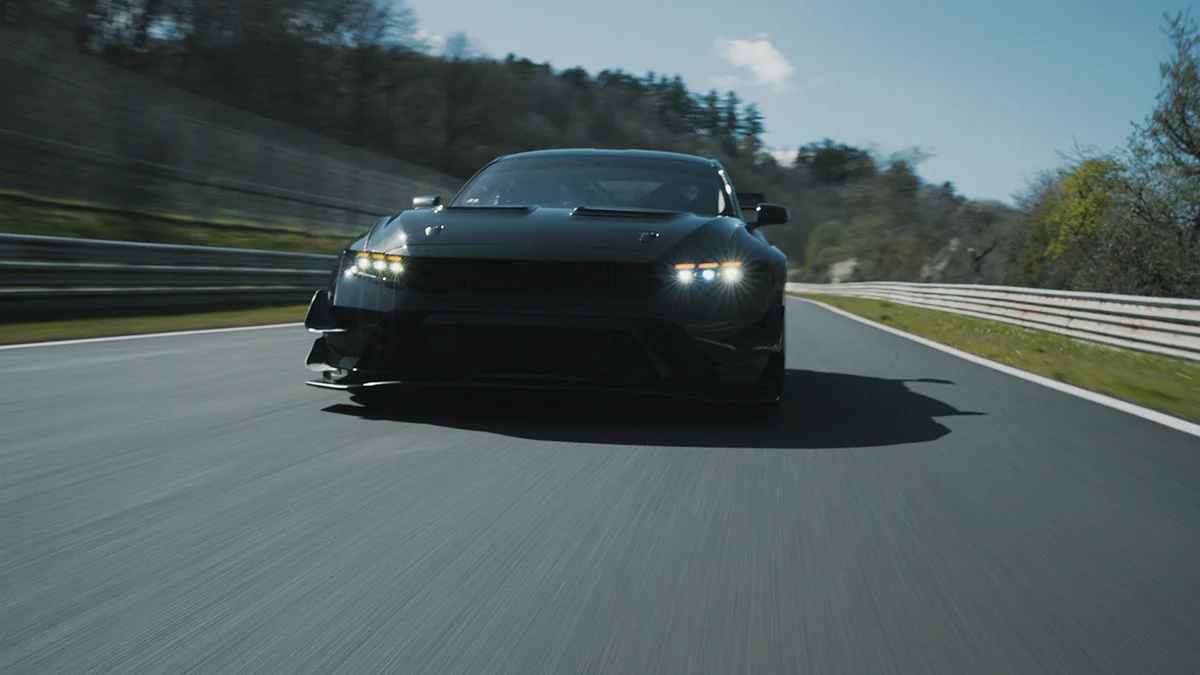
In a significant display of automotive engineering prowess, the Ford Mustang GTD Competition has etched its name in the annals of Nürburgring history, securing the second-fastest lap time ever recorded by an American-made production car on the legendary Nordschleife circuit. Ford announced on April 17, 2026, that the formidable Mustang variant conquered the challenging 12.94-mile "Green Hell" in an astonishing 6 minutes and 40.835 seconds. This blistering performance not only surpasses the previous Nürburgring record set by the standard Mustang GTD by over 11 seconds but also solidifies the Mustang’s evolution from a beloved muscle car into a genuine track-focused supercar contender.
The historic lap was expertly piloted by Ford Racing and Multimatic factory driver Dirk Müller, a seasoned veteran renowned for his exploits in motorsport. The pre-production/prototype vehicle’s achievement, officially logged on March 24, places it sixth overall on the Nürburgring Nordschleife’s pre-production/prototype leaderboard, a testament to its extreme performance capabilities. The Nordschleife, affectionately nicknamed the "Green Hell" by racing enthusiasts, is a notoriously demanding 12.94-mile track characterized by its 73 officially recognized turns – a mix of 33 left-handers and 40 right-handers – and significant elevation changes exceeding 1,000 feet. Its unforgiving nature demands not only raw power but also exceptional handling, aerodynamic efficiency, and driver skill.
A Hierarchy of American Speed at the Nürburgring
The Mustang GTD Competition’s impressive 6:40.835 lap time positions it firmly behind only one other American machine: the Ford GT Mk IV. This specialized, track-only variant of the Ford GT achieved an even more astonishing 6:15.977 lap time just one week prior to the GTD Competition’s run, though this record was announced subsequently. The GT Mk IV, developed in collaboration with Multimatic, represents the pinnacle of Ford’s performance engineering, designed explicitly for extreme track use.
While the GT Mk IV occupies the undisputed top spot for American cars, the Mustang GTD Competition’s second-place finish is a remarkable feat in itself. It decisively outpaced the Chevrolet Corvette ZR1X, which had previously held the third-fastest American car title with a lap time of 6:49.275, set in the summer of the previous year. The margin of over eight seconds between the Mustang GTD Competition and the Corvette ZR1X underscores the significant leap in performance Ford has achieved. Further down the list, the original Mustang GTD, a road-legal variant, had previously lapped the Nordschleife in 6:52.072 minutes in the spring of the preceding year, highlighting the iterative improvements made to the GTD platform.
Engineering a Nürburgring Champion: The GTD Competition’s Enhancements
The substantial reduction in lap time by the GTD Competition is not by chance; it is the result of meticulous engineering and targeted enhancements to the already potent GTD platform. At the heart of this performance surge lies a more powerful iteration of the 5.2-liter supercharged V-8 engine. While Ford has not yet disclosed the exact horsepower output, it has confirmed that this new mill surpasses the original GTD’s 815 hp. This significant increase in power, combined with optimized torque delivery, provides the necessary thrust to tackle the Nordschleife’s long straights and demanding uphill sections.
Beyond the powertrain, the GTD Competition boasts a more aggressive aerodynamic package. This includes revised front splitters, larger rear diffusers, and a substantial rear wing, all meticulously designed to generate greater downforce. Increased downforce is crucial for maintaining stability and grip at high speeds, particularly through the Nordschleife’s numerous high-speed corners. The car also features an extensive use of lightweight materials throughout its construction. This includes the incorporation of magnesium wheels, a significant weight-saving measure that not only reduces unsprung mass, improving handling and responsiveness, but also contributes to overall vehicle agility. Furthermore, the GTD Competition is equipped with specialized high-performance tires, engineered to offer superior grip and thermal management, essential for sustained high-performance driving on a demanding circuit like the Nordschleife.
The Nürburgring Nordschleife: A Benchmark of Automotive Excellence

The Nürburgring Nordschleife, often referred to as the "Green Hell" due to its lush surrounding forests and unforgiving nature, is widely regarded as the ultimate proving ground for performance vehicles. Its length, intricate layout, and extreme elevation changes present a unique set of challenges that push both man and machine to their absolute limits. Car manufacturers worldwide use the Nordschleife to test and validate their vehicles’ performance, durability, and handling characteristics. A fast lap time on this circuit is not merely a bragging right; it signifies a vehicle’s exceptional engineering, aerodynamic efficiency, and powertrain capability.
The Nordschleife’s complexity can be broken down into distinct sections, each demanding specific attributes from a car. The "Adenauer Forst" section, for instance, requires precise braking and turn-in due to its fast, sweeping nature. The "Karussell," a banked concrete turn, tests a car’s suspension and ability to maintain momentum. The "Foxhole" section demands courage and commitment from the driver as it plunges downhill. The track’s constant undulations and unpredictable surface conditions mean that a car must possess a supple yet controlled suspension system to maintain tire contact and stability.
From Prototype to Production: The GTD’s Journey
The Mustang GTD Competition’s impressive Nürburgring lap was achieved in a pre-production/prototype guise. This classification is standard practice at the Nürburgring, allowing manufacturers to test and refine their vehicles before their official market launch. However, Ford has unequivocally announced its intention to bring this high-performance Mustang to market. The company confirmed that the GTD Competition will be offered in "strictly limited, serialized quantities" for the North American market. While specific launch dates and pricing details remain undisclosed, industry speculation suggests a price point significantly exceeding the original GTD’s $327,960 base price, reflecting its enhanced performance and exclusive nature.
The development of the GTD itself was a collaborative effort between Ford and Multimatic, a Canadian engineering firm with extensive experience in motorsports and high-performance vehicle development. This partnership was instrumental in transforming the Mustang into a track-focused machine. The GTD’s design ethos was to create a road-legal car that could perform at a level comparable to a GT3 race car, blurring the lines between production automobiles and dedicated racing machines. The GTD Competition represents an even more extreme evolution of this concept, pushing the boundaries of what a Mustang can achieve.
Implications for the Automotive Landscape
The Ford Mustang GTD Competition’s Nürburgring performance has significant implications for the automotive industry and performance car enthusiasts. Firstly, it demonstrates Ford’s unwavering commitment to pushing the performance envelope of its iconic Mustang. By developing a variant capable of such blistering lap times, Ford is not only competing with established supercar manufacturers but also redefining the capabilities of American muscle cars.
Secondly, the success of the GTD Competition highlights the growing trend of manufacturers offering increasingly track-focused variants of their road cars. This allows a broader range of enthusiasts to experience near-race-car performance in a (somewhat) more accessible package. The "strictly limited, serialized quantities" approach also caters to collectors and enthusiasts seeking exclusive and high-performance vehicles.
Thirdly, the rivalry at the top of the American Nürburgring leaderboard, with Ford cars dominating the top spots, intensifies the competitive spirit among American automakers. This healthy competition ultimately benefits consumers, as it drives innovation and leads to the development of even more compelling and high-performing vehicles. The ongoing pursuit of faster lap times on demanding circuits like the Nürburgring serves as a constant catalyst for automotive advancement.
The presence of the Mustang GTD Competition on the Nürburgring leaderboard, alongside its stablemate the GT Mk IV, is a powerful statement about Ford’s engineering prowess and its ambition in the high-performance automotive segment. As the automotive world continues to evolve, such achievements serve as benchmarks for future development and inspire a new generation of performance vehicles. The Green Hell has once again witnessed a remarkable display of American automotive engineering, with the Mustang GTD Competition firmly cementing its place in performance car history.
