

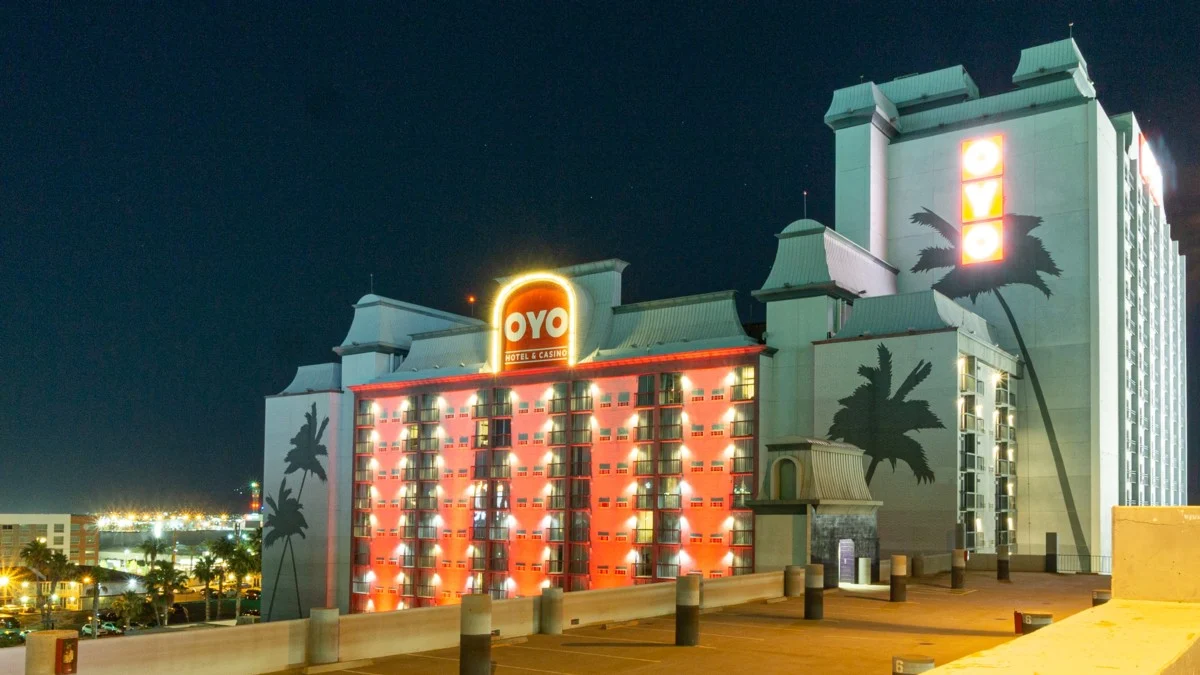
For the second time in a span of twelve months, the Oyo Hotel & Casino has abruptly halted all alcohol sales and service, thrusting the off-Strip property into the unprecedented and commercially precarious position of operating a Nevada gaming floor entirely devoid of liquor. The sudden suspension took effect at 9 a.m. on Friday, October 23, 2026, catching patrons, industry observers, and regulators by surprise.
According to reports initially published by the Las Vegas Review-Journal, the property ceased all distribution of alcoholic beverages without providing an official public rationale. In the absence of transparent corporate communication, industry insiders and investigative reports—including coverage by Casino.org’s Vital Vegas—have scrambled to piece together the root cause. While one anonymous casino employee attributed the dry spell to an abrupt lapse in insurance coverage, other sources close to the property pointed toward potential complications involving state and local tax compliance or municipal licensing renewals. As of publication, management at the Oyo has declined to address media inquiries, leaving its licensing status shrouded in ambiguity.
The development represents the latest in a relentless series of operational, legal, and public relations challenges for the boutique resort, which occupies prime real estate just steps away from the Las Vegas Strip. For a hospitality and gaming enterprise that relies heavily on beverage revenues to supplement casino floor margins, operating dry delivers an acute financial blow. More broadly, the incident compounds an already damaged brand reputation, arriving on the heels of controversial rebranding maneuvers, a major cyberattack, and a revolving door of third-party operators.
A Troubled Legacy on the Former Hooters Footprint
To understand the current plight of the Oyo, one must examine its turbulent evolution. Located at 115 E. Tropicana Ave., the property originally opened its doors as the San Rémo Hotel and Casino in 1973. Decades later, in 2006, the aging boutique resort was famously rebranded as the Hooters Casino Hotel, complete with orange-and-black branding, waitresses in signature uniforms, and a distinctively boisterous party atmosphere.
That era came to an end in August 2019, when a partnership led by Oyo Hotels & Homes and New York-based real estate investment firm Aarch Capital acquired the property for $135 million. Following a multi-million-dollar renovation, the venue was officially rechristened as the Oyo Hotel & Casino Las Vegas in September 2019.
Despite its strategic geographic footprint—situated directly adjacent to the massive construction site of the forthcoming Major League Baseball stadium for the relocating Oakland Athletics (formerly the Tropicana Las Vegas site)—the property has struggled to capture a stable market share. While the long-term land value of the parcel is widely projected to skyrocket once the stadium opens its gates, the day-to-day operations of the Oyo have been marred by continuous management friction and financial headwinds.
Chronology of a Cracking Foundation: The October 2025 Liquor Licensing Crisis
The current suspension of liquor sales bears a striking resemblance to a crisis that crippled the property almost exactly one year prior. In October 2025, the Oyo was forced to halt alcohol sales for approximately 10 days, plunging the resort into administrative chaos.
The root of that 2025 shutdown lay in a contentious corporate divorce. For years, the property’s hotel operations had been managed by Highgate, a prominent hospitality investment and management firm. Under the operational structure, Highgate held the primary master liquor license for the venue. However, relations between Oyo ownership and Highgate deteriorated rapidly following a catastrophic cybersecurity breach in January 2025.
That cyberattack compromised the sensitive personal and financial data of approximately 4,700 casino guests and employees. The security failure triggered widespread regulatory scrutiny and internal finger-pointing. Consequently, Oyo ownership severed its management agreement with Highgate.
The abrupt termination of the contract, however, brought an unintended administrative consequence: Highgate took its liquor license with it. Because Oyo leadership had failed to secure a seamless transition of the licensing framework prior to the split, the casino was legally barred from serving alcohol until emergency regulatory applications could be filed and processed by the Nevada Gaming Control Board and Clark County liquor licensing authorities. The resulting 10-day dry period served as an embarrassing harbinger of the administrative instability plaguing the property.
The Fake Hotel Listings Scandal
Compounding its operational woes, the Oyo found itself at the center of a bizarre digital deception scandal in August 2026. Global travelers browsing major online booking platforms—including Expedia and Booking.com—discovered that the Oyo was being marketed under entirely fictitious aliases, specifically "Palette Las Vegas" and "Collection O Las Vegas."

The revelation sparked immediate backlash across the Las Vegas tourism community. Consumer advocates and industry critics accused the property’s management of attempting to launder its digital reputation. By masking the Oyo brand behind benign, generic monikers, the resort was allegedly trying to distance itself from a persistent wave of dismal customer reviews, which routinely cited unclean rooms, lackluster amenities, and general property degradation.
Prism, the parent company overseeing Oyo, scrambled to contain the public relations disaster. Representatives issued a statement claiming that the altered listings were merely the preliminary byproduct of planned, forward-looking rebranding efforts and asserted that the mock-up pages should never have gone live before physical renovations were completed.
Yet, months after the scandal broke, no substantial physical renovations or official rebrandings have materialized. The property remains branded as the Oyo, burdened by the same online reputation that ownership seemingly attempted to evade.
A Revolving Door of Casino Operators
The persistent friction surrounding management standards and regulatory compliance has triggered substantial changes within the property’s corporate hierarchy. Most notably, reports surfaced in late summer 2026 indicating that Fifth Street Gaming was actively preparing to step in and assume casino operations at the Oyo.
Fifth Street Gaming, a well-established regional gaming operator known for managing off-Strip and neighborhood properties such as the Silver Nugget and the Emerald Island, was slated to replace Paragon Gaming, which had long overseen the casino floor operations. The transition, pending standard regulatory approvals from Nevada gaming authorities, was viewed by industry analysts as an emergency intervention designed to inject professional stability into a lagging gaming operation.
However, transitions in the highly regulated Nevada gaming ecosystem rarely occur overnight. The integration of a new casino operator requires meticulous background checks, financial disclosures, and the formal transfer of gaming licenses—a bureaucratic process that can leave properties vulnerable to operational gaps during executive handovers. Whether the sudden October 2026 loss of liquor sales is directly connected to this ongoing transition of casino operators remains a central question for gaming attorneys and regulatory observers.
Economic and Regulatory Implications of a Dry Casino
In the hyper-competitive ecosystem of Las Vegas tourism, a casino operating without the ability to serve alcohol faces a severe economic handicap. The business model of modern casino resorts relies heavily on vertical integration—using low-margin gaming floors to drive high-margin food, beverage, and entertainment revenues.
Offering complimentary drinks to active gamblers is a time-tested retention strategy designed to keep patrons engaged on slot machines and table games. When a casino is forced to turn off its taps, players quickly migrate to competing properties down the street. For a venue like the Oyo, which already struggles to attract high-value tourists, losing the ability to serve alcoholic beverages functions as an immediate repellent to foot traffic.
Furthermore, the recurring nature of these regulatory and operational failures invites intense scrutiny from state authorities. The Nevada Gaming Control Board and the Clark County Liquor and Gaming Licensing Board maintain stringent standards regarding corporate fitness, administrative competence, and regulatory compliance. Repeated failures to maintain basic operational licenses—whether related to liquor, security, or corporate governance—can trigger formal disciplinary complaints, heavy financial penalties, or, in extreme cases, jeopardize the validity of the property’s restricted and unrestricted gaming licenses.
The Road Ahead: High Stakes Near the Future Stadium
As the Oyo navigates its second major liquor crisis in twelve months, the broader narrative surrounding the property remains one of immense, unrealized potential juxtaposed against relentless operational dysfunction.
Situated directly across from the multi-billion-dollar stadium project destined to house the Athletics, the Oyo sits upon some of the most coveted dirt in Southern Nevada. Real estate experts project that when the stadium opens, surrounding land values and commercial demand will surge exponentially, transforming the immediate vicinity into a bustling sports and entertainment district.
Whether the current ownership group—or any prospective future buyer—can right the ship before that economic windfall materializes remains to be seen. For now, patrons walking onto the Oyo casino floor must navigate an environment stripped of one of hospitality’s most fundamental amenities, serving as a glaring symbol of a resort caught in perpetual transition.
