

Security researchers have uncovered two severe security vulnerabilities within OpenAI’s Codex AI coding agent, highlighting the ongoing challenges of securing autonomous artificial intelligence tools. The flaws, designated "Heapjack" and "Overpatch," allowed malicious actors to completely bypass Codex’s protective isolation boundaries. Most alarmingly, the more critical of the two exploits enabled an attacker to achieve unprompted, silent remote code execution on a developer’s local machine simply by having the developer open a compromised code repository within the agent.
Discovered by Oren Yomtov of security firm Accomplish AI, the vulnerabilities underscore a systemic architectural pitfall common in modern AI development assistants: relying on internal mechanisms to enforce boundaries that can be manipulated from within the sandbox environment itself. Following a responsible disclosure made on August 12, OpenAI moved swiftly to remediate both issues, pushing out patches across its desktop and command-line interfaces within an eight-day window. Nevertheless, the incident has reignited industry-wide conversations regarding the inherent safety risks of running automated code-generation agents in local developer environments.
Mechanics of the Heapjack Exploit
The more sophisticated and dangerous of the two vulnerabilities, dubbed Heapjack, specifically targeted the desktop iteration of OpenAI Codex. The attack vector focused on a background component known as node_repl, which Codex Desktop automatically installs into the user’s global configuration directory (~/.codex/config.toml) during the initial setup process. Crucially, this component is deployed by default without requiring explicit user opt-in, meaning that standard users of the Codex Command Line Interface (CLI) inherit the exact same underlying architecture and associated risks.
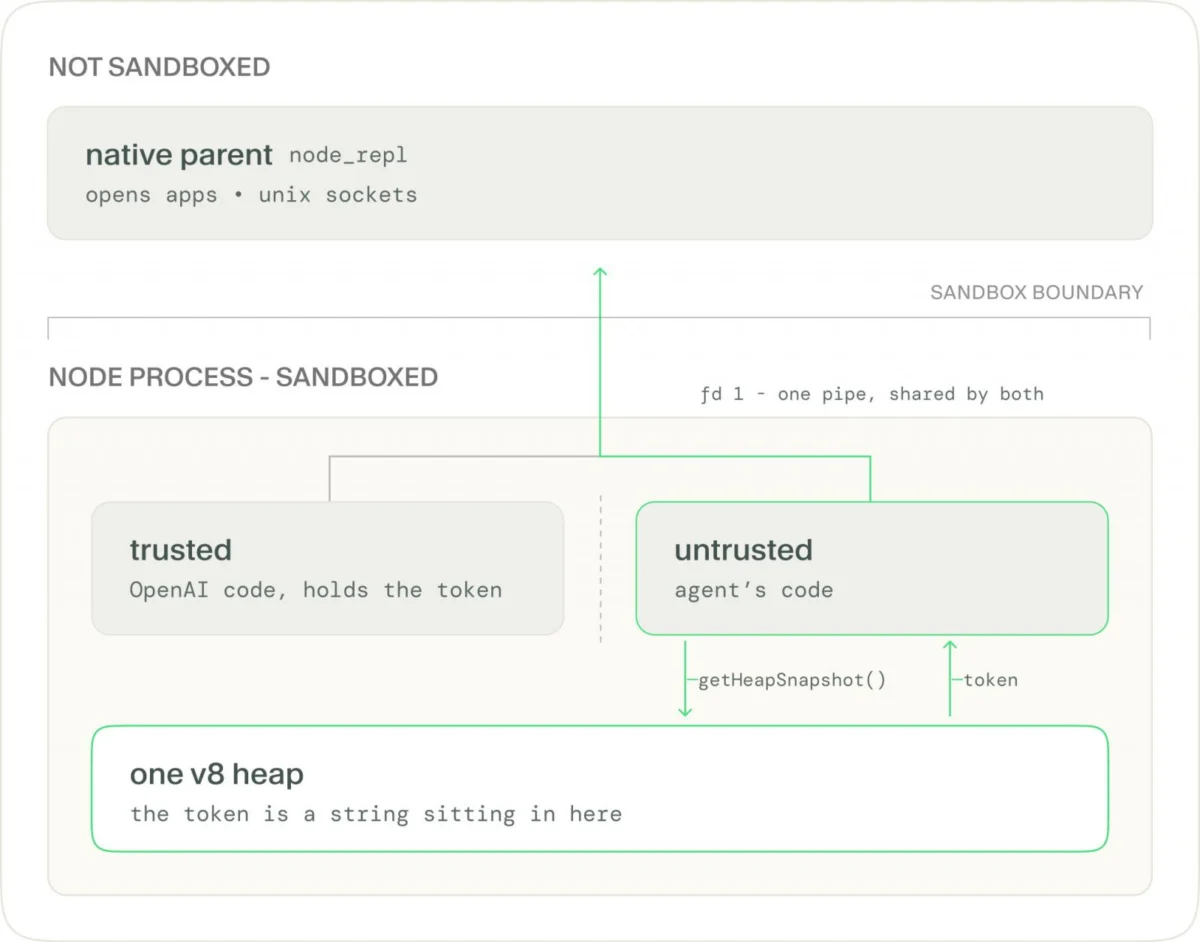
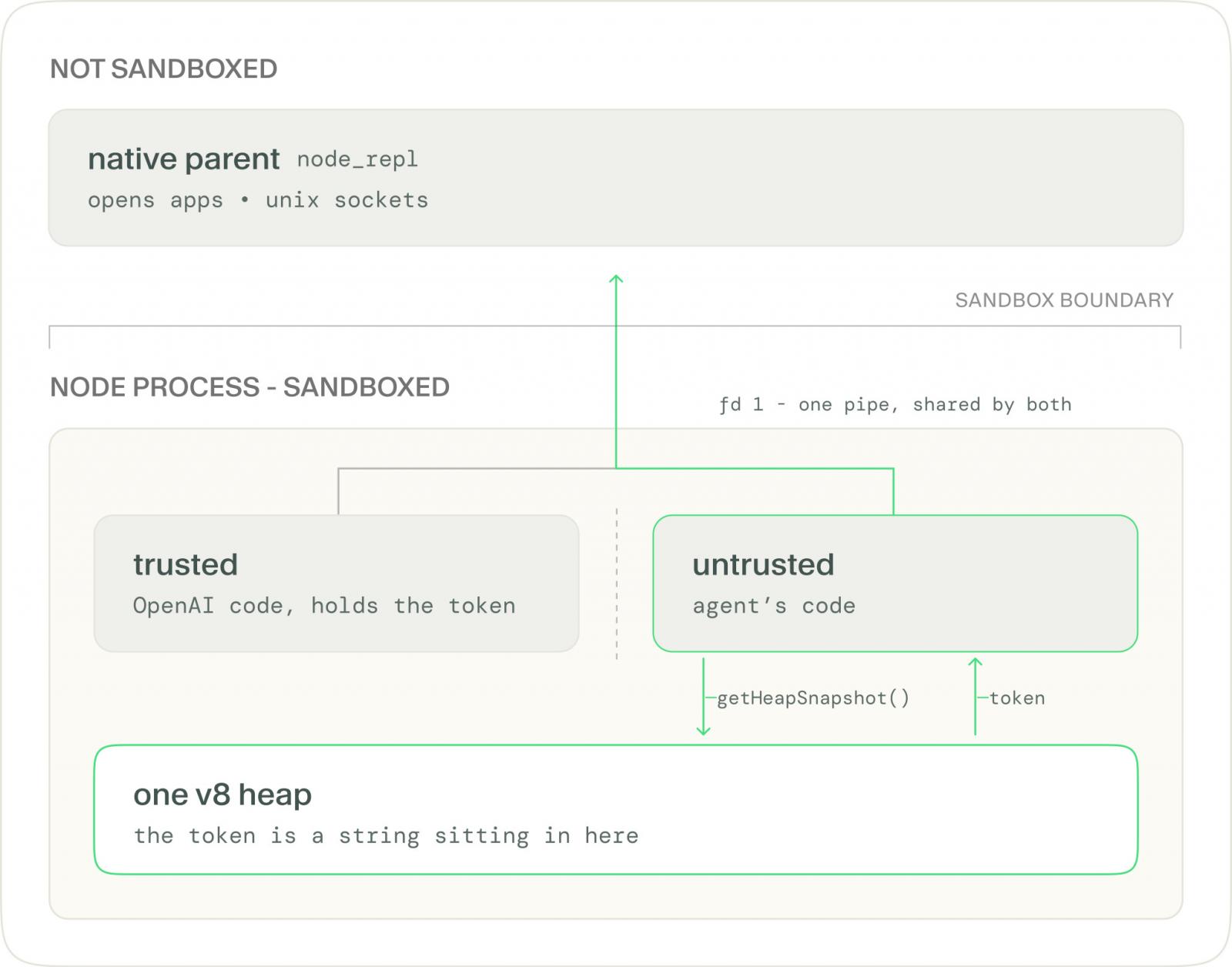
The node_repl utility operates by spinning up a single Node.js process that simultaneously hosts two distinct JavaScript execution contexts: a trusted context containing OpenAI’s core codebase, and an untrusted context designed to execute agent-driven actions. To prove its legitimacy, the trusted context relies on a cryptographically random authorization token generated dynamically every time the application starts up.
However, because both the trusted and untrusted contexts reside within the exact same Node.js process and share a common memory heap, this security token is effectively exposed. Yomtov’s research demonstrated that untrusted code could easily bypass this logical barrier by capturing a snapshot of the memory heap using the native v8.getHeapSnapshot() function.
By scanning the heap snapshot for strings matching the format of a UUID, the untrusted code could pinpoint the authorization token. The exploit script then tested potential strings by making targeted validation calls. While a completely incorrect guess yielded a "not authorized" message, a correct token paired with an invalid argument triggered a standard validation error, confirming to the attacker that the token had been successfully harvested.
Armed with the valid authentication token, the untrusted script could forge requests and transmit them across the internal communication pipe normally reserved for the trusted context to speak with the parent, unsandboxed system process. In their proof-of-concept demonstration, the researchers leveraged this capability to invoke the operating system’s native open command, seamlessly launching applications completely outside the Codex process tree. This level of access theoretically grants malicious payloads the ability to interact with any available Unix socket—such as a Docker daemon socket—or modify core configuration files, all while operating under Codex’s strictest "read-only" security profile where file system modifications are supposedly prohibited.
The Overpatch Vulnerability and Workspace Escape
While Heapjack targeted memory sharing in the desktop application, the second vulnerability, named Overpatch, exploited a logic flaw within the open-source Codex CLI tool. Under normal operational parameters, when Codex is set to workspace-write mode, the agent is strictly confined to making modifications within the designated project folder. Any attempt by the AI to issue shell commands or write files to external directories—such as the user’s home directory—is automatically blocked by the platform’s safety guardrails.
The Accomplish AI research team discovered a way to weaponize Codex’s own patch-application utility, known as apply_patch, to subvert these boundaries. The vulnerability stemmed from how the tool calculated directory permissions based directly on input provided within the patch itself. Specifically, the utility granted write access to the parent folder of every file path explicitly declared in the patch.
By strategically formatting a patch to include a reference to the generic /tmp directory, the tool inadvertently expanded the agent’s write permissions to cover the root of the entire disk. The functional exploit utilized a dual-action patch: the first change targeted /tmp solely to widen the scope of permitted writes, while the second change utilized a symlink pointing directly into the developer’s home directory to append malicious code into the .zshrc shell configuration file.
If the first directory-widening instruction was removed, the write attempt was successfully denied. When included, however, the modification quietly persisted, ensuring that the next time the developer opened a terminal window, the injected payload would execute automatically with full user privileges, entirely outside the intended sandbox environment.
Chronology and Remediation
The timeline of discovery and patching highlights both the speed of modern vulnerability research and the urgency of vendor response:
- August 12: Security researchers at Accomplish AI formally report both the Heapjack and Overpatch vulnerabilities to OpenAI through responsible disclosure channels.
- August 14–19: OpenAI security engineers analyze the exploit vectors, validate the root causes related to shared memory heaps and path-permission logic, and begin developing targeted patches.
- August 20: OpenAI officially remediates both flaws, closing the eight-day disclosure-to-patch lifecycle.
- Post-August 20: Updates are pushed to the public. OpenAI fixes the Heapjack vulnerability in Codex Desktop build
26.818.21641and resolves the Overpatch issue in Codex CLI version0.149.0.
Industry observers have widely praised the rapid turnaround time demonstrated by OpenAI, noting that a resolution achieved within eight days significantly minimizes the window of exposure for active development teams. Security agencies and independent researchers continue to urge all active users of OpenAI Codex to verify their local installations and immediately upgrade to the patched versions or later iterations.
Broader Industry Implications and the Illusion of the Sandbox
The disclosure of Heapjack and Overpatch has reignited intense debate among software security professionals regarding the inherent limitations of software sandboxes when applied to generative artificial intelligence agents. Both bugs share a fundamental architectural flaw: the security enforcement mechanism was embedded directly within the environment it was designed to police. In the case of Heapjack, the trust boundary relied on memory isolation within a single runtime instance; in the case of Overpatch, the permission validator relied on input supplied by the untrusted agent itself.
This incident is far from an isolated event. Earlier in July 2026, researchers from Pillar Security published findings detailing a widespread class of sandbox escapes affecting multiple leading AI coding assistants, including Cursor, Gemini CLI, and Google’s Antigravity platform. In those scenarios, security analysts demonstrated that AI agents capable of operating within restricted local boundaries could still generate and write specific files that would subsequently be executed by trusted, privileged tools operating outside the sandbox ecosystem.
Commenting on social media platforms following the publication of Yomtov’s research, cybersecurity analysts dissected the architectural realities of modern runtime environments. One expert noted that standard V8 JavaScript contexts are fundamentally engineered to isolate global variables rather than underlying system memory, characterizing the Codex sandbox setup as "a promise the heap never agreed to." Another analyst derisively compared the software’s internal trust boundary to a flimsy "room divider," questioning why high-privilege administrative tokens were permitted to reside within a memory space accessible to untrusted agent logic in the first place.
As organizations increasingly integrate autonomous AI coding agents into enterprise software development pipelines, these vulnerabilities serve as a stark reminder of the attack surfaces introduced by autonomous software tools. Unlike traditional static libraries, AI agents actively interpret untrusted external data—such as third-party code repositories downloaded from public open-source registries—and execute dynamic logic locally.
Security experts emphasize that securing the next generation of developer tooling will require a fundamental shift away from logical software partitions running on shared hardware processes. Instead, true defense-in-depth for AI agents will likely necessitate strict hardware-level virtualization, containerization, and immutable privilege separation to ensure that a compromised workspace can never translate into systemic command execution across a developer’s local machine or corporate network.
