

LG Electronics USA has announced a significant policy shift regarding its smart TV ecosystem, stating its intention to suspend all applications built for its webOS platform that transform consumer televisions into "always-on" residential proxy nodes. This decisive action follows a series of investigative reports revealing that a substantial portion of the games and utilities available on the LG webOS store contain hidden or poorly disclosed software components that allow third parties to route internet traffic through the user’s home network. The move highlights an emerging battleground in the world of Internet of Things (IoT) security, where household appliances are increasingly being leveraged as infrastructure for global proxy networks, often without the informed consent of the device owners.
The controversy gained momentum in early July 2024, following the release of a comprehensive study by the cybersecurity firm Spur.us. The research examined the prevalence of residential proxy Software Development Kits (SDKs) within the app ecosystems of major smart TV manufacturers. According to the findings, more than 42 percent of apps available for download on LG’s webOS store were found to include these SDKs. These components essentially turn a television into a proxy node indefinitely, allowing external entities to use the television’s IP address to mask their own activities. The study further noted that while the issue was most prevalent on LG devices, it was not unique to them; more than 25 percent of applications developed for Samsung’s Tizen operating system were found to contain similar residential proxy components.
Understanding Residential Proxies and the "Proxyware" Economy
To understand the gravity of LG’s decision, it is necessary to examine the mechanics of residential proxy networks. A residential proxy is an intermediary that uses an IP address assigned by an Internet Service Provider (ISP) to a homeowner. Unlike data center proxies, which are easily identified and blocked by websites, residential proxies appear to be legitimate domestic traffic. This makes them highly valuable for various activities, ranging from benign tasks like price aggregation and market research to more controversial uses such as bypassing geographic restrictions on streaming services, automated "sneaker bot" purchasing, and web scraping.
In the "proxyware" economy, app developers looking to monetize their creations without relying solely on traditional advertising can partner with residential proxy providers. These providers offer SDKs that developers embed into their apps. In exchange for a fee paid to the developer, the app converts the user’s device—be it a smartphone, a computer, or, in this case, a smart TV—into a node in the provider’s network. When the app is running (and sometimes even when it is in the background), the proxy provider can rent out the device’s bandwidth to its customers.
For the end-user, the presence of these SDKs often remains hidden behind a wall of technical jargon or buried within long-winded Terms of Service agreements. In some instances, users are presented with a choice: pay for a "pro" version of an app, view frequent advertisements, or "share" their idle internet resources to keep the app free. Many users, unaware of the security and privacy implications, opt for the latter, effectively turning their home network into an open gateway for unknown third-party traffic.
The Spur.us Investigation: Alarming Statistics for Smart TV Users
The research conducted by Spur.us shed light on the scale of this practice within the smart TV sector. By analyzing thousands of applications, researchers identified that residential proxy SDKs were bundled with a wide variety of software, ranging from simple arcade games like "Pac-Man" clones to functional tools like screensavers, weather apps, and file management utilities.
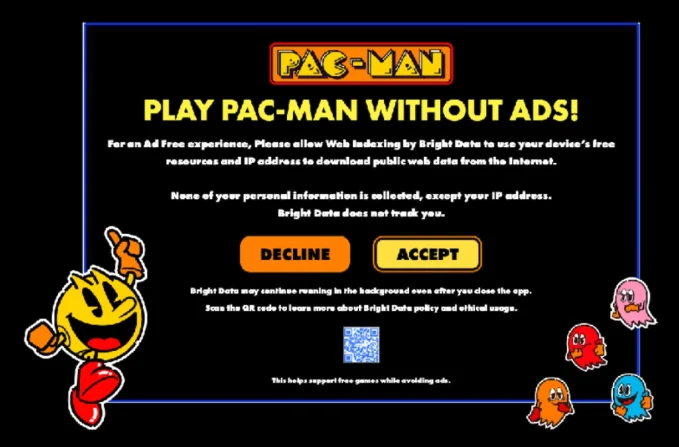
One of the most striking examples highlighted in the report was a "Pac-Man" style game which, upon launch, presented users with a binary choice. Users could either agree to view advertisements or allow their TV to serve as a residential proxy node for a provider known as Bright Data. While the prompt offered a semblance of consent, security experts argue that such prompts are often misleading.
"A one-time consent prompt buried in a TV app is not a substitute for meaningful transparency, ongoing control, and platform oversight," wrote Trevor Sutter of Spur.us. He emphasized that the risk is particularly high in a household environment where a minor or a non-technical family member might click "Accept" without understanding that they are compromising the security of the entire home network.
Official Response from LG Electronics
In response to the findings published by Spur.us and subsequent inquiries from cybersecurity journalists, LG Electronics took a firm stance against the integration of proxy SDKs. John Taylor, Senior Vice President at LG Electronics USA, clarified that residential proxy networking is not an intended or supported use for LG smart TVs.
"LG Electronics is working with developers to remove the residential proxy option from their apps on the webOS platform," Taylor stated. He further warned that developers who fail to comply with these new directives would face the immediate suspension of their applications from the webOS store. Taylor confirmed that a comprehensive review of the existing app library is currently "well underway," and that the company is committed to preventing these SDKs from infiltrating the platform in the future.
This move by LG represents one of the first major interventions by a hardware manufacturer against the proxyware industry. By auditing developer-submitted apps more rigorously, LG aims to enhance platform quality and ensure that the user experience is not degraded by unauthorized background processes that could potentially slow down internet speeds or expose users to legal and security risks.

The Defense from Residential Proxy Providers
The companies that facilitate these networks, such as Bright Data, have defended their business models by emphasizing transparency and the "value exchange" they offer to users. Bright Data, which was identified by Spur.us as the most prevalent proxy provider across both LG and Samsung platforms, issued a statement asserting that its network is built on the principles of consent and responsibility.
"Every peer opts in through a dedicated screen and receives value in return; every customer is vetted, and our practices have now undergone a second independent audit by PwC," the company stated. Bright Data maintains that its services are used by legitimate businesses and researchers to access public data and that they incorporate technological countermeasures to ensure that proxy customers cannot interact with or control other devices on the user’s local network.
Despite these assurances, the cybersecurity community remains skeptical. The primary concern is that even if a proxy provider attempts to vet its customers, the sheer volume of traffic makes it difficult to prevent all malicious activity. Furthermore, once a device is established as a proxy node, it becomes a target for hackers who may attempt to exploit the proxy software itself to gain deeper access to the host’s private network.
Security Implications and the Risk to Local Networks
The security risks associated with turning a smart TV into a proxy node are manifold. Smart TVs are often the "weakest link" in a home network; they frequently lack the robust security updates and antivirus software found on PCs and smartphones. If a proxy SDK contains a vulnerability, or if the proxy provider’s infrastructure is compromised, an attacker could potentially use the TV as a foothold to move laterally across the network, targeting sensitive devices like home servers, laptops, or security cameras.
There is also a significant concern regarding IP reputation. If a third party uses a homeowner’s IP address to engage in illegal activities—such as launching cyberattacks, distributing copyrighted material, or accessing illicit content—the homeowner’s IP address may be flagged or blacklisted by security services and law enforcement. This can lead to the homeowner being blocked from legitimate websites or, in extreme cases, facing legal scrutiny for actions they did not commit.
Chronology of Recent Security and Privacy Developments
The crackdown on proxyware is part of a broader timeline of increasing scrutiny over how smart device manufacturers manage user data and third-party software:
- January 2024: Security researchers identify the "Kimwolf" botnet, which specifically targets IoT devices to build a massive proxy infrastructure for cybercriminal activity.
- Early July 2024: Spur.us releases its report on the prevalence of residential proxy SDKs in smart TV apps, naming LG and Samsung as the primary platforms affected.
- Mid-July 2024: LG Electronics USA issues its first public statement regarding the suspension of proxy-enabled apps, initiating an audit of the webOS store.
- Late July 2024: Major proxy providers, including Bright Data, defend their practices, citing independent audits and "opt-in" mechanisms.
- Ongoing: LG continues its review process, with several developers reportedly already receiving notices to update or remove their applications.
Wider Impact on the IoT Ecosystem and Consumer Privacy
LG’s decision may set a precedent for other manufacturers in the IoT space. As smart home devices—from refrigerators to thermostats—become more computationally powerful, they become more attractive to proxy providers and botnet operators. The incident highlights the need for stricter industry standards regarding what types of background processes are permissible on consumer devices.
Furthermore, this situation underscores the "hidden costs" of free software. As the digital economy shifts away from traditional advertising due to increased privacy regulations and ad-blocker usage, developers are seeking alternative revenue streams. The use of proxyware represents a shift toward monetizing the user’s hardware and bandwidth, often without the user fully grasping the trade-off.
Pattern of Software Overreach: The McAfee Monitor Controversy
While LG’s move to protect smart TV users has been largely praised by security experts, the company has recently faced criticism for other software-related practices. Recently, reports emerged from tech outlets such as Gamers Nexus regarding LG’s high-end LCD monitors. It was discovered that certain LG monitors automatically trigger the installation of a McAfee security app on connected Windows PCs via Windows Update, without a clear approval prompt from the user.
This practice, often referred to as "bloatware" or "crapware," has sparked frustration among consumers who feel that their hardware should not serve as a delivery vehicle for third-party paid subscriptions. The juxtaposition of LG’s proactive stance on TV proxyware and its aggressive promotion of McAfee on monitors suggests a complex and sometimes contradictory approach to software partnerships and user experience.
As LG moves forward with its audit of the webOS store, the tech industry will be watching closely to see if other manufacturers, particularly Samsung, follow suit. For now, the message to developers is clear: the era of using smart TVs as silent conduits for global internet traffic is coming to an end. For consumers, the situation serves as a reminder to be cautious of "free" apps and to remain vigilant about the permissions granted to every "smart" device in the home.
