


BRITISH VIRGIN ISLANDS — In a significant structural evolution within the decentralized finance (DeFi) sector, Jumper, a prominent consumer application for cross-chain asset movement and trading, has officially announced its transition into an independent corporate entity. Alongside this corporate restructuring, the platform has revealed plans for its inaugural JUMP token sale, hosted through the Legion fundraising launchpad.
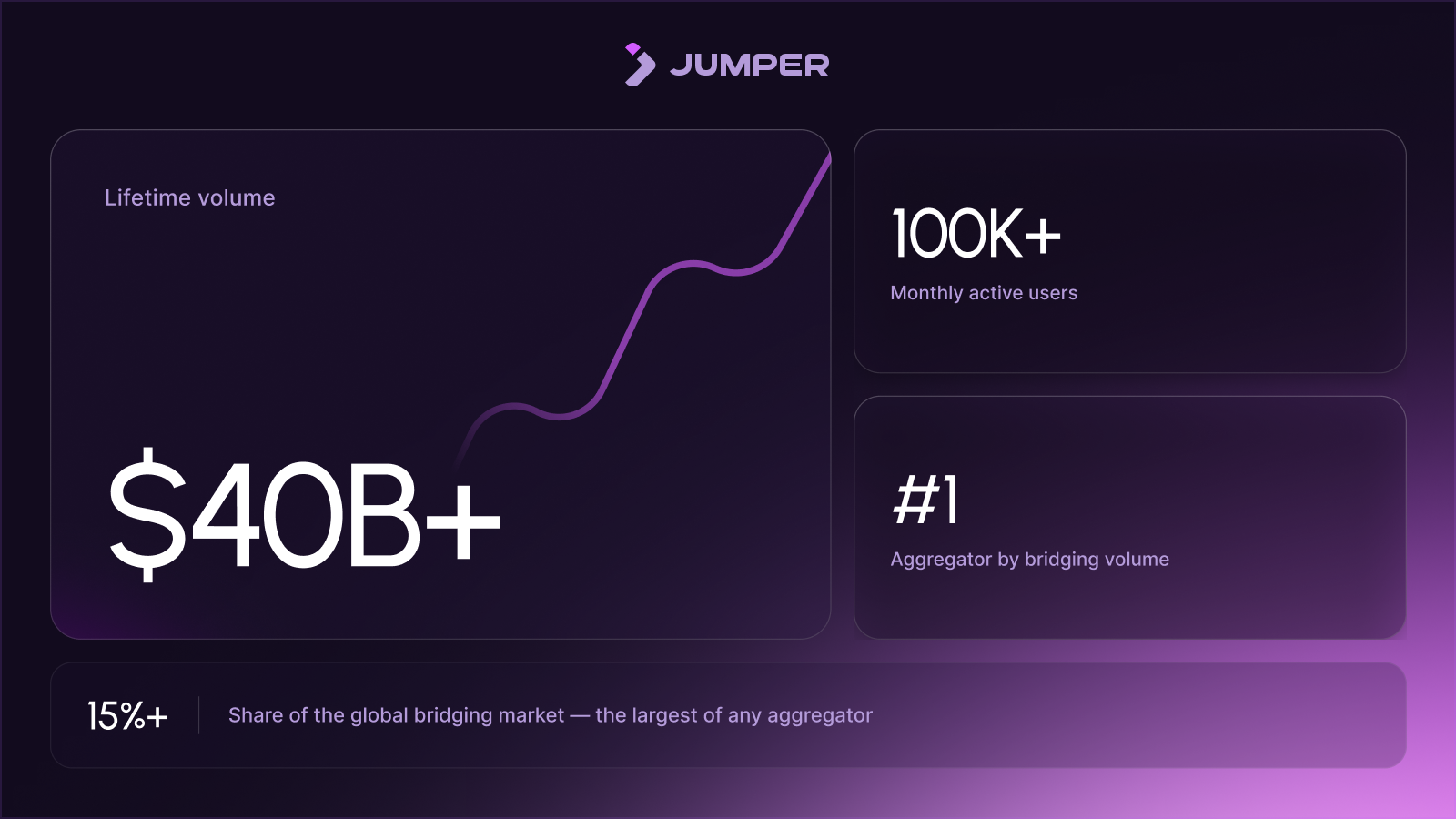
The strategic separation marks a major milestone for the protocol, which was originally incubated within LI.FI. Having established itself as a dominant force in cross-chain liquidity aggregation, Jumper enters its next phase of commercial growth backed by impressive operational metrics, including more than $40 billion in cumulative lifetime volume and over 100,000 monthly active users.
By carving out a distinct organizational roadmap, dedicated leadership team, and independent capital structure, Jumper aims to transition from a leading bridging utility into a comprehensive super-app for onchain finance. This expansion intends to unify fragmented liquidity venues, advanced trading instruments, and real-world assets (RWAs) into a single, cohesive user interface.
Evolution from a Bridging Protocol to an Onchain Financial Super-App
Since its inception, Jumper has operated under the umbrella of LI.FI, functioning primarily as a user-facing front-end that leveraged LI.FI’s underlying cross-chain orchestration infrastructure. Over the operational lifecycle of the product, Jumper captured substantial market share, ultimately securing its position as the leading aggregator by bridging volume, commanding over 15% of the total market sector.
However, leadership recognized that the long-term trajectory of decentralized finance extends far beyond basic token bridging. As traditional financial assets, equities, and alternative instruments increasingly migrate onto public blockchains, the demand for unified, asset-centric execution layers has grown exponentially.
Marko Jurina, Chief Executive Officer of Jumper, emphasized the strategic shift in the platform’s core mandate. "Bridging was the starting point for Jumper, and we’ve grown into the #1 aggregator by bridging volume with more than 15% market share," Jurina stated. "As more financial assets move onchain, the opportunity gets much bigger than bridging. We want Jumper to become the application users open whenever they want to trade, invest, or move value onchain."
To actualize this vision, the platform’s product architecture has progressively expanded to incorporate diverse financial verticals. Beyond standard token swaps and cross-chain routing, Jumper currently facilitates yield generation strategies and supports asset discovery across a wide spectrum of tokens, spanning major cryptocurrencies, speculative memecoins, and tokenized real-world assets such as equities.
Upcoming Launch of Jumper Perps and Advanced Trading Infrastructure
A central pillar of Jumper’s growth strategy as an independent entity is the diversification of its product suite. In the coming weeks, the platform is scheduled to launch Jumper Perps, a decentralized trading product designed to aggregate multiple perpetual futures venues into a unified user experience.
The introduction of perpetual futures trading represents a crucial strategic inflection point for the protocol. By consolidating fragmented derivatives liquidity into a single interface, Jumper expects to capture higher-value trading volume, generate diversified revenue streams, and significantly increase user retention. For active traders, the integration eliminates the friction of navigating multiple margin accounts, decentralized exchanges (DEXs), and disparate blockchain networks.
Each newly integrated vertical reinforces the platform’s overarching utility, driving sustained transaction volume and reinforcing Jumper’s position as a central hub for decentralized economic activity.
Structural Independence and the LI.FI Relationship
The formal split between Jumper and LI.FI represents a deliberate organizational design intended to optimize operational focus. Moving forward, the two entities will operate independently while pursuing complementary objectives across the blockchain technology stack.
LI.FI will continue to concentrate on foundational orchestration infrastructure, providing the underlying cross-chain routing intelligence and developer tools necessary to connect disparate blockchain networks. Conversely, Jumper will focus exclusively on the consumer-facing application layer, optimizing the user experience, driving retail and institutional adoption, and expanding its suite of financial products.
This division of labor allows each organization to specialize in its core competencies. While LI.FI scales its business-to-business (B2B) infrastructure services to other developers and protocols, Jumper will dedicate its capital and engineering resources to consumer acquisition and interface refinement.
The Legion Token Sale and Token-First Ownership Model
To fund its next phase of expansion, Jumper has selected Legion as the launchpad for its upcoming JUMP token sale. The proceeds generated from the token offering will be directly allocated toward accelerating product development, scaling user acquisition initiatives, and expanding market distribution across the platform’s ecosystem.
Notably, the capital-raising structure eschews traditional equity financing rounds in favor of a unified token-first model. Jumper has made a conscious decision not to conduct a concurrent equity sale alongside the JUMP token offering. Under this framework, users, ecosystem contributors, and financial backers will hold the exact same asset class, effectively eliminating the structural divide that often separates equity holders from tokenholders in crypto-native ventures.
Elaborating on this governance and economic philosophy, CEO Marko Jurina underscored the importance of aligning stakeholder incentives directly with the underlying business protocol.
"We believe the token should be the only way to have ownership and exposure to the value being created by Jumper," Jurina noted. "There shouldn’t be one group holding equity and another group holding a token. JUMP is intended to be the only way users, contributors, and investors participate in Jumper’s growth, so the value created by Jumper is aligned with tokenholders."

Jurina further challenged conventional venture capital structures within the blockchain industry, advocating for a broader cultural shift toward inclusive economic participation.
"Getting here has meant pushing against a lot of incumbent processes and thinking that still treat the token as something separate from the underlying business," Jurina added. "We think that model needs to change. If crypto is serious about creating new forms of ownership, the people who use, support, and build these businesses should be able to participate directly in the value they help create. We want Jumper to be at the forefront of that shift. We believe token-first ownership should become an industry standard, and we want to help lead that change."
Market Implications and Future Outlook
The transition of Jumper into an independent corporate structure and the impending launch of the JUMP token arrive at a critical juncture for the decentralized finance sector. As the total value locked (TVL) across layer-1 and layer-2 networks continues to expand, user acquisition has increasingly shifted toward platforms capable of abstracting away the inherent complexities of blockchain interoperability.
By unifying cross-chain bridging, perpetual futures, yield optimization, and real-world asset trading into a single interface, Jumper addresses a primary point of friction for modern market participants: platform fragmentation.
Industry analysts note that consumer applications successfully executing the super-app model frequently capture outsized network effects. By streamlining asset discovery and execution across multiple networks, Jumper positions itself to capitalize on the ongoing institutional and retail adoption of onchain financial markets.
The success of the forthcoming Legion token sale will serve as an initial benchmark for market appetite regarding Jumper’s token-first ownership thesis. If the model proves effective, it could establish a precedent for how future blockchain-native enterprises structure capitalization and community alignment.
Additional updates regarding the JUMP token generation event, exact launch dates for Jumper Perps, and ecosystem participation guidelines are expected to be released by the Jumper team in the coming weeks through official communication channels and the platform’s web portal.
