

The landscape of global cybersecurity is undergoing a profound and potentially perilous transformation as artificial intelligence increasingly dictates the pace, scale, and nature of software vulnerability discovery. According to comprehensive research published on September 30, 2026, by the Google Threat Intelligence Group (GTIG), vulnerabilities uncovered with the assistance of artificial intelligence are disproportionately severe, showing a dramatic propensity to enable remote code execution (RCE). This alarming trend coincides with a staggering overall acceleration in vulnerability disclosures and active cyber exploitation throughout the first eight months of 2026, forcing security professionals, enterprise defenders, and software vendors to reevaluate their defensive postures against automated threats.
The GTIG findings illuminate a rapidly shifting paradigm where threat actors and security researchers alike harness autonomous agents and machine learning pipelines to parse complex software architectures. While the integration of artificial intelligence into vulnerability research was once viewed as a speculative horizon, the empirical data from 2026 demonstrates that AI is now an active, high-impact force reshaping the digital threat theater. The implications extend far beyond traditional code auditing, touching upon critical infrastructure security, enterprise patch management cycles, and the fundamental economics of offensive and defensive cyber operations.
The Scope of the Surge: Disclosures and Exploitation Accelerate
To understand the current state of cybersecurity, one must examine the sheer volume of security flaws entering the public domain in 2026. The data compiled by Google’s threat researchers reveals an unprecedented expansion in vulnerability disclosures. In January 2026, the global security community processed 5,045 vulnerability disclosures. By July of the same year, that monthly figure had more than doubled, reaching 10,477 disclosures, before climbing further to 10,740 disclosures in August.
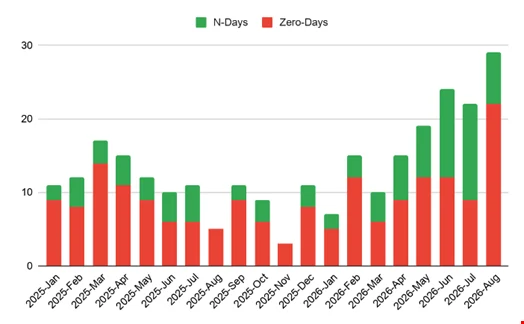
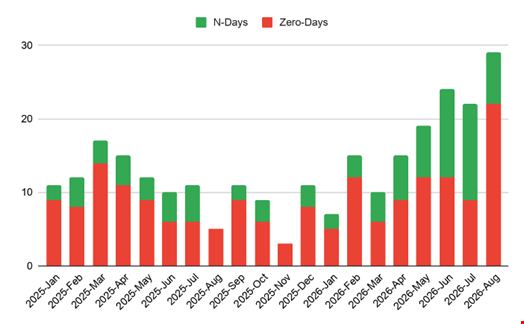
This dramatic uptick in reported flaws is mirrored by an intensification of active exploitation in the wild. In 2025, security teams observed an average of 10.5 exploited vulnerabilities per month. However, that figure escalated sharply during the first eight months of 2026, rising to an average of 18 exploited vulnerabilities per month.
Interestingly, the trajectory of zero-day exploits—vulnerabilities attacked before the vendor is aware or has issued a patch—remained relatively stable for much of the period. Zero-day exploitation rose only marginally from a baseline of eight to 11 instances per month. Nevertheless, August 2026 saw a notable spike, with zero-day exploits jumping to 22. GTIG analysts suggest that the broader growth in active exploitation stems primarily from the rapid, AI-assisted weaponization of n-day vulnerabilities (known flaws with existing patches). Automated tools capable of rapidly analyzing software patches, reverse-engineering updates, and synthesizing proof-of-concept exploit code have enabled malicious actors to bridge the gap between disclosure and exploitation faster than ever before.
The AI Factor: Remote Code Execution and Risk Distribution
The most striking revelation from the GTIG research centers on the specific nature of AI-discovered vulnerabilities. When comparing flaws identified through likely AI-assisted methods against traditional vulnerabilities (CVEs), the risk profiles diverge significantly.

According to GTIG, a staggering 50% of vulnerabilities identified as likely discovered by AI resulted in remote code execution (RCE) capabilities. In stark contrast, only 26% of non-AI-attributed CVEs carried the same severe consequence. Remote code execution remains one of the most perilous classes of software flaws, granting unauthorized external actors the ability to execute arbitrary commands or code on a target system, often leading to total compromise.
Furthermore, the research shed light on the risk ratings of AI-discovered flaws, categorized using GTIG’s internal metrics rather than standard CVSS scores. Between January and August 2026, medium-risk flaws accounted for 58% of likely AI-discovered vulnerabilities, compared to just 28% for non-AI discoveries. Conversely, low-risk flaws made up 39% of AI-associated findings, contrasted with 69% for traditional discoveries.
Google’s analysis indicates that this distribution is not accidental. Rather, it reflects the deliberate deployment strategies of security researchers and threat actors utilizing autonomous agents. Instead of deploying broad, noisy automated scans that typically unearth low-risk syntax errors or minor bugs, operators are increasingly pointing sophisticated AI agents at critical infrastructure, high-value enterprise applications, and complex enterprise software architectures. Google also noted that public data likely undercounts the true volume of AI-discovered vulnerabilities, as many organizations and researchers quietly remediate findings before public disclosure.
Real-World Case Studies: The Acceleration of N-Day Exploitation
While Google characterized confirmed exploitation of AI-discovered flaws as an early indicator rather than a fully entrenched systemic trend, tangible examples underscore the reality of the threat. A prominent case cited by GTIG is CVE-2026-1731, an unauthenticated command injection vulnerability affecting BeyondTrust Privileged Remote Access and Remote Support solutions.
This specific flaw was discovered autonomously by Hacktron AI. The discovery process highlighted the speed at which machine-driven research can outpace human defensive reactions. Following the public disclosure of CVE-2026-1731, threat actors moved with exceptional velocity. One distinct cyber threat cluster initiated active exploitation of the flaw within a mere four days of disclosure. Within seven days of the initial sighting, five additional threat groups had adopted the exploit into their operational arsenals. This rapid aggregation of diverse threat actors targeting a single AI-uncovered flaw serves as a cautionary tale for modern security operations centers.
Orchestration Tools, Edge Devices, and Perimeter Vulnerabilities
Beyond general software flaws, GTIG tracked more than 1,500 AI-related vulnerabilities specifically disclosed throughout 2026. This subset of vulnerabilities highlights the unique security debt introduced by the rapid proliferation of artificial intelligence technologies themselves.
Agent orchestration frameworks accounted for the lion’s share of these AI-specific flaws, with 782 reported instances. Meanwhile, AI inference and serving infrastructure accounted for an additional 212 vulnerabilities. Notably, nearly a quarter of these infrastructure flaws involved unauthenticated APIs or server-side request forgery (SSRF), presenting attractive entry points for network intruders. While only a small fraction of these AI infrastructure vulnerabilities have been confirmed as actively exploited—and zero-day exploitation of AI infrastructure remains unobserved by GTIG—the sheer volume of exposed attack surface is concerning.
Despite the focus on AI, physical and logical perimeter security remains a primary battleground. GTIG data indicates that overall cyber exploitation in 2026 remains heavily concentrated at the network edge. Edge and security appliances accounted for 14% of all exploited vulnerabilities during the year, and more than 65% of those perimeter flaws were rated as high or critical risk.
This trend was further emphasized by recent events involving Citrix NetScaler products. Citrix issued critical patches to address two exploited zero-day vulnerabilities in its NetScaler appliances, flaws that GTIG and Mandiant actively tracked in ongoing malicious campaigns. Commenting on the urgency of the situation, Charles Carmakal, Chief Technology Officer at Mandiant, emphasized the limitations of traditional patching in the face of sophisticated intrusion sets. Writing on LinkedIn on September 27, Carmakal advised, "Given the active exploitation, NetScaler customers should prioritize examining their systems for compromise before upgrading/patching. Patching alone may not eradicate the threat actor from your environment."
Implications and the Future of Defensive Cybersecurity
The findings presented by the Google Threat Intelligence Group mark a critical turning point in the ongoing cyber arms race. As artificial intelligence matures, its dual-use nature becomes increasingly pronounced. On one hand, defensive organizations utilize machine learning to monitor networks, automate incident response, and detect anomalies at scale. On the other hand, malicious actors and opportunistic researchers leverage autonomous agents to map attack surfaces, discover deep logical flaws, and weaponize patches within hours rather than weeks.
The disproportionate prevalence of remote code execution among AI-discovered vulnerabilities suggests that future attacks will be characterized by deeper system penetration and more immediate administrative access for threat actors. Furthermore, the convergence of AI orchestration framework vulnerabilities and edge device exploits points to an increasingly complex threat environment where traditional perimeter defenses are constantly tested by automated probing tools.
For enterprise security leaders, the 2026 threat landscape demands a paradigm shift. Relying solely on reactive patching cycles is no longer sufficient when AI-driven tools can reverse-engineer updates and deploy n-day exploits within days of public disclosure. Organizations must prioritize proactive threat hunting, robust identity and access management, and rigorous visibility into AI inference infrastructure and perimeter edge appliances. As artificial intelligence continues to redefine the boundaries of vulnerability research, the cybersecurity community must adapt with equal measures of technological innovation and vigilance to safeguard critical digital infrastructure against an increasingly automated adversary.
