

The 2026 edition of the FanDuel Breeders’ Cup Juvenile (G1) at Keeneland Race Course arrives with a compelling narrative arc, defined by the dominance of trainer Bob Baffert and the sophisticated analytical metrics provided by Total Performance Data (TPD). As the field of eight prepares for the 1 1/16-mile test on Friday, October 30, the conversation centers on whether the current juvenile hierarchy can withstand the pressures of a high-stakes Grade 1 environment, or if the data-backed favorites will cement their status as the premier prospects for the 2027 Triple Crown series.
The absence of U. S. S. Valor, who demonstrated elite potential in his Champagne Stakes (G1) victory at Belmont Park, has shifted the landscape of the race. While his connections opted to preserve him for a 3-year-old campaign, his recorded performance—highlighted by an average stride length of 25.5 feet and a top speed of 41.56 mph—serves as the benchmark for this year’s class. In his absence, the focus turns to the undefeated Hughes, a son of Into Mischief who has become the standard-bearer for the Baffert barn.
The Baffert Dynasty and the Hughes Factor
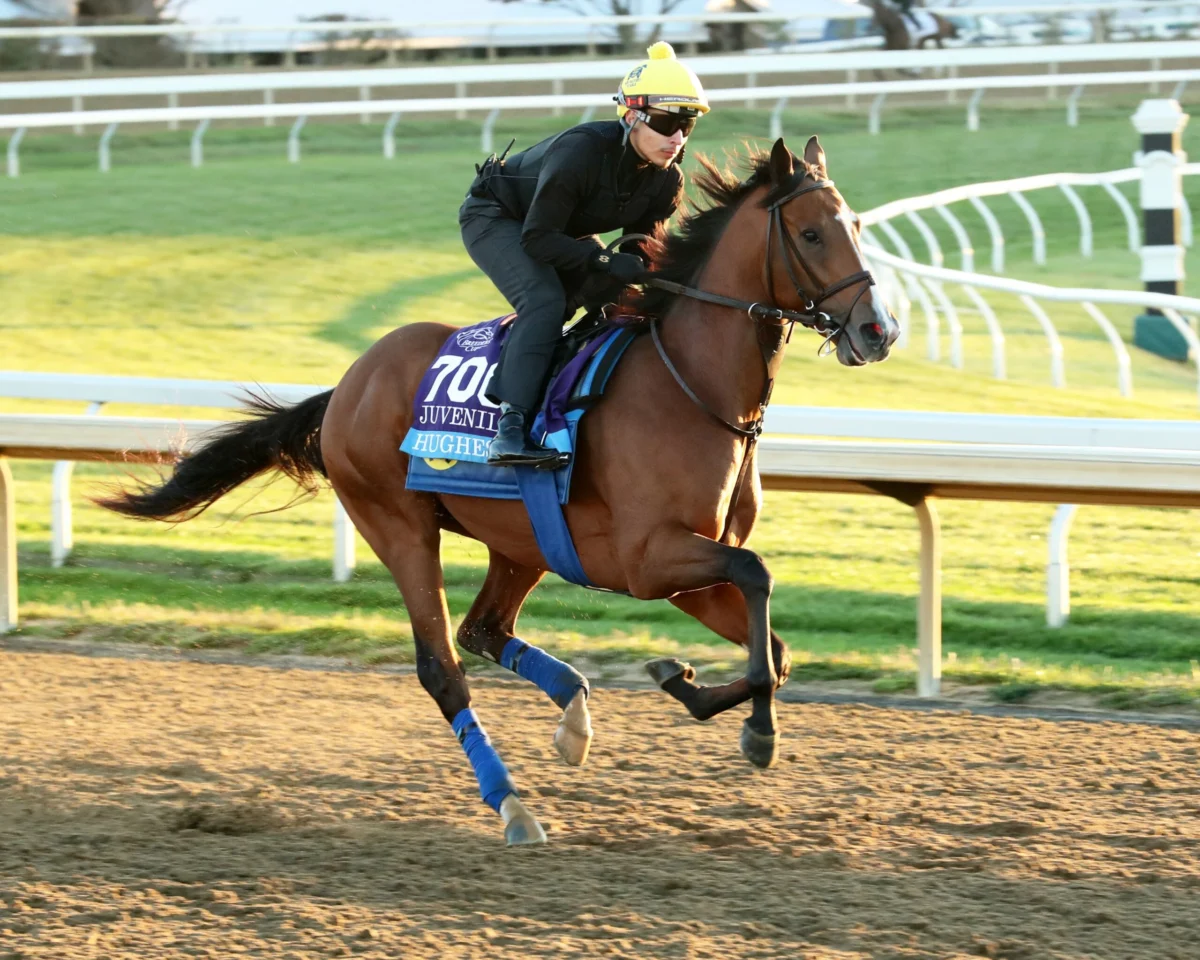
Bob Baffert’s pursuit of a seventh Breeders’ Cup Juvenile victory is anchored by Hughes, a colt whose record of four wins in four starts speaks to both consistency and raw talent. Hughes has navigated the Southern California circuit with clinical precision, culminating in back-to-back Grade 1 scores. His victory in the American Pharoah Stakes (G1) at Santa Anita Park was particularly telling; under the guidance of jockey Juan Hernandez, Hughes pulled away to a six-length victory while recording a late speed figure exceeding 35 mph.
Analytical metrics suggest that Hughes possesses a distinct tactical advantage. In both the American Pharoah and the Del Mar Futurity, Hughes displayed the ability to maintain the highest speed during the final three furlong splits, a testament to his endurance and composure under pressure. His peak average stride length of over 25 feet, combined with a TPD average time figure that outperformed the track standard for stakes winners at Del Mar, suggests that Hughes is operating well within his limits. For handicappers, the primary question is not whether Hughes possesses the speed to win, but whether he can sustain his peak form against a deeper field at Keeneland.
The Rising Challenger: Salahudin
While Hughes occupies the favorite’s role, the inclusion of Salahudin, another trainee from the Baffert stable, adds a layer of complexity to the race. Salahudin’s victory in the Iroquois Stakes (G3) at Churchill Downs in September generated significant buzz within the racing analytics community. The horse recorded an average stride length of 26.67 feet, with a peak extension of 28.67 feet—an anomaly that initially triggered data verification protocols.
Subsequent reviews confirmed the accuracy of these measurements, establishing Salahudin as an exceptionally long-striding colt. With a top speed of 41.74 mph recorded during his Iroquois win, he demonstrated the ability to pair raw power with high-end acceleration. While his connections face questions regarding the subsequent performance of the horses he defeated in Louisville, his physical profile suggests he is a prime candidate for maturation. If the pace of the Breeders’ Cup Juvenile proves testing, Salahudin’s ability to sustain his stride could make him the most dangerous closer in the final furlong.
Assessing the Breeders’ Futurity Form
The Breeders’ Futurity (G1) at Keeneland serves as a traditional gateway to the Juvenile, and this year’s renewal provided a tactical puzzle for observers. American History, trained by Todd Pletcher, secured a gritty victory after trailing a blistering early pace set by Coach Pope and Q B Rocket. The early fractions—reaching the half-mile pole in under 52.5 seconds—essentially turned the race into a war of attrition.
American History’s ability to stay on dourly while competitors faded is a testament to his fitness, yet his reliance on a strong pace to soften up the front-runners presents a risk for the Breeders’ Cup. Data indicates that American History’s stride frequency was at its limit during the far turn at Keeneland, and while he finished with authority, his reliance on the tactical failure of his rivals may be difficult to replicate against a more disciplined field.
Coach Pope, who set the pace in the Breeders’ Futurity, remains a wildcard. His maiden victory at Churchill Downs in September, where he clocked times two seconds faster than his rivals over the final three furlongs, suggests that his performance at Keeneland may have been hampered by an unsustainable pace. If he can secure a more measured lead in the Juvenile, his ability to manage his stride—peaking at 25.74 feet—could allow him to remain a factor well into the stretch.

Potential Upsets and Tactical Considerations
Beyond the primary contenders, Earth Song and Damavand represent interesting angles for the exotics. Earth Song, a half-brother to the Keeneland-specialist Further Ado, brings an impressive pedigree and a debut victory at Monmouth Park to the table. Though he was soundly defeated by U. S. S. Valor in the Champagne, his top speed of 42.6 mph remains the highest recorded speed in the field.
Damavand, also representing the Todd Pletcher stable, offers an intriguing profile based on his maiden win over the Keeneland track. His winning time surpassed that of American History on the same course, and his finishing speed of 101% indicates a more efficient, controlled effort. Having navigated the Keeneland surface successfully, Damavand is a logical inclusion for those seeking value in a race that often rewards track experience.
The Role of Data in Modern Racing
The application of TPD metrics to the 2026 Juvenile field underscores a shift in how connections and fans evaluate young thoroughbreds. By focusing on stride length, frequency, and run-out speeds, analysts can now identify which horses are truly peaking and which are merely benefitting from favorable race conditions.
The consensus among analysts remains that Hughes possesses the most complete data profile. His ability to produce high-end speed without being pushed to his physical maximum provides a buffer that few others in the field can claim. However, the Breeders’ Cup Juvenile is historically a race of high volatility. The transition from regional stakes to the national stage on the main track at Keeneland demands a level of versatility that will test even the most talented juveniles.
Implications for the 2027 Triple Crown
The results of this year’s Juvenile will ripple through the 2027 Kentucky Derby trail. Trainer Bob Baffert’s dominance this year has ensured that his stable remains the focal point of the division, but the presence of promising prospects like Salahudin and American History suggests that the 3-year-old crop is beginning to show depth.

As the industry prepares for the post-race analysis, the key will be identifying which horses demonstrated the "stayer" profile. Breeders’ Cup winners often struggle to translate their juvenile speed into 1 1/4-mile distance capacity, and the data collected on Friday will be the first step in identifying which of these colts has the necessary aerobic capacity for the classic distances of the spring.
Final Verdict
As the gates open on Friday, the field reflects a mix of West Coast speed and Kentucky-based stamina. While the analytics favor Hughes, the performance of the field will ultimately be determined by the early pace scenario and the ability of the horses to handle the specific Keeneland dirt. The depth of the field, combined with the proven track records of trainers like Baffert and Pletcher, ensures that the 2026 Breeders’ Cup Juvenile will be a definitive chapter in the development of this year’s 2-year-old crop. Whether the result validates the current market favorites or introduces a new challenger to the Triple Crown conversation, the event remains the most significant indicator of future racing excellence in the United States.
