

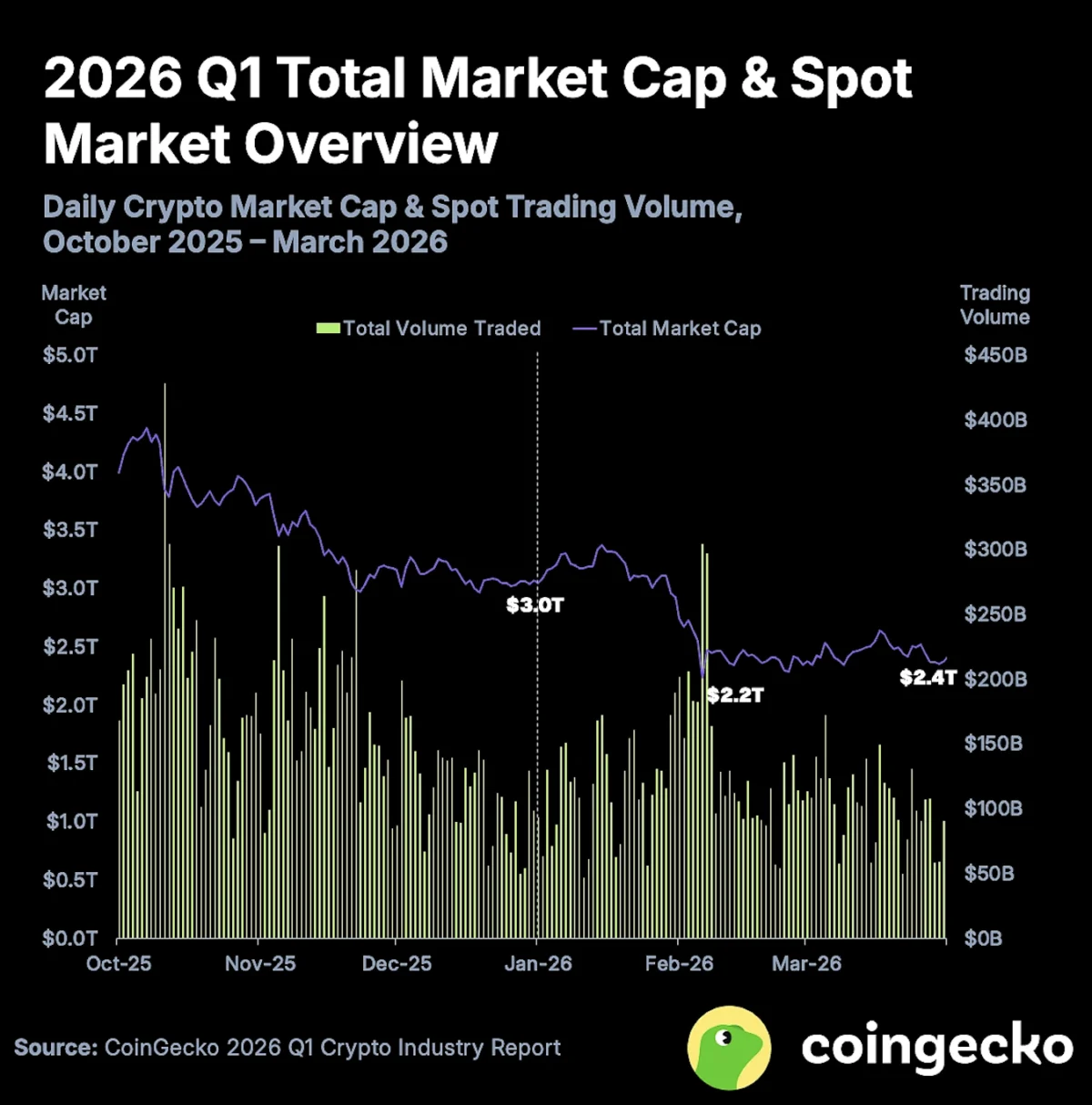
The digital assets market has officially entered a prolonged period of downturn, commonly referred to as a "crypto winter," as indicated by a significant and sustained decline in both market capitalization and trading volume over the past two consecutive quarters. Data released by CoinGecko on Thursday confirms a transition from a sharp market correction to a more entrenched bearish phase in the first quarter of 2026, a situation exacerbated by the convergence of late 2025 bearish sentiment and escalating global geopolitical tensions. This prolonged downturn marks a stark contrast to the vibrant growth experienced in previous years, prompting a reassessment of market dynamics and investor confidence.
The Onset of a Lingering Crypto Winter
CoinGecko’s comprehensive 2026 Q1 Crypto Industry Report paints a detailed picture of the market’s deteriorating condition. The total cryptocurrency market capitalization experienced a substantial drop of approximately 20.4%, equating to a loss of roughly $622 billion. This contraction brought the market’s overall value to $2.4 trillion by the end of the first quarter, marking the second consecutive quarter of decline. This downward trend was particularly pronounced between mid-January and early February, accelerating the market’s descent. Consequently, the total market capitalization now stands approximately 45% below its peak of $4.27 trillion recorded in October of the previous year.
Accompanying the shrinking market cap, daily trading activity also saw a significant reduction. The report indicates a Quarter-over-Quarter (QoQ) decline of 27.2% in average daily trading volume, which settled at $117.8 billion. This diminished trading interest reflects a broader investor hesitancy and a reduced appetite for risk within the digital asset space.
Centralized Exchanges Face Steep Declines in Trading Volume
The impact of the crypto winter has been acutely felt across centralized exchanges (CEXes), which are critical conduits for trading digital assets. Spot trading volume on the top 10 CEXes, including prominent platforms like Binance, MEXC, KuCoin, and Bybit, plummeted by 39.1% QoQ, reaching a total of $2.7 trillion for the quarter. This significant contraction signifies a substantial decrease in liquidity and trading activity on these key platforms.
Analysis of CoinGecko data reveals a clear downward trajectory in trading volumes throughout the first quarter of 2026. While volumes managed to remain above the $1 trillion mark in January, they steadily declined as the quarter progressed. March proved to be the weakest month, with trading volume falling to just $0.8 trillion, the lowest level observed since November 2023. This sustained decline underscores the broad-based nature of the market’s downturn.
Despite the overall market contraction, Binance maintained its position as the dominant player, holding a 37% market share. However, MEXC was the only other exchange to achieve a double-digit market share, accounting for 10% of the total trading volume on the top 10 CEXes. The report further highlights that all top 10 spot CEXes experienced declines in trading volume, with reductions ranging from 23% to 55%. HTX, in particular, witnessed the most significant slump, with its quarterly trading volume falling from $294.4 billion in Q4 2025 to $133.6 billion in Q1 2026. This drastic reduction led to HTX’s market share shrinking to 4.9%, placing it at the tenth position among the leading exchanges.

Major Cryptocurrencies Underperform, Stablecoins Provide Stability
The broad-based market declines extended to the major cryptocurrencies, with several of the leading digital assets experiencing significant pullbacks for the second consecutive quarter. Bitcoin (BTC), while outperforming other top five crypto assets by a narrow margin with a 22% decline during the quarter, still underperformed traditional assets such as Oil, Gold, and the S&P 500. This underperformance suggests a broader flight to perceived safer assets amidst global economic uncertainty.
Ethereum (ETH), BNB, XRP, and Solana (SOL) recorded drawdowns similar to Bitcoin, collectively weighing heavily on the total market capitalization. Even established legacy tokens like Uniswap (UNI) and Chainlink (LINK) faced continued downward pressure. This occurred despite increasing institutional adoption and their recognition as "digital commodities" under the recent SEC-CFTC Joint Interpretive Guidance, indicating that broader market sentiment is currently overriding specific asset class developments.
However, the report did identify pockets of relative strength emerging among certain altcoins following the sell-off in Q4 2025. Projects like Hyperliquid (HYPE) and Bittensor (TAO) managed to outperform the broader digital asset sector, suggesting that niche innovation and specific use cases might continue to attract investor interest even in a bear market.
In stark contrast to the volatile major cryptocurrencies, the total stablecoin market capitalization remained largely stable during the first quarter of 2026. It experienced a marginal increase of 0.5%, concluding the quarter at $309.9 billion. This resilience highlights the critical role stablecoins play as a perceived safe haven and a liquidity anchor within the often-turbulent digital asset ecosystem.
Within the stablecoin market, Tether’s USDT saw a supply decline of 1.6% to $184.1 billion, marking the first significant drop in its supply since the second quarter of 2022. This contraction could be attributed to various factors, including profit-taking by investors or a shift in demand towards other stablecoin offerings. Conversely, Circle’s USDC experienced growth, increasing by 2.4% to reach $77.1 billion. Additionally, newer entrants like Sky’s USDS and WLFI’s USD1 demonstrated robust performance, recording double-digit growth rates. Despite the fluctuations in individual stablecoin supplies, their overall stability underscores their function as a crucial intermediary and a store of value for investors navigating the complexities of the crypto market.
Historical Context and Emerging Factors
The current "crypto winter" follows a period of unprecedented growth and excitement in the digital asset market. The bull run of late 2020 and early 2021 saw Bitcoin reach all-time highs, fueled by increased retail and institutional interest, the proliferation of decentralized finance (DeFi) protocols, and the emergence of non-fungible tokens (NFTs). However, this exuberance was followed by a significant correction in 2022, which some analysts initially termed a "crypto winter." While the market showed signs of recovery in late 2023 and early 2024, the events of late 2025 and early 2026 appear to have ushered in a more prolonged and severe downturn.
The report specifically points to the collision of the late 2025 bearish momentum with the onset of global geopolitical tensions as a key catalyst for the current sustained downturn. Escalating conflicts, trade disputes, and broader economic uncertainties often lead investors to de-risk their portfolios, moving away from speculative assets like cryptocurrencies towards traditional safe-haven assets. The interconnectedness of the global financial system means that events in one region can have ripple effects across all asset classes, and the digital asset market is no exception.

Furthermore, regulatory scrutiny continues to be a significant factor influencing the digital asset landscape. While recent guidance from the SEC and CFTC has provided some clarity on the classification of certain digital assets, ongoing debates and potential future regulations in major economies could create further uncertainty and deter institutional investment. The market’s sensitivity to regulatory news has been a recurring theme, and any adverse developments could exacerbate the current downturn.
Broader Implications and Future Outlook
The sustained crypto winter has several significant implications for the digital asset industry. Firstly, it is likely to lead to a period of consolidation, with weaker projects and companies struggling to survive. This could result in job losses within the sector and a reduced pace of innovation, at least in the short term. However, it also presents an opportunity for more robust and fundamentally sound projects to gain market share and establish themselves as leaders in the next market cycle.
Secondly, the diminished trading volumes and market capitalization may impact the revenue streams of exchanges, crypto service providers, and blockchain developers. This could lead to a more cautious approach to funding new ventures and a greater emphasis on profitability and sustainability.
Thirdly, the prolonged bear market might test the conviction of retail investors, potentially leading to a period of disengagement. However, for long-term believers in the underlying technology and potential of digital assets, this period could be seen as an opportunity to accumulate assets at lower prices, anticipating a future recovery.
The role of stablecoins as a liquidity anchor becomes even more pronounced during such downturns. Their ability to maintain their peg and provide a reliable medium of exchange can be crucial for facilitating trading and preserving capital when market volatility is high. The growth observed in USDC and other stablecoins, despite Tether’s slight supply reduction, indicates a potential diversification of stablecoin holdings and a continued reliance on these assets for stability.
Looking ahead, the trajectory of the crypto winter will likely depend on a confluence of factors, including the resolution of geopolitical tensions, macroeconomic stability, regulatory clarity, and the pace of technological innovation within the blockchain space. While the current environment is challenging, the resilience demonstrated by certain sectors of the market, such as stablecoins and specific altcoins, suggests that the long-term potential of digital assets remains a subject of ongoing interest and development. The industry will be closely watching for signs of a sustained recovery, which will likely be driven by renewed investor confidence and a clearer path forward regarding regulation and adoption. The current downturn, while painful, may ultimately serve as a crucial period of recalibration and maturation for the digital asset market, paving the way for a more sustainable and robust future.
