

A sophisticated Chinese-speaking threat actor has launched a widespread cyberespionage campaign, systematically exploiting vulnerabilities across enterprise hardware, content management systems, and virtual private network (VPN) gateways to compromise sensitive government infrastructure. According to recent findings published by threat intelligence firm GreyNoise, the adversary has successfully infiltrated nearly 1,000 devices and harvested upwards of 18,500 sensitive records from backend databases. The campaign highlights an escalating trend of opportunistic yet highly targeted attacks that leverage a diverse arsenal of zero-day and known exploits to bypass modern perimeter defenses.
The malicious activity, first identified through telemetry gathered by the GreyNoise Global Observation Grid (GOG) sensor network, has been active since early June 2026. Analysts have attributed the campaign to a threat cluster bearing tactical similarities to the notorious "Red Heron" cyberespionage group, an entity previously implicated in high-profile code injection assaults targeting self-hosted Git services such as Gitea. Operating from centralized IP infrastructure, the threat actor has demonstrated a high degree of operational agility, rapidly pivoting from edge-device exploitation to internal network reconnaissance, privilege escalation, and database exfiltration.
Anatomy of an Advanced Intrusion: The Western Government Breach
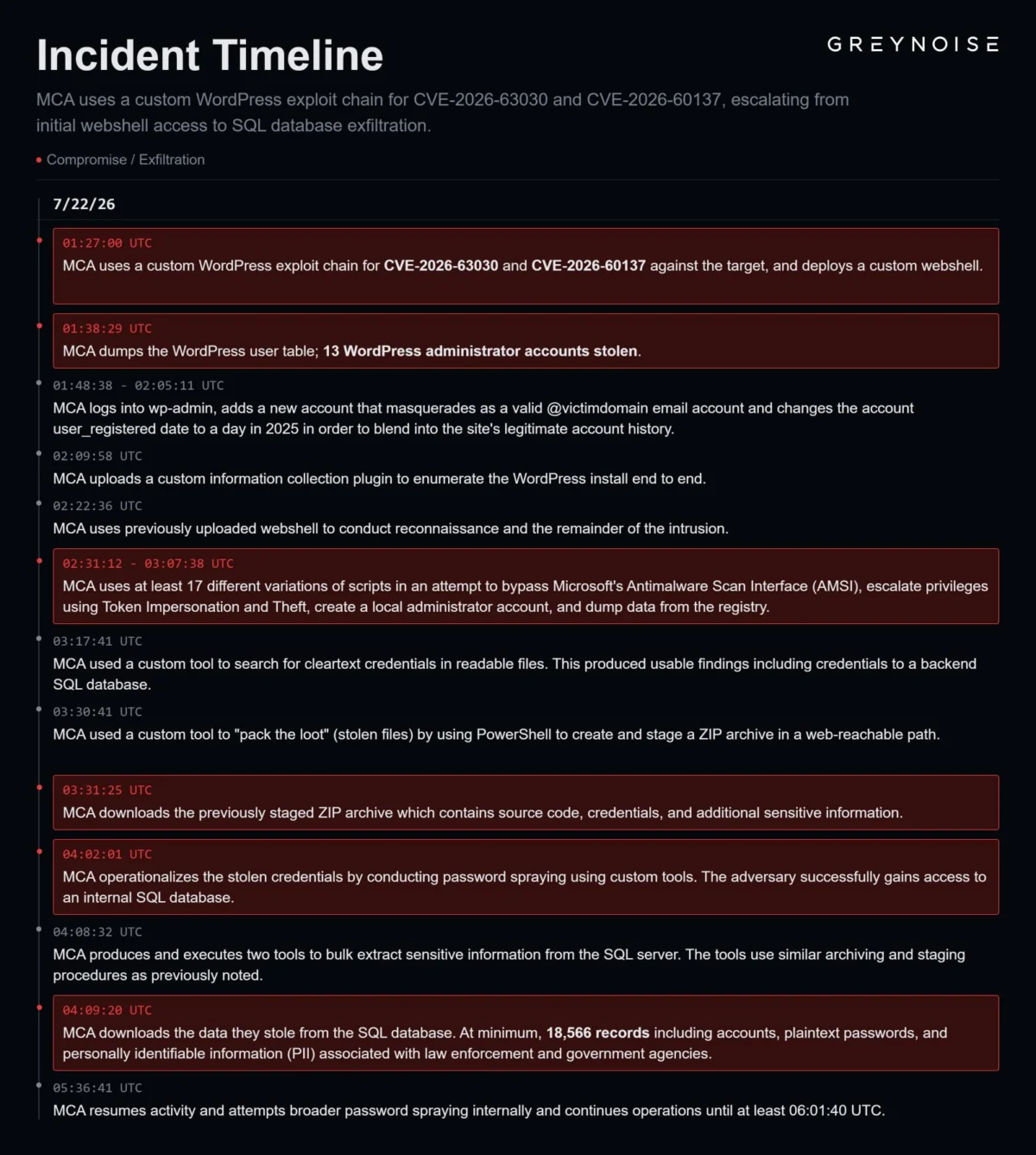
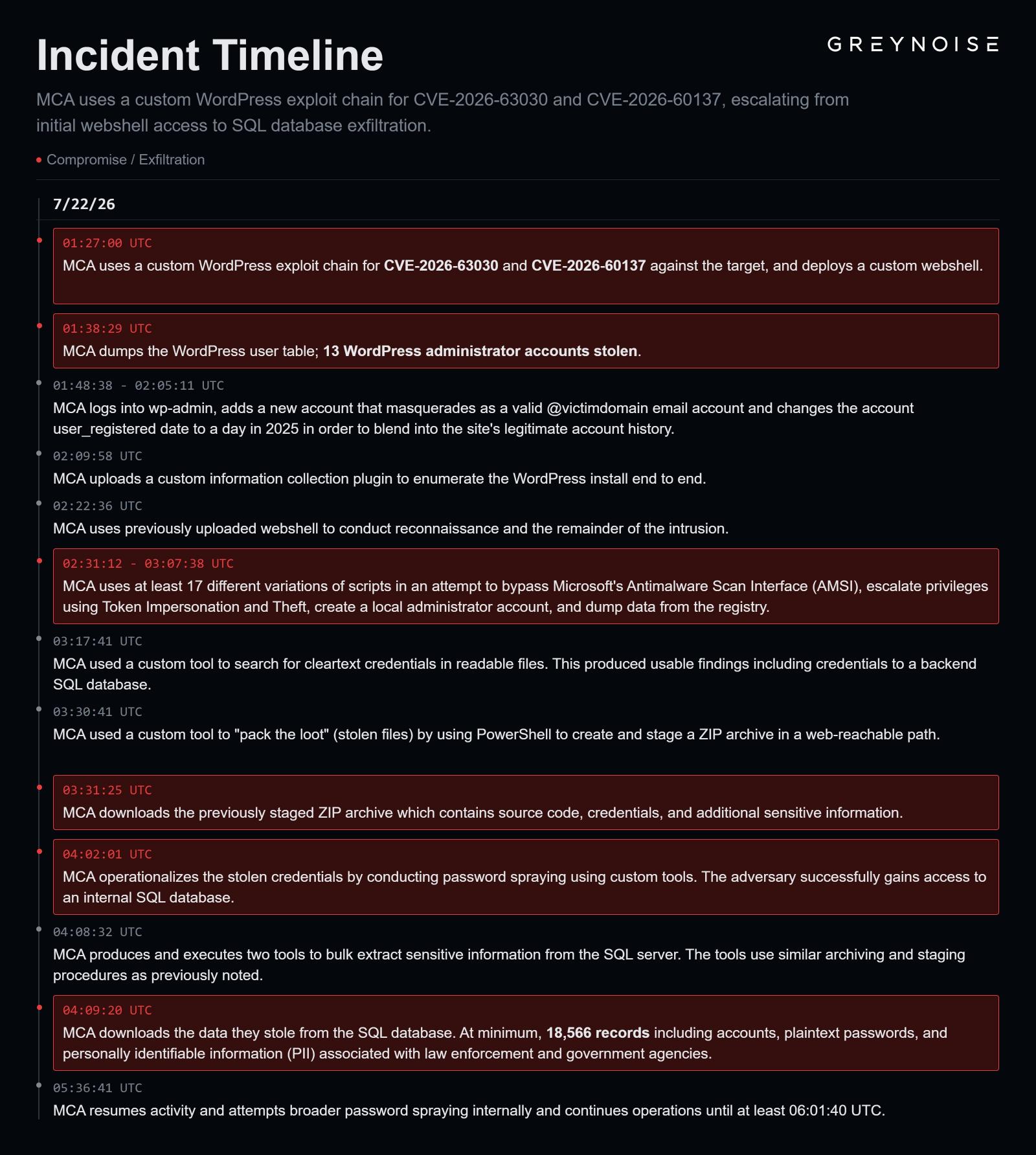
While the campaign’s footprint spans small businesses and municipal entities across dozens of countries, the most alarming incident involves a successful intrusion into an unnamed Western government organization. In this specific attack, the adversary leveraged newly minted vulnerabilities in the WordPress Core component—specifically the "wp2shell" flaws tracked as CVE-2026-63030 and CVE-2026-60137—to establish an initial foothold. Publicly disclosed exploit code for these vulnerabilities began circulating in mid-July 2026, and active exploitation was observed by researchers shortly thereafter.
Once inside the enterprise network via a compromised WordPress instance, the attackers transitioned from initial access to deep reconnaissance. Over a calculated window of just 36 minutes, the threat actor executed a methodical sequence of commands designed to evaluate the host environment. Telemetry indicates that the hackers systematically probed for Microsoft Defender status, the Antimalware Scan Interface (AMSI), active network services, listening ports, local user accounts, software restriction policies, and underlying database configurations.

To maintain persistence and evade detection, the intrusion script executed 17 distinct iterations aimed at neutralizing AMSI defenses. The operator attempted to elevate privileges through token impersonation and token theft, provision a rogue local administrator account, and systematically extract sensitive security data from the Windows Registry. This meticulous operational tempo ultimately led the attackers to credentials for a backend SQL server. Utilizing these stolen credentials in a targeted password-spraying maneuver, the threat actor gained unauthorized entry to the internal database, exfiltrating more than 18,566 records containing plaintext passwords, user accounts, and personally identifiable information (PII) linked directly to government and law enforcement operations.
Beyond Western targets, the same infrastructure and attacker profile were observed breaching a Russian state organization located in occupied Ukraine, illustrating a complex geopolitical threat landscape characterized by "red-on-red" espionage operations where nation-state actors target rival or allied jurisdictions alike.
Chronology of Exploitation: From Edge Devices to Enterprise Software
The campaign’s success relies heavily on the actor’s ability to weaponize a vast array of disparate technologies. Rather than relying on a single entry vector, the threat cluster continuously scans the internet for vulnerable perimeter devices and misconfigured servers.
The timeline of known exploitation activity reveals a structured, multi-phase approach:
Early June 2026: Initial scanning and reconnaissance activity originating from the primary attacker IP address are detected by GreyNoise sensors, targeting enterprise firewalls, development environments, and virtualization platforms such as PAN-OS Global Protect, FlowiseAI, Nuclio, and Proxmox VE.
Mid-to-Late June 2026: The threat actor begins probing for vulnerabilities in Ubiquiti UniFi OS products, attempting to chain critical bugs—CVE-2026-34908, CVE-2026-34909, and CVE-2026-34910—to achieve unauthenticated root-level remote code execution. These flaws were concurrently flagged by the U.S. Cybersecurity and Infrastructure Security Agency (CISA) as being actively exploited in the wild.
Mid-July 2026: Public exploits for the WordPress wp2shell vulnerabilities emerge. The threat actor immediately integrates these exploits into their campaign, breaching at least 49 organizations spanning 29 countries, culminating in the high-profile government database breach.
August 17, 2026: The adversary broadens their targeting parameters to include hardware infrastructure, initiating mass exploitation of a high-severity flaw (CVE-2026-7273) affecting ZyXEL GS1900 Smart Managed Switches. Within days, the hackers successfully compromise 996 individual devices across 48 countries, extracting critical configuration files, network topology data, and hashed root-level credentials.
Throughout this timeline, researchers confirmed that the threat group also targeted FlowiseAI (CVE-2026-56271), the Linux kernel’s infamous "Dirty Pipe" privilege escalation flaw (CVE-2022-0847), Gitea code injection vectors (CVE-2026-60004), Nuclio serverless vulnerabilities (CVE-2026-79756), SENAITE LIMS laboratory information management flaws (CVE-2026-54569), and Proxmox VE virtualization bugs (CVE-2023-54391). Notably, a significant portion of the vulnerabilities leveraged in this campaign have not yet been cataloged in CISA’s official Known Exploited Vulnerabilities (KEV) database, leaving many organizations unaware of their exposure.
Broader Implications for Global Cybersecurity
The GreyNoise disclosures underscore a troubling evolution in modern cyber warfare: the commodification and rapid weaponization of edge-device vulnerabilities. Historically, nation-state actors reserved complex zero-day exploits for high-value espionage targets, while routine cybercrime syndicates relied on commodity malware and phishing. The Red Heron-linked campaign bridges this divide, utilizing an extensive portfolio of publicly disclosed vulnerabilities to infiltrate operational technology, network switches, and content management systems with equal proficiency.
.jpg)
Security analysts emphasize that perimeter defense models are failing because organizations treat network hardware, cloud tools, and web applications as isolated silos. When an attacker can transition seamlessly from a compromised WordPress blog to an internal law enforcement database within minutes, it signals a systemic failure in internal network segmentation, identity management, and endpoint detection and response (EDR) telemetry.
Furthermore, the targeting of networking hardware—such as the ZyXEL GS1900 switches—provides adversaries with long-term strategic advantages. By extracting root-level credentials and configuration files, hackers can establish persistent man-in-the-middle capabilities, reroute traffic, or prepare the ground for future supply-chain attacks without triggering traditional host-based antivirus alerts.
Mitigation and Defensive Recommendations
In response to the escalating campaign, cybersecurity authorities and threat intelligence providers have urged system administrators to audit their networks immediately. Organizations utilizing ZyXEL Smart Managed Switches must apply vendor-supplied firmware patches to remediate CVE-2026-7273, while web administrators running WordPress instances are advised to update core components instantly to neutralize wp2shell vectors.
GreyNoise has released a comprehensive set of Indicators of Compromise (IoCs), including cryptographic hashes for deployed backdoors, malicious script signatures, and command-and-control (C2) server IP addresses. Security operations centers (SOCs) are encouraged to cross-reference their logs against these artifacts to detect potential unauthorized access.
As threat actors continue to automate the exploitation of edge infrastructure and enterprise software, defenders must adopt a posture of continuous validation—treating every connected device as a potential vector for lateral movement and ensuring that administrative credentials across SQL servers and domain controllers are protected by robust multi-factor authentication (MFA) and strict principle-of-least-privilege policies.
