


A sophisticated, China-aligned cyber espionage actor has been actively exploiting a critical remote code execution vulnerability within Tencent’s immensely popular Sogou Input Method for Windows. Tracked as CVE-2026-51990, the flaw has been leveraged in targeted operations to deliver a newly updated and highly capable iteration of the GrayRabbit backdoor. Cybersecurity researchers warn that the vulnerability represents a dangerous vector for threat actors, as it requires only minimal user interaction—specifically, clicking a maliciously crafted web link—to completely compromise a target system.
The discovery underscores a persistent trend in modern threat landscapes: the weaponization of legitimate, widely trusted consumer software as an initial access vector for corporate and governmental espionage. With hundreds of millions of installations, primarily across China, the Sogou Input Method presented a massive, high-value attack surface that advanced persistent threat (APT) groups were quick to operationalize once the vulnerability conditions were met.
Anatomy of the Exploit Chain
According to an in-depth technical analysis published by researchers at Gen Threat Labs, the campaign is being orchestrated by a tracked threat cluster known as UNC3569. This group operates within a complex ecosystem bridging conventional cybercrime and state-sponsored contractor-for-hire operations. Rather than relying on traditional phishing payloads or complex macro-enabled documents, UNC3569 devised a multi-stage attack chain that weaponizes custom URI (Uniform Resource Identifier) handlers and deeply embedded, out-of-date software components.
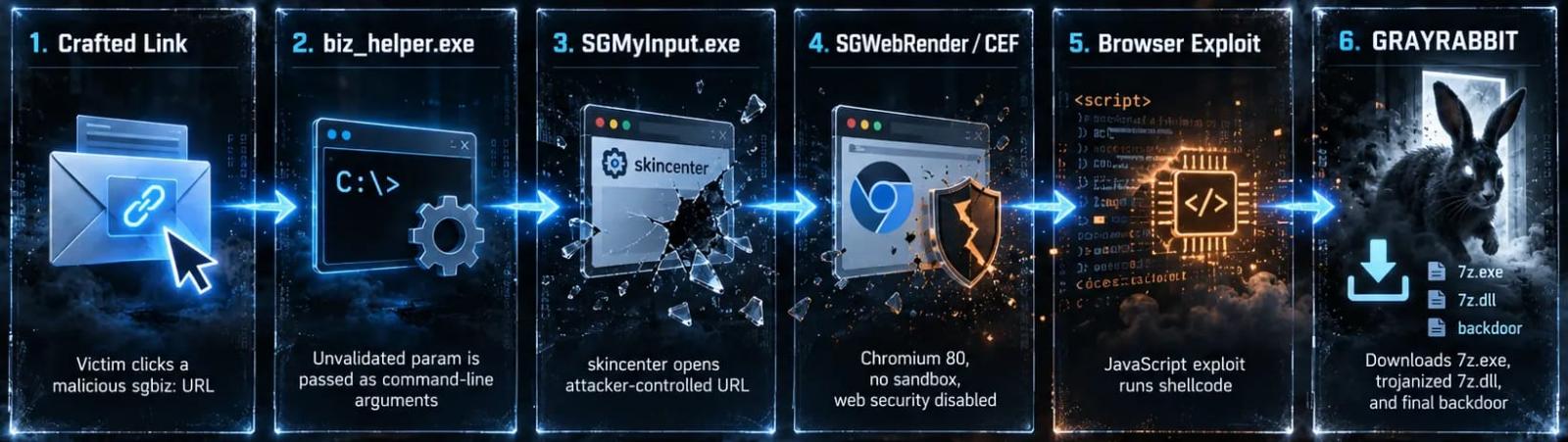
The attack initiates when an unsuspecting victim clicks a specially crafted hyperlink utilizing the custom sgbiz: URI scheme. This action forces the Windows operating system to invoke biz_helper.exe, a protocol handler native to the Sogou Input Method. Crucially, this handler suffers from an input-validation flaw, allowing attacker-controlled command-line arguments to pass directly to a legitimate underlying executable, SGMyInput.exe, without undergoing any rigorous sanitization or verification checks.
In the second stage of the exploit, these injected arguments instruct the software to launch its built-in "skincenter" component. This internal module features an embedded Chromium-based web view designed to fetch UI elements and styling data. However, because Sogou’s implementation failed to restrict URL schemes or destination endpoints, the application obediently navigates to an attacker-controlled external URL.
The final stage of the compromise occurs when the malicious page loads within the embedded browser environment. The page exploits a well-documented vulnerability intrinsic to the application’s embedded Chromium 80 engine. Because this webview implementation operates entirely without a sandbox and has essential web-security mitigations disabled by default, the malicious code successfully breaks out of the application context. This achieves unprivileged remote code execution on the host operating system, facilitating the silent installation of the GrayRabbit backdoor.

Evolution and Capabilities of the GrayRabbit Backdoor
GrayRabbit is not a new tool on the threat intelligence radar, but its deployment in this campaign highlights its continued evolution. Originally brought to widespread public attention by Google researchers in 2024, GrayRabbit was detailed as a modular malware family primarily utilized by UNC3569. Over successive reporting cycles, analysts have mapped the tool’s deployment across various espionage and targeted intrusion campaigns.
The variant analyzed by Gen Threat Labs during the recent exploitation cycle represents a significantly more mature, 64-bit iteration of the malware. It features a vastly expanded command set designed for deep system reconnaissance and persistent espionage. Key functional capabilities of this modern GrayRabbit variant include:
- Arbitrary process execution and command-line management.
- The ability to open interactive reverse shells for direct operator control.
- Comprehensive file system operations, including remote uploading and downloading.
- Extensive system and user information harvesting, including environment enumeration and credential harvesting artifacts.
- The capacity to reflectively load modular plugins directly into the host process’s memory, minimizing disk artifacts and evading traditional endpoint detection and response (EDR) signatures.
Furthermore, communication with command-and-control (C2) infrastructure is heavily obfuscated, utilizing RC4-encrypted configurations to blend in with standard network traffic and frustrate network-level heuristic detection tools.
Timeline and Vendor Response
The lifecycle of this vulnerability highlights the fast-paced coordination required between commercial software vendors and threat intelligence organizations. The timeline of discovery, disclosure, and remediation unfolded across several weeks in the spring of 2026:
- April 9, 2026: Gen Threat Labs formally reports its findings regarding the exploitation of CVE-2026-51990 and the associated UNC3569 campaign to Tencent’s security response team.
- April 21, 2026: Tencent acts on the disclosure, releasing Sogou Input Method version 16.3.0.3498 to remediate the immediate protocol-handling flaw.
The official software patch introduces stricter input-validation controls on the custom protocol handler. Specifically, the updated application now validates the URL arguments accepted through the sgbiz: scheme, enforces a strict requirement for HTTPS protocols, and restricts browser navigation strictly to approved, trusted domains associated with Sogou and its parent company, Tencent.
Despite the swift deployment of the patch, cybersecurity analysts have raised cautionary flags regarding the completeness of the remediation. While the protocol handler can no longer be easily abused to load arbitrary external URLs, researchers point out that the underlying Chromium engine remains severely outdated. Furthermore, the application continues to run without a proper browser sandbox, leaving crucial web-security defenses disabled. Consequently, security experts warn that if another vector or secondary vulnerability is discovered within the application’s rendering pipeline, the core risk of remote code execution may persist.
Broader Industry Implications and Analysis
The weaponization of the Sogou Input Method sheds light on a broader, systemic risk facing enterprise and consumer security environments alike: the supply chain of internal components. Many popular desktop applications integrate browsers, web-rendering engines, or script interpreters to provide rich, dynamic user interfaces. When these integrated components—often referred to as wrapper applications or hybrid desktop apps—fall behind upstream security patching schedules, they create massive blind spots for users.
Unlike standalone web browsers like Google Chrome, Mozilla Firefox, or Microsoft Edge, which benefit from automated, silent background updates and robust sandboxing architectures, embedded third-party components inside productivity software, communication tools, and utility applications are frequently neglected. End users rarely consider an input method editor (IME) or a keyboard utility as a potential vector for advanced espionage, leading to delayed patch adoption in enterprise networks where such consumer tools may bypass standard IT asset inventories.
From a geopolitical and intelligence perspective, the campaign illustrates the persistent operational focus of China-aligned threat groups on high-density communication and typing platforms. Because input method editors require low-level operating system hooks and extensive privileges to function smoothly, they represent ideal vehicles for maintaining persistent, stealthy access within specific demographic or geographic targets.
Security Recommendations for Defenders
In light of the active exploitation campaign involving CVE-2026-51990 and the GrayRabbit backdoor, enterprise security teams and system administrators are advised to take immediate remediation steps:
- Immediate Software Updates: Ensure that all instances of the Tencent Sogou Input Method across organizational endpoints are updated to version 16.3.0.3498 or later immediately.
- Inventory and Asset Discovery: Conduct comprehensive endpoint audits to identify unauthorized or consumer-grade utility applications, such as alternative input methods, that may have been sideloaded or installed by users on corporate networks.
- Application Control Policies: Implement rigorous application whitelisting and software restriction policies (SRP) to limit the execution of unapproved utilities, particularly those featuring embedded, un-sandboxed browser engines.
- Network Monitoring: Monitor perimeter and internal network traffic for anomalous behaviors associated with UNC3569, including suspicious outbound connections utilizing RC4 encryption patterns or unusual traffic directed at known command-and-control infrastructure.
- Endpoint Detection Tuning: Update EDR and SIEM detection rules to flag anomalous command-line arguments passed to helper executables and protocol handlers originating from browser or utility application wrappers.
As threat actors continue to weaponize fringe components of everyday software, organizations must expand their vulnerability management programs beyond traditional operating systems and mainstream enterprise software to encompass the hidden dependencies lurking within consumer utility applications.
