

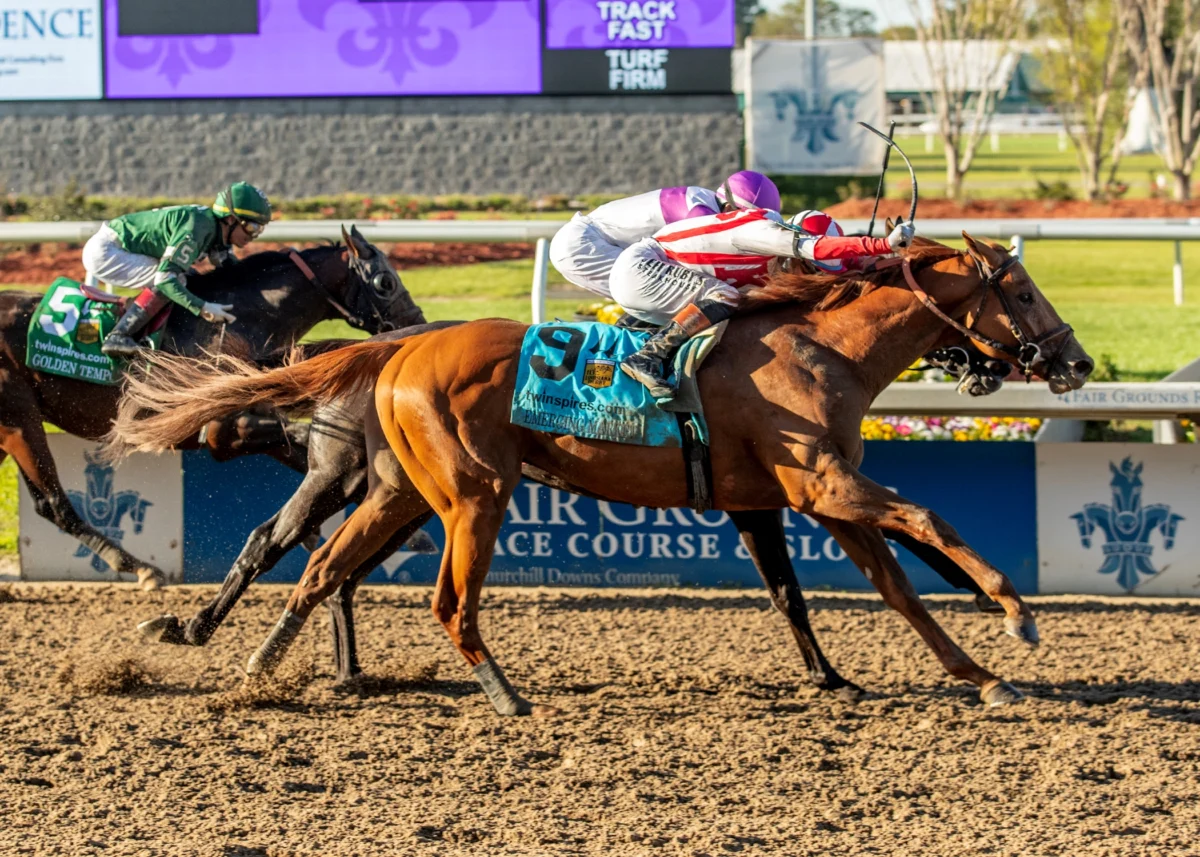
The pursuit of the Kentucky Derby is often a journey defined by rigorous preparation, a meticulously planned series of prep races, and the accumulation of seasoning intended to steel a three-year-old thoroughbred for the chaos of a 20-horse field. However, for five-time Eclipse Award-winning trainer Chad Brown, the path to the 152nd running of the Grade 1 Kentucky Derby and the Grade 1 Kentucky Oaks has taken a sharp detour from tradition. Brown arrived at Churchill Downs this spring not with the battle-hardened veterans typical of the modern era, but with two exceptionally talented yet lightly raced contenders: Emerging Market and Always a Runner. Both horses will attempt to capture the most prestigious prizes in American racing with only two lifetime starts under their belts, a feat that defies nearly a century and a half of historical data.
The historical significance of this endeavor cannot be overstated. Emerging Market, the winner of the Grade 2 Louisiana Derby, is attempting to become the first horse to win the Kentucky Derby with only two prior starts since Leonatus accomplished the feat in 1883. To put that in perspective, when Leonatus won the ninth Derby, the race was still contested at its original distance of 1.5 miles, and the American West was still largely a frontier. In the 141 years since, the "two-start jinx" has remained one of the most stubborn statistics in the sport. Since 1937, only six horses have even attempted to win the Derby with such a sparse resume. The most successful among them were T O Password, who finished fifth in 2024, and China Visit, who managed a sixth-place finish in 2000.
The Evolution of Training and the End of the Apollo Curse
While the two-start hurdle remains formidable, Chad Brown remains undeterred, pointing to the recent disintegration of other long-standing racing "curses" as evidence that modern training methods are evolving. For over a century, the "Curse of Apollo" dictated that no horse could win the Kentucky Derby without having raced as a two-year-old. That rule held firm from 1882 until 2018, when Justify stormed through the Triple Crown. The myth was further dispelled in 2023 when Mage captured the Run for the Roses. Emerging Market, who did not race as a juvenile, falls into this category, but Brown argues that the lack of quantity in a horse’s record is often offset by the sheer quality of their ability.
"It wasn’t what I mapped out last fall, coming with my Oaks and Derby chances with only two starts, but it just worked out that way," Brown noted following a series of works at Churchill Downs on April 24. "It takes a special horse. I think there’s more reward than risk with this particular horse. I’d rather have a horse like him that has very special ability and is lightly raced than an experienced longshot."
Brown’s perspective reflects a broader shift in the industry toward preserving a horse’s peak performance for the biggest stages. In the current points-based qualification system, a single high-level victory can secure a spot in the starting gate, reducing the necessity for a grueling winter campaign. However, the lack of "bottom"—the aerobic foundation built through multiple races—remains the primary concern for skeptics who wonder if a two-start horse can endure the demanding 1 1/4-mile distance of the Derby.
A Chronology of Setbacks and Resilience
The road to Churchill Downs for Emerging Market was anything but linear. A son of the prolific sire Candy Ride, the Klaravich Stables-owned colt showed immense promise from his earliest days in training. Brown recalled that the horse "stood out as obvious as a horse can that he had a lot of ability." However, a series of health and physical setbacks repeatedly delayed his competitive debut.
In July of his two-year-old year, just as he was being pointed toward a summer start, Emerging Market suffered a shoulder laceration that forced him out of training. After recovering and returning to the work tab in the fall, he appeared to be training "brilliantly" before disaster struck again. The colt contracted a severe virus that developed into pneumonia, a life-threatening condition for a thoroughbred. The recovery process was extensive, requiring hyperbaric oxygen therapy and a significant period of rest on the farm.
"Those are disappointing situations that you encounter in this job," Brown said. "It’s not like when we got the horse back going that we circled the Derby, but I think what you need to do is just take it day by day, week by week, month by month and just see where the horse takes you."
Emerging Market finally made his debut on February 7 at Tampa Bay Downs, winning a two-turn maiden race with grit. He followed that performance with a breakout victory in the Louisiana Derby on March 21 at Fair Grounds Race Course & Slots. Despite drawing the widest post and facing rivals with significantly more experience, Emerging Market showcased a professional "doggedness" to secure the win and the qualifying points necessary for the Derby.
Analyzing the Professionalism of the Lightly Raced
One of the primary arguments against lightly raced horses in the Kentucky Derby is their lack of experience navigating large, crowded fields. The Derby features 20 runners, a stark contrast to the nine-horse fields Emerging Market faced in his first two outings. However, jockey Flavien Prat, who will pilot the colt in the Derby, believes the horse’s temperament will bridge the gap.
"In both his runs, he showed a lot of professionalism," Prat said. "He’s been very straightforward so far. Yeah, he hasn’t run as many as most of the rest of the field, but the reality is that a 20-horse field is going to be a first for everybody. I’m confident that he could adapt."
Brown echoes this sentiment, suggesting that the quality of Emerging Market’s two starts carries more weight than a longer list of mediocre performances. In the Louisiana Derby, Emerging Market outfinished a horse that had nine career starts, demonstrating a level of mental toughness usually reserved for seasoned veterans. To Brown, these "dog fights" down the stretch provided more education than a dozen easy victories would have.
The Oaks Contender: Always a Runner
The story of Always a Runner, Brown’s contender for the Kentucky Oaks, mirrors that of her stablemate. Owned by Douglas Scharbauer and Three Chimneys Farm, the daughter of Gun Runner also faced delays due to illness. She did not debut until February 6 at Tampa Bay Downs, but she immediately signaled her talent. Her subsequent victory in the Grade 3 Gazelle Stakes solidified her status as a top-tier filly, even with her limited exposure to the track.
Always a Runner will be ridden by Jose Ortiz, who has been intimately involved in her final preparations at Churchill Downs. Brown remains bullish on her prospects, stating, "I think her best races are ahead of her." Like Emerging Market, she represents a gamble on raw talent and physical freshness over the traditional path of seasoning.
Chad Brown’s Quest for the Final Jewels
For all his success, including five Eclipse Awards for Outstanding Trainer and two Preakness Stakes victories (Cloud Computing in 2017 and Early Voting in 2022), the Kentucky Derby and Kentucky Oaks remain the missing pieces in Chad Brown’s trophy cabinet.
Brown has come agonizingly close to Derby glory in the past. In 2018, Good Magic finished second to the eventual Triple Crown winner Justify. More recently, in 2024, Sierra Leone was defeated by a mere nose in one of the most thrilling three-horse photos in the race’s history. In the Oaks, Brown suffered a similarly heartbreaking defeat when Search Results was edged out at the wire by Malathaat in 2021.
"Winning either race means so much to me, personally," Brown admitted. "It would mean a lot to my team. We’ve worked so hard. We’ve won so many big races together, and these are two races that we’ve been knocking on the door. I’m proud of my team. Over the years, we’ve gotten horses here the right way to run their best races. They just weren’t quite good enough. Hopefully, this year, we have two horses that are."
Broader Implications for the Sport
The performance of Emerging Market and Always a Runner will be closely watched by bloodstock agents, owners, and rival trainers. If Brown is successful in breaking the 141-year-old jinx, it could further validate the trend toward lighter racing schedules for elite three-year-olds.
In an era where the durability of the modern thoroughbred is a frequent topic of debate, a victory by a two-start horse would suggest that the "foundation" required for classic distances can be built on the training track rather than exclusively through racing. It would also highlight the importance of individual horse management—letting the horse dictate the schedule rather than forcing a horse into a traditional prep sequence regardless of their physical condition.
As the first Saturday in May approaches, the spotlight remains on the historical weight carried by Emerging Market. While 143 years of history suggest the odds are stacked against him, the evolution of the sport and the talent of the individual suggest that records are made to be broken. For Chad Brown, the hope is that this year, the "special ability" of his lightly raced duo will finally provide the keys to the winner’s circle at Churchill Downs.
