

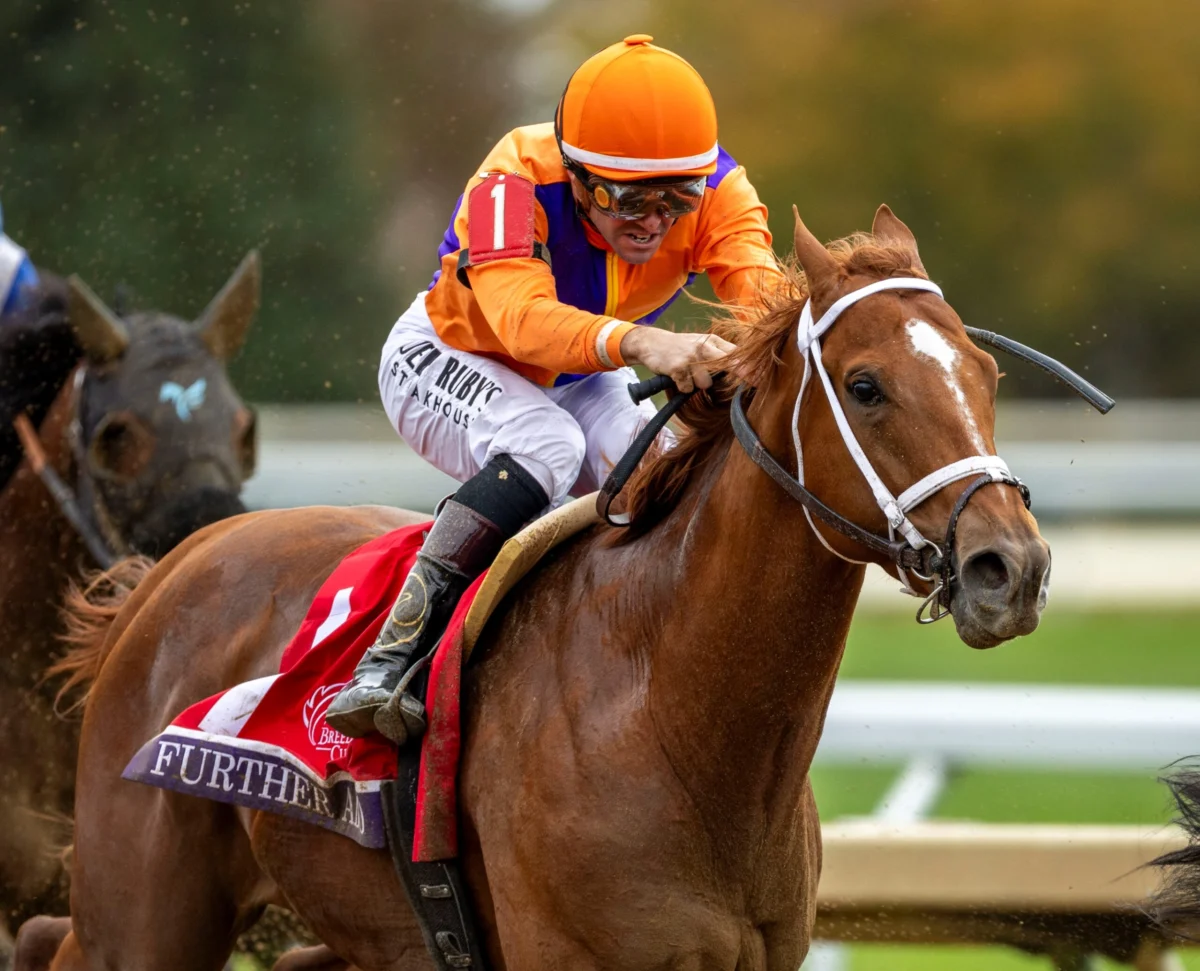
The decision to retire a high-profile Thoroughbred to the breeding shed or continue a racing campaign is a perennial dilemma for prominent owners, but the victory of Further Ado in the Breeders’ Cup Dirt Mile (G1) has elevated this internal debate at Spendthrift Farm to a critical juncture. Following a dominant performance at the World Championships, the connections of the talented colt are balancing the immediate commercial appeal of a stallion career against the potential for an even more illustrious trajectory on the track.
Spendthrift Farm, a leader in the stallion industry, had previously signaled in September that Further Ado, along with fellow grade 1 winner Baeza, would transition to stud duty for the 2026 season. However, the prestige of a Breeders’ Cup victory, combined with the colt’s physical maturation and lineage, has prompted a pause in those plans. Farm owner Eric Gustavson acknowledged that the victory fundamentally altered the calculus, forcing the organization to reconsider whether the horse’s ceiling has truly been reached.
The Provenance of the Prospect
Spendthrift Farm acquired Further Ado for $550,000 at the 2025 Ocala Breeders’ Sales Spring 2-Year-Olds in Training Sale, purchasing him from consignor Six K’s Training and Sales. The investment was made with an eye toward both track performance and long-term breeding value.
The colt’s career has been marked by steady, impressive progression. At age two, he established himself as a contender in the division by winning the Kentucky Jockey Club Stakes (G2). His three-year-old campaign saw a significant leap in ability, highlighted by a victory in the Blue Grass Stakes (G1) and the Matt Winn Stakes, alongside a hard-fought second-place finish in the Pennsylvania Derby (G2). His crowning achievement to date, the Breeders’ Cup Dirt Mile, brought his career record to five wins, two seconds, and one third from 11 starts, with total purse earnings amounting to $2,181,958.
The Gun Runner Precedent
Central to the discussion regarding Further Ado’s future is the career trajectory of his sire, the legendary Gun Runner. In the world of Thoroughbred racing, lineage is often a primary indicator of how a horse will mature, and the history of Gun Runner provides a compelling argument for keeping Further Ado in training.
Gun Runner’s career serves as a masterclass in development. At three, he was an elite runner, winning four graded stakes including the Risen Star (G2) and the Louisiana Derby (G2), finishing third in the Kentucky Derby (G1), and concluding the season with $1,970,880 in earnings. Despite his success, he was not yet the force of nature he would become.
It was at age four that Gun Runner ascended to the pinnacle of the sport. His 2017 campaign included five victories in six starts—all in high-level company—including the Breeders’ Cup Classic (G1), the Woodward Stakes (G1), the Whitney Stakes (G1), and the Stephen Foster Handicap (G1). His lone defeat that year was a narrow second-place finish in the Dubai World Cup (G1) against the exceptional Arrogate. Gun Runner’s 2017 earnings alone eclipsed $6.9 million, culminating in Horse of the Year and champion older dirt male honors. He returned at five to win the $16.3 million Pegasus World Cup (G1) before retiring with total earnings of nearly $16 million.
If Further Ado follows a similar growth pattern, the implications for his future earnings and, more importantly, his eventual value as a sire, are significant. The "Gun Runner effect" suggests that the best may be yet to come for his offspring.
Insights from the Front Office
Ned Toffey, chief operating officer and general manager of Spendthrift Farm, provided a nuanced perspective on the situation during the Fasig-Tipton November Sale. Toffey emphasized that while the commercial logic of retiring a horse off a major victory is sound, the specific circumstances surrounding this colt suggest a more complex strategy.
"There certainly is a logic that says off a win like that you come to stud with a lot of momentum and that makes all the sense in the world," Toffey stated. "At the same time, he is our horse. We paid $550,000 for him, and he has already paid for himself."
Toffey noted that the horse’s physical development is a key factor in the deliberation. "As a Gun Runner, there is some thought he could get better as a 4-year-old. Certainly, as he has improved through the year, that is believable. Physically, he is doing so well and has put on weight this fall. He has thrived in training, and it is very tempting to go on. We could try to have some fun with him and bolster his résumé that much more next year."
The decision remains in flux. The farm is maintaining an open dialogue with trainer Brad Cox, whose intimate knowledge of the colt’s daily condition will likely be the deciding factor in whether Further Ado faces the starting gate in 2026.
Pedigree and Potential Longevity
Beyond his sire, the pedigree of Further Ado offers further evidence of potential longevity. He is the first foal out of the mare Sky Dreamer, a graded stakes-placed winner by Sky Mesa. Her other notable offspring, Kimbear, provides a case study in durability and late-stage development.
Kimbear, who won group stakes at ages four and six, saw the vast majority of his career success occur well into his maturity. He earned 83% of his total $807,269 career purse winnings between the ages of four and six, suggesting that the maternal side of Further Ado’s pedigree is predisposed to success in the handicap division. This genetic inclination toward long-term competitiveness provides empirical support for those within Spendthrift who argue that the colt has not yet hit his ceiling.
The Broader Economic Implications
The choice between the racetrack and the breeding shed is a high-stakes financial calculation. A Breeders’ Cup win provides an immediate, tangible increase in a horse’s "book" potential—the number and quality of mares he would attract as a first-year stallion. Waiting another year carries the risk of injury, which could diminish or entirely erase that stud value. Conversely, a successful four-year-old campaign could elevate him from an "interesting prospect" to a "proven superstar," potentially doubling his initial stud fee valuation.
The industry will be watching closely as the Spendthrift team weighs these variables. The final decision will not only shape the future of Further Ado but also serve as a case study for how modern, data-driven breeding operations navigate the intersection of racing excellence and commercial necessity.
For now, the consensus from the farm is one of cautious, calculated patience. As Gustavson remarked, the team intends to let the dust settle on the Breeders’ Cup result, consult with their training staff, and eventually align on a strategy that maximizes the horse’s long-term legacy. Whether that legacy is built in the winner’s circle or in the breeding shed remains one of the most intriguing storylines of the upcoming winter season.
