


U.S. spot Bitcoin exchange-traded funds (ETFs) concluded a turbulent week on a precarious note, managing to finish in the green by the narrowest of margins despite a significant late-week selloff. Data from industry trackers reveals that the sector shed $137.9 million in outflows on Friday alone, marking the second consecutive session of net withdrawals. This two-day retreat, which totaled approximately $773.5 million, effectively neutralized the momentum gained earlier in the week, during which the funds recorded a robust $1.07 billion inflow streak from Monday through Wednesday.
While the aggregate weekly performance remained positive at approximately $301 million—thereby successfully breaking a two-week losing streak—the broader narrative for the month of October remains bearish. Historically regarded as a seasonally favorable period for digital asset holders, October 2026 has thus far proven to be a disappointment. The funds had briefly ventured into positive territory for the month during the midweek session, but a staggering $635.6 million exodus on Thursday—the largest single-day outflow of the month—reversed those gains. Consequently, the sector is currently down by roughly $314 million for October, a stark contrast to the historical expectations surrounding the asset class during this time of year.
The Evolution of Institutional Crypto Exposure
To understand the current volatility, one must consider the structural shift in how institutional and retail investors engage with digital assets. Spot crypto ETFs have fundamentally altered the landscape by allowing investors to gain exposure to Bitcoin, Ethereum, and other assets through traditional brokerage accounts, effectively bridging the gap between legacy finance and the crypto-native ecosystem.
Since the historic debut of spot Bitcoin ETFs in January 2024, these vehicles have attracted a cumulative $57.6 billion in net inflows, cementing their role as a bellwether for institutional sentiment. Ethereum ETFs, which followed in July 2024, have similarly attracted $12.7 billion. The daily reporting of these flows has transformed the funds into a real-time pulse check for the broader financial market. When these numbers turn negative, it rarely suggests a mere rebalancing of portfolios; rather, it often reflects a macro-level shift in risk appetite, influenced by everything from geopolitical tension to interest rate expectations.
Chronology of a Choppy Week
The week’s trading activity was a study in rapid reversals. Monday began with cautious optimism, bolstered by a notable report from J.P. Morgan Asset Management that projected a 10% annual return for Bitcoin over the next decade. This institutional validation provided the necessary tailwinds to push the funds into a period of consistent accumulation.

However, the mood shifted by Thursday. As global markets grappled with a broader selloff—exacerbated by a spike in oil prices exceeding $111 per barrel and a cooling of enthusiasm for AI-driven tech stocks—crypto investors pivoted toward risk mitigation. The resulting $635.6 million outflow on Thursday erased the midweek gains, leaving the market in a state of apprehension. By Friday, as the markets headed into the weekend, the outflow continued, albeit at a reduced pace of $137.9 million.
The price action reflected this uncertainty. Bitcoin, which had seen periods of strength earlier in the week, slid 1.1% over the 24-hour period ending Saturday, settling near $80,490. On a weekly basis, the leading cryptocurrency is down 1.2%. The contagion of selling was not limited to Bitcoin; Ethereum dropped 2.6% to approximately $2,344, and Solana saw a 2.8% decline to roughly $101. The total crypto market capitalization contracted by 1.2%, falling to $2.79 trillion as investors across the board sought liquidity.
Ethereum and Solana: The Secondary Market Perspective
While Bitcoin often dictates the rhythm of the market, the performance of Ethereum and Solana ETFs provides critical context regarding investor diversification. Ethereum ETFs, which struggled throughout the month, eked out a minor $4.4 million inflow on Friday. Despite this, the weekly tally remained firmly in the red, with losses totaling approximately $221 million. For the month of October, Ethereum funds are down roughly $1.18 billion, suggesting that institutional interest in the second-largest cryptocurrency has cooled significantly compared to the fervor seen during its initial launch phase.
Solana ETFs, meanwhile, remained stagnant on Friday, recording zero net flows. This followed a Thursday session that saw an $8.9 million exit. With a monthly decline of roughly $68 million, Solana’s institutional adoption remains in a nascent, albeit volatile, stage. The lack of movement on Friday for Solana suggests a "wait-and-see" approach, where institutional players are unwilling to commit capital until the macro-environment stabilizes.
Predictive Markets and the Bearish Pivot
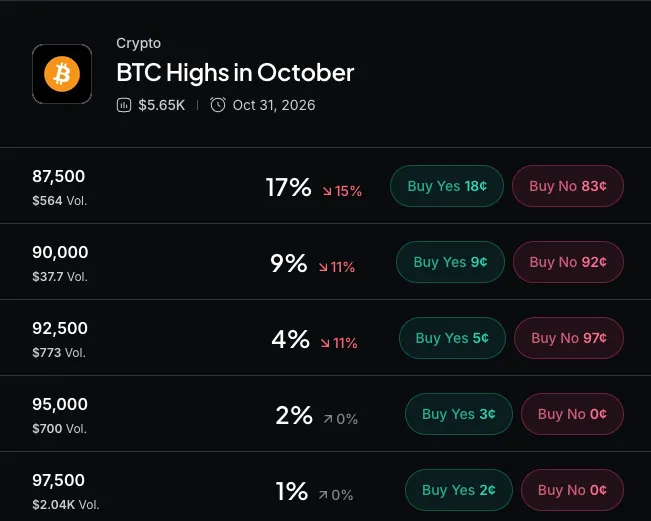
The growing anxiety among traders is increasingly visible in predictive markets. Myriad, a prediction platform, has tracked a notable shift in sentiment regarding Bitcoin’s performance for the remainder of October. Traders are currently assigning a 43% probability to Bitcoin dropping to the $77,500 level before the month closes, a significant jump from the 32% probability recorded just 24 hours prior. Even more telling is the decline in optimism regarding the upside: the probability of Bitcoin topping $87,500 has plummeted from 17% to 10%.
This bearish tilt is mirrored in the sentiment surrounding other assets. While Ethereum bulls maintain a 61.3% confidence level that the asset will reach $3,000 before falling to $1,500, the Solana outlook is narrowing. Bulls currently edge out bears with a 51.6% chance of the asset reaching $160, down from a previous high of 54.9%. These figures are more than just numbers; they represent the collective expectation of a market that is preparing for potential further downside before any renewed attempt at a breakout.
Macroeconomic Implications and Analysis
The current state of the crypto market cannot be decoupled from the wider macroeconomic climate. The midweek market selloff, which saw oil prices surge and AI stocks retreat, highlights the interconnected nature of modern asset classes. Bitcoin, once touted as an "uncorrelated" asset, has increasingly demonstrated high sensitivity to global liquidity conditions. When major indices slide, crypto often experiences a magnified reaction due to its 24/7 trading cycle and higher volatility profile.
Analysts have described the current phase as a "wait-and-see" environment. This terminology refers to a period of consolidation where investors are looking for clear signals from major central banks and domestic economic indicators, such as inflation data and unemployment reports. The J.P. Morgan forecast for 10% annual returns remains a long-term anchor for bullish investors, but in the short term, the market is clearly prioritizing capital preservation over aggressive expansion.
The cumulative net inflows of $57.6 billion since the inception of spot Bitcoin ETFs remain a testament to the long-term commitment of institutional players. However, the short-term fluctuations observed this week serve as a reminder that even institutional-grade assets are subject to the whims of broader market volatility.
Conclusion: Looking Ahead
As October draws to a close, the focus shifts to whether the funds can recover from their current monthly deficit. The volatility of the past week underscores the fragility of current market sentiment, which remains highly reactive to macro-level developments. Investors and analysts alike will be watching the next few sessions closely to determine if the outflow trend represents a structural retreat or merely a temporary correction within a larger, ongoing cycle of institutional adoption.
For now, the market remains in a state of flux. The data from the past week confirms that while the infrastructure for crypto investment is more robust than ever, the behavior of the participants remains governed by the same fundamental principles of risk and reward that drive all traditional markets. Whether Bitcoin can reclaim its October gains or if it will face further downward pressure depends on a complex interplay of global economic data, investor patience, and the continued maturation of the ETF ecosystem.
Disclaimer: The views and information presented in this report are for educational and informational purposes only and do not constitute financial, investment, legal, or professional advice. Market data provided is based on available public information and may be subject to revision. Readers should conduct their own research and consult with a qualified financial advisor before making any investment decisions.
