

For decades, the divide between liquid public markets and illiquid private equity has defined the investment landscape, with traditional investors often viewing stocks as "funny money"—assets that lack the tangible utility of real estate until liquidated. However, the recent performance of the artificial intelligence sector, exemplified by the rapid valuation growth of the AI assistant platform Instinct, is challenging these long-standing conventions. As companies stay private for longer durations, a significant portion of value creation is now occurring well before an initial public offering (IPO), forcing institutional and individual investors alike to reconsider the role of venture capital in a diversified portfolio.
Instinct, an AI assistant accessible via standard text messaging, has emerged as a case study in the current hyper-speed funding cycle of the Silicon Valley tech ecosystem. Founded in April 2026 by Noah Shinn, a former research scientist at Sierra, the startup has achieved a valuation trajectory that defies historical benchmarks for early-stage companies.
A Chronology of Unprecedented Growth
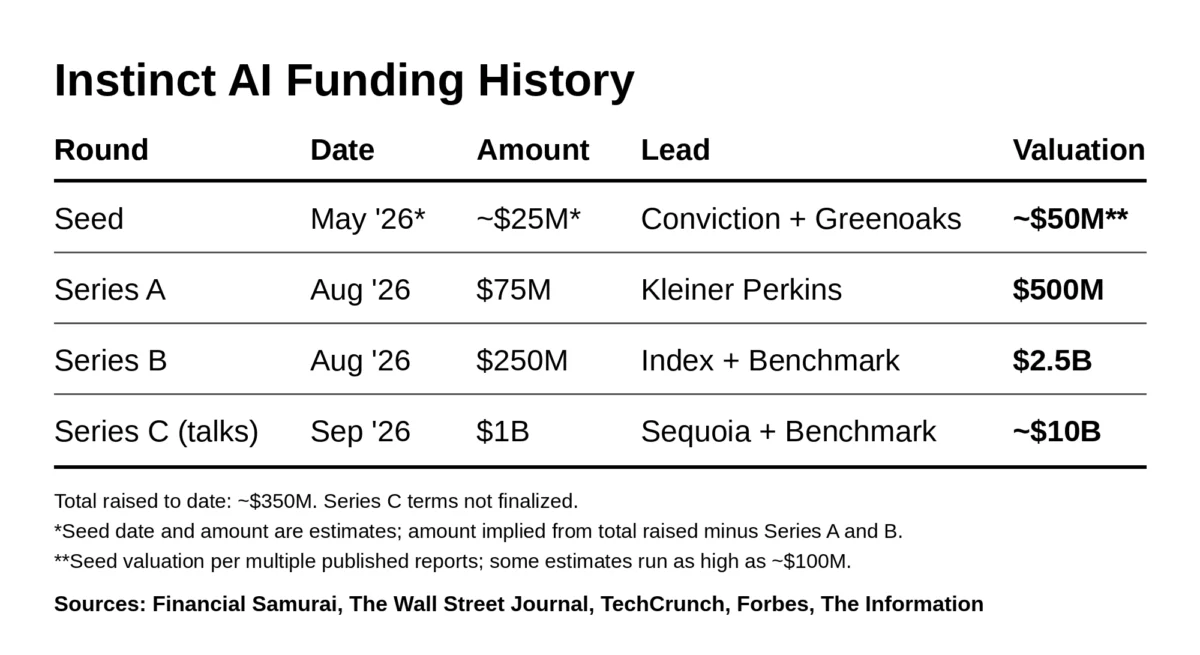
The funding timeline for Instinct illustrates the aggressive appetite of venture capital firms for AI infrastructure and consumer-facing applications.
- April 2026: The company is formally registered.
- Late Spring 2026: The seed round is finalized, backed by Conviction and Greenoaks, at a reported valuation of $50 million.
- August 2026: Kleiner Perkins leads a $75 million Series A funding round, driving the valuation to $500 million.
- Late August 2026: In a move indicating intense investor competition, Index Ventures and Benchmark co-lead a $250 million Series B round, pushing the company’s valuation to $2.5 billion.
- September 2026: Reports emerge that the company is in advanced negotiations for a $1 billion raise at a $10 billion valuation, with participation from marquee firms Sequoia Capital and Benchmark.
This growth, resulting in a potential 200x gross return for seed investors in approximately five months, represents an outlier even by the standards of the modern venture capital industry. The pace at which Instinct has scaled its valuation suggests that capital allocators are betting heavily on the company becoming a dominant layer in the personal AI assistant market, potentially rivaling established tech giants.
Understanding the Mechanics of Paper Gains
For Limited Partners (LPs) and venture funds, these valuations generate significant "paper gains," which serve as a primary indicator of fund health even in the absence of liquidity. To navigate these metrics, analysts and investors rely on three key performance indicators: MOIC, TVPI, and DPI.
Multiple on Invested Capital (MOIC) measures the current value of an investment relative to the original capital deployed. In the case of Instinct, if the $10 billion valuation round closes, the dilution from successive rounds must be factored in. Analysts estimate that accounting for dilution from the Series B and the subsequent $1 billion round, a seed investor could see a gross MOIC of approximately 16x. However, net returns are significantly impacted by "carry"—the performance fee charged by General Partners (GPs), typically ranging from 20% to 35%—which reduces the actual profit realized by the LP.
Total Value to Paid-In Capital (TVPI) serves as the broader scorecard for a fund. It combines distributed cash with the Net Asset Value (NAV) of remaining holdings, divided by the total capital contributed by LPs. Because funds often call capital over several years, the TVPI provides a snapshot of performance before an exit occurs. The primary caveat remains that valuations are subject to "marking" lags; a fund’s reported TVPI may not reflect the latest market valuation until the deal officially closes and is incorporated into quarterly financial statements.

Finally, Distributions to Paid-In Capital (DPI) remains the industry’s "gold standard" for actual financial health. Unlike TVPI, which reflects theoretical value, DPI tracks cash returned to investors. In the current venture climate, the industry is witnessing a disconnect where high TVPIs are common, yet DPI remains low due to the lack of IPO activity and M&A exits. Consequently, while paper gains provide a psychological sense of wealth creation and portfolio growth, they cannot be deployed for capital expenditures or personal financial obligations until a liquidity event occurs.
Broader Economic Implications and Sector Volatility
The rapid appreciation of companies like Instinct has significant implications for the broader San Francisco and global tech economies. As AI startups command record-breaking valuations, the "wealth effect" in tech hubs is intensifying. This influx of capital influences local real estate, services, and the broader labor market, as high-net-worth individuals and venture-backed employees circulate newfound wealth throughout the economy.
However, this environment is not without risk. The reliance on continuous funding rounds to sustain high valuations creates a dependency on favorable market conditions. AI startups are currently facing significant operational hurdles, including intense competition for compute power and the logistical challenges of scaling invite-only platforms to hundreds of millions of users. If user adoption fails to materialize or if established tech incumbents—such as Meta or Google—successfully integrate competing, lower-cost AI assistants, the valuations of high-flying startups could face significant downward pressure.
Furthermore, the "fear of missing out" (FOMO) that permeates the current investment climate has accelerated the deployment of capital into the AI sector. For many investors, participating in venture funds is a defensive strategy to maintain parity with the rapid wealth creation occurring within the tech industry. As traditional asset classes experience varying degrees of volatility, the shift toward venture capital as an essential component of a high-net-worth portfolio has become more pronounced.
Institutional Perspectives on AI Infrastructure
While the paper gains of software-centric AI companies capture headlines, institutional investors are increasingly looking toward the physical infrastructure that enables the AI boom. The industry consensus is that artificial intelligence is fundamentally a compute-intensive endeavor. Consequently, the bottleneck for AI development is not just software innovation, but the physical reality of data centers, power generation, and permitting.
Investment trends are shifting toward real assets that provide the backbone for AI. While software-based venture returns offer the potential for exponential growth, they remain highly speculative. In contrast, investments in data center real estate, energy infrastructure, and fiber optics offer a more stable, albeit less explosive, risk-reward profile. This "infrastructure-first" approach is becoming a staple for diversified portfolios seeking to capitalize on the AI revolution without relying solely on the mark-to-market fluctuations of private tech valuations.
Conclusion
The case of Instinct highlights the duality of modern venture capital: the excitement of participating in a potentially transformative technology versus the harsh reality of illiquidity. While the reported valuation growth is historic, it remains a reflection of investor sentiment rather than realized cash flow. For the individual investor, the lesson is clear: venture capital can offer unparalleled returns, but it requires a high risk tolerance and the understanding that until a liquidity event occurs, the gains remain purely theoretical. As the AI sector continues to evolve, the distinction between "funny money" paper valuations and tangible, income-generating assets will remain the defining challenge for capital allocators navigating an increasingly complex and digital-first financial environment.
