

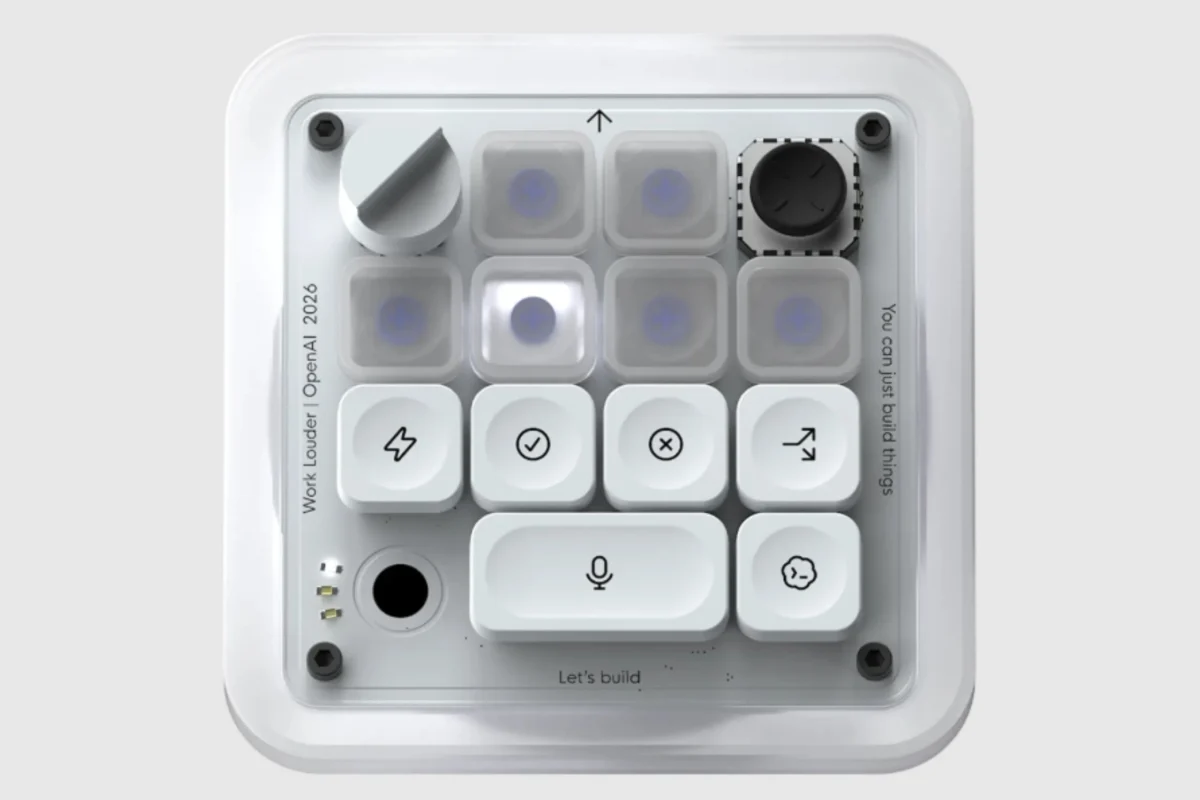
OpenAI, the San Francisco-based artificial intelligence research laboratory, has officially transitioned from a software-centric enterprise into the hardware sector with the launch of its first physical product, the Micro. Developed in close collaboration with the specialty keyboard design firm Work Louder, the Micro is a compact, artisanal macropad specifically engineered to integrate with the ChatGPT ecosystem. While the device is being marketed as a productivity enhancer for developers and power users, its release comes at a tumultuous time for the company, which is currently navigating a high-stakes legal battle with Apple and internal shifts regarding its long-term hardware strategy.
The Micro is priced at $230, positioning it as a premium accessory within the niche market of mechanical keyboards and productivity peripherals. Its primary function is to provide physical shortcuts for ChatGPT and OpenAI’s agentic coding tool, Codex. The device features a minimalist aesthetic characterized by a sturdy, heavy-duty build that reviewers have noted feels substantial enough to serve as a high-end desktop ornament. However, the launch has sparked a debate within the tech community regarding the utility of dedicated AI hardware in an era where software integration is increasingly seamless.
Technical Specifications and User Interface
The Micro’s physical layout is divided into two primary sections of six keys each. The top row consists of "agent" keys, which are frosted and backlit with multi-colored LEDs. These keys are designed to be mapped to specific "agents" or persistent chat sessions within the ChatGPT interface. By pressing an agent key, a user can instantly switch between different AI-driven projects, such as a code debugging session, a creative writing draft, or a data analysis task.
Below the agent keys are six command keys intended for navigation and execution of tasks within the OpenAI software environment. A standout feature of the hardware is the dedicated voice dictation button. By holding this button, users can bypass manual typing, leveraging OpenAI’s Whisper speech-to-text technology to input prompts directly into the application. Once the dictation is complete, an adjacent "send" button allows for immediate submission.
The device offers dual-mode connectivity, supporting both Bluetooth for wireless setups and a USB-C connection for low-latency wired use. Customization is handled through a dedicated "Micro" tab within the ChatGPT web and desktop applications. From this interface, users can adjust the brightness of the key backlighting, reassign key functions, and manage the specific GPT models or sessions associated with each physical button.
To assist users in monitoring the AI’s status, the Micro employs a color-coded notification system through its LED-backlit keys. A white light indicates that an agent is currently idle; a pulsing blue light signals that the AI is processing a request; green indicates a successfully completed task; and red serves as a warning for errors or connectivity issues.
The Competitive Landscape and Market Reception
The $230 price tag has become a focal point of criticism from early adopters and tech analysts. In the broader peripheral market, established devices like the Elgato Stream Deck offer similar macro-programming capabilities for approximately $150, though they lack the specific, out-of-the-box integration with OpenAI’s proprietary API. Independent tech outlets have pointed out that for many professional coders—the Micro’s primary target demographic—the cost is difficult to justify when compared to DIY solutions or standard mechanical keyboards with programmable layers.
Reception on community platforms like Reddit has been decidedly mixed. While some enthusiasts appreciate the "clicky" tactile feedback and the vintage-inspired design provided by Work Louder, others have dismissed the product as a "novelty" or a "prank." Critics argue that for a seasoned developer, the time required to memorize a new set of physical key mappings may outweigh the efficiency gains of not using a mouse to switch tabs.
Despite these criticisms, the Micro represents a significant branding exercise for OpenAI. The packaging of the device—a clean, immaculate white box with minimalist typography—has drawn immediate comparisons to Apple’s iconic industrial design. This "Apple-coded" presentation is particularly notable given the current legal tensions between the two companies.
Legal Turmoil and the Apple Conflict
The launch of the Micro is shadowed by a major lawsuit filed by Apple Inc. against OpenAI. The litigation, initiated several weeks ago, accuses OpenAI of trade secret theft. Apple alleges that OpenAI recruited several of its high-level engineers and executives to jumpstart its hardware division, potentially utilizing proprietary knowledge related to neural processing units and consumer electronics design.

This legal friction is compounded by reports of another, more ambitious hardware project currently in development at OpenAI. Industry insiders suggest the company is working on a screenless smart home speaker designed to act as a central hub for ChatGPT-driven home automation. Reports indicate that this upcoming device is being spearheaded by former Apple hardware veterans, including individuals who worked closely under Jony Ive, Apple’s former Chief Design Officer.
The conflict highlights the intensifying rivalry between traditional tech giants and the new wave of AI-first companies. As Apple prepares to roll out its own "Apple Intelligence" features across its product line, OpenAI’s move into physical hardware suggests an attempt to establish a direct, hardware-level relationship with users, bypassing the operating systems controlled by Apple, Google, and Microsoft.
Contextualizing the AI Hardware Trend
OpenAI’s entry into hardware follows a string of high-profile, yet commercially struggling, AI-dedicated devices released over the past year. Products like the Humane AI Pin and the Rabbit R1 attempted to replace the smartphone with AI-native interfaces, but both faced harsh reviews due to poor battery life, slow processing speeds, and limited utility.
Unlike those devices, which sought to be standalone computers, the OpenAI Micro is positioned as a "macropad"—a peripheral intended to augment an existing workstation. This conservative approach may be a strategic choice by OpenAI to test the waters of the hardware market without the risks associated with building a full mobile operating system.
The Micro serves as a physical manifestation of "agentic workflows." In the field of AI, "agents" are autonomous or semi-autonomous programs capable of performing complex, multi-step tasks. By providing physical buttons for these agents, OpenAI is signaling a future where users don’t just "chat" with an AI, but manage a fleet of specialized digital workers.
Strategic Implications and Future Outlook
For OpenAI, the Micro is likely less about generating significant hardware revenue and more about ecosystem lock-in. By placing a branded physical object on a user’s desk, OpenAI increases the friction for that user to switch to a competing LLM (Large Language Model) like Google’s Gemini or Anthropic’s Claude.
The collaboration with Work Louder also suggests that OpenAI is interested in the "prosumer" market—users who value both high-end design and specialized functionality. Work Louder has built a reputation for creating "creator boards" that cater to designers and editors, and this partnership allows OpenAI to tap into an established community of hardware enthusiasts.
However, the long-term viability of the Micro remains uncertain. As software-based keyboard shortcuts and voice-activation features become more integrated into standard operating systems (such as the new "Copilot" key on Windows laptops), the need for a $230 external keypad may diminish.
The true test for OpenAI’s hardware ambitions will be the rumored smart home device. If the company can successfully navigate its legal battle with Apple and deliver a product that offers a superior user experience through former Apple talent, it could redefine how consumers interact with artificial intelligence in their daily lives. For now, the Micro stands as a sturdy, well-crafted, but controversial first step into the physical world—a device that serves as both a tool for power users and a statement of intent for a company no longer content with staying inside the screen.
As the legal proceedings with Apple move into the discovery phase, the tech industry will be watching closely to see if OpenAI’s hardware team can continue to innovate or if the "Micro" will remain a solitary artifact of a brief foray into artisanal electronics. For the "code monkeys" and ChatGPT power users who have already embraced the device, it represents a tangible link to the digital intelligence they rely on, provided they are willing to pay the premium for a "fancy little keypad."
