

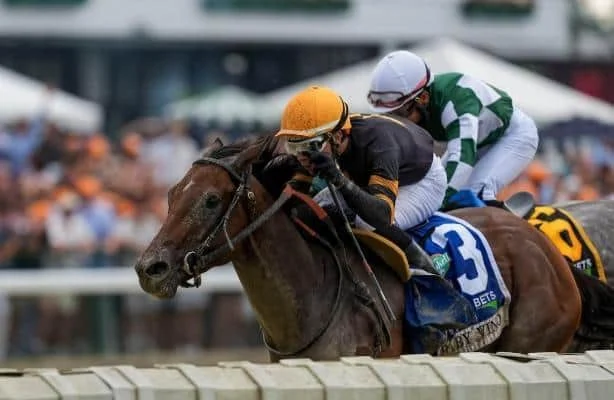
In a stunning display of resilience and tactical positioning, Baby Vino captured the 2026 edition of the Grade 1, $1 million Haskell Stakes at Monmouth Park on Saturday, overcoming long odds and a challenging sloppy track to secure a career-defining victory. Navigating the 1 1/8-mile distance with precision under jockey Jorge Vargas Jr., the three-year-old son of Vino Rosso stalked the pace, engaged in a grueling stretch duel with the front-running Napoleon Solo, and ultimately prevailed by a narrow head. The victory not only marked Baby Vino’s first Grade 1 triumph but also secured him an automatic, all-expenses-paid berth in the Breeders’ Cup Classic later this year through the "Win and You’re In" Challenge Series.
The afternoon at the Oceanport, New Jersey, oval was defined by inclement weather, which left the main track rated as sloppy. Despite the unfavorable conditions, a crowd of dedicated racing enthusiasts witnessed one of the most significant upsets in the recent history of the Haskell. Sent off at odds of 28-1, Baby Vino was the second-longest shot in the seven-horse field, returning a staggering $58.00 for a $2 win bet. The victory provided a major milestone for trainer Lindsay Schultz and owners Cosmo Stables and Delta Squad Racing, who saw their colt transition from a local stakes winner to a legitimate contender on the national stage.
A Duel Through the Mud: The Race Chronology
The narrative of the 2026 Haskell Stakes began at the break, where Napoleon Solo, ridden by veteran Paco Lopez, utilized his gate speed to seize an immediate lead. Lopez, known for his prowess on the Monmouth Park circuit, guided Napoleon Solo through sensible opening fractions of 24.15 seconds for the first quarter-mile and 48.29 seconds for the half-mile. While Napoleon Solo dictated the tempo, the heavy post-time favorite, Further Ado, sat in a tracking position under Irad Ortiz Jr., appearing poised to strike as the field moved toward the backstretch.
As the leaders hit the six-furlong mark in :12.01, the complexion of the race began to shift. Baby Vino, who had been settled comfortably in fifth position during the early stages, began to make his move under Jorge Vargas Jr. Tipping his mount out to find clear running room, Vargas accelerated approaching the far turn, surging past Star Sweeper and the fading Further Ado to loom as the primary threat to Napoleon Solo.
By the time the field reached the top of the stretch, the race had evolved into a two-horse battle. Napoleon Solo held a slim advantage, but Baby Vino, hugging the rail, refused to concede. The two colts raced "heads apart" for the final furlong, with the gray Napoleon Solo fighting gamely on the outside while Baby Vino found more under left-handed urging from Vargas. The clock stopped at 1:50.18 as Baby Vino surged ahead in the final strides to claim the victory.
The Stewards’ Inquiry and Final Results
The drama did not end at the wire. Shortly after the horses crossed the finish line, the stewards at Monmouth Park posted the inquiry sign, reviewing the high-stakes stretch run. The focus of the review was the physical proximity and potential interference between Baby Vino and Napoleon Solo as they battled toward the wire. After several minutes of deliberation and a review of multiple camera angles, the stewards determined that while the horses were in close quarters, no infraction had occurred that warranted a disqualification. The result was made official, sparking celebrations in the Baby Vino camp.
The final order of finish saw Baby Vino ($58.00, $19.20, $7.00) in the winner’s circle, followed by Napoleon Solo ($5.60, $4.40) in second. Iron Honor, who rallied from mid-pack under Flavien Prat, finished third, paying $4.20 to show. The Puma, who was last through much of the middle stages, managed to close for fourth, followed by a disappointing Further Ado in fifth, Star Sweeper in sixth, and Ocelli trailing the field in seventh.
Tactical Brilliance: Analysis of the Performance
The success of Baby Vino can be attributed to a combination of tactical maturity and an affinity for the Monmouth Park surface. Prior to Saturday’s G1 victory, the colt had served notice of his talent with a dominant 10 3/4-length win in the Pegasus Stakes, the local prep race for the Haskell. However, many handicappers dismissed that performance as being against lesser competition, leading to his high odds on Saturday.
Jorge Vargas Jr.’s ride was instrumental in the upset. By opting to save ground along the rail during the final turn, Vargas capitalized on the shortest path to the wire. This strategy was particularly effective given the sloppy track conditions, where the rail can sometimes be a disadvantage, but on this day, it provided the necessary opening for Baby Vino to launch his bid.
"He’s a horse that just keeps giving," Vargas noted in the post-race environment. "When I asked him at the eighth pole, I knew we had a chance. He didn’t care about the mud or the horse next to him; he just wanted to get his head in front."
Background: The Rise of Lindsay Schultz
The victory represents a breakthrough moment for trainer Lindsay Schultz. A former assistant to Hall of Fame trainer Shug McGaughey, Schultz has been steadily building a reputation as a shrewd conditioner since launching her own stable. Winning a Grade 1 race of the Haskell’s magnitude solidifies her position among the top tier of trainers in the Mid-Atlantic region and beyond.
For the ownership group of Cosmo Stables and Delta Squad Racing, the win is the culmination of a patient approach with a horse that has shown steady improvement throughout his three-year-old campaign. The decision to skip other major summer targets in favor of staying at Monmouth Park for the Pegasus and Haskell proved to be a masterstroke of scheduling.
Pedigree and Breeding: The Vino Rosso Connection
Baby Vino’s pedigree suggested he would handle the 1 1/8-mile distance and the off-track conditions with ease. He is a son of Vino Rosso, the 2019 Breeders’ Cup Classic winner and Eclipse Award champion for Older Dirt Male. Vino Rosso, standing at Spendthrift Farm, has been noted for producing offspring with significant "bottom"—the stamina and grit required for classic distances.
On his dam’s side, Baby Vino carries lines that emphasize durability, a trait that was on full display as he fended off a seasoned campaigner like Napoleon Solo. The victory adds significant value to the colt’s future stallion prospects, marking him as a Grade 1 winner from a championship sire line.
Implications for the Three-Year-Old Division
The 2026 Haskell Stakes has injected a dose of uncertainty into the three-year-old male division rankings. Entering the weekend, the division lacked a clear leader, with several different horses winning the Triple Crown races earlier in the spring. Further Ado, the favorite in the Haskell, was expected to assert dominance but his fifth-place finish suggests he may have struggled with the track surface or the quick turnaround from his previous start.
Conversely, Baby Vino now enters the conversation for the Eclipse Award. While he will likely need another strong showing in a race like the Travers Stakes at Saratoga or the Pennsylvania Derby to cement his status, a Grade 1 win in the Haskell is a formidable credential.
The Road to the Breeders’ Cup Classic
By virtue of his victory, Baby Vino has earned a "Win and You’re In" ticket to the Breeders’ Cup Classic, scheduled to be held at Del Mar in November. This incentive program is vital for mid-sized stables, as it covers entry fees and provides a travel allowance, ensuring that the Haskell winner will have a spot in the starting gate for the world’s richest dirt race.
The transition from the Haskell to the Breeders’ Cup Classic is a path well-traveled by champions. Notable horses such as American Pharoah and Authentic have used the Haskell as a springboard to year-end championship honors. While Baby Vino was an underdog on Saturday, his performance suggests he possesses the tactical speed and stamina required to compete against older horses on the international stage.
Historical Context: Haskell Upsets
The Haskell Stakes has a long history of producing legendary performances, but it is also known for occasional shocks. Baby Vino’s $58.00 win price ranks among the higher payouts in the race’s history, though it does not quite reach the record heights of some of the legendary longshots of the 20th century. Nonetheless, in an era where the Haskell often attracts small, top-heavy fields, a 28-1 winner is a significant statistical anomaly that will be remembered by bettors and historians alike.
The race also continued the tradition of the "Monmouth Horse" performing well on their home turf. Baby Vino’s familiarity with the track, having trained and raced there throughout the early summer, likely gave him a "home court advantage" over shippers who were dealing with the New Jersey humidity and the specific consistency of the Monmouth dirt.
Conclusion and Looking Ahead
As the sun set over Monmouth Park, the connections of Baby Vino were already looking toward the future. The immediate plan for the colt involves a period of recovery before a potential target in late August. With a Grade 1 trophy now on his mantle and a spot in the Breeders’ Cup secured, the pressure has shifted from qualifying for the big stage to performing on it.
For the racing world, the 2026 Haskell Stakes served as a reminder of the sport’s inherent unpredictability. On a day when the favorites faltered in the mud, a determined colt with a champion’s pedigree and a perfectly timed ride rose to the occasion, rewriting the narrative of the three-year-old season in the process. Baby Vino’s name is now etched in the annals of Monmouth Park history, alongside the greats who have conquered the Haskell.
