

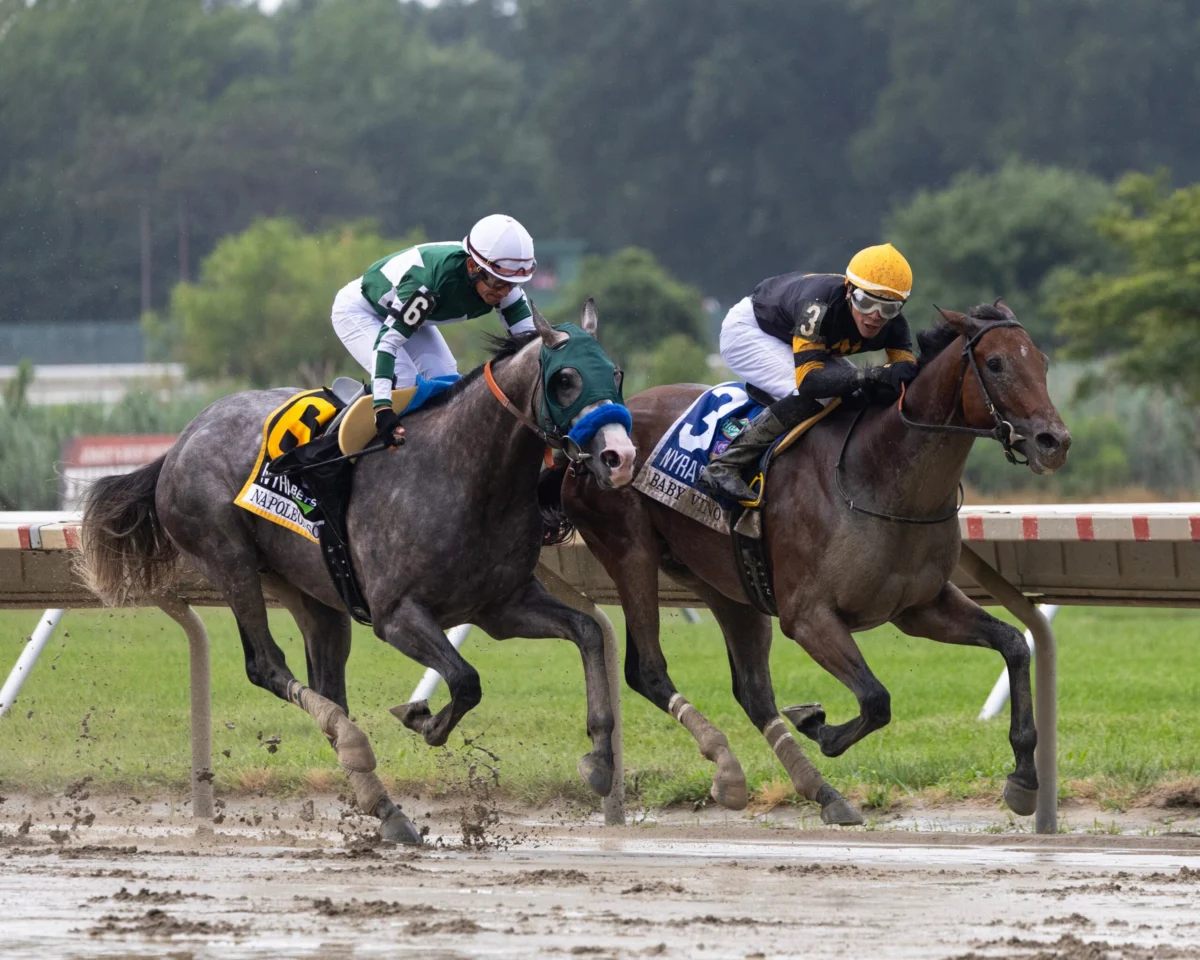
In a performance that defied both the betting market and the deteriorating track conditions at Monmouth Park, the unheralded Baby Vino surged to a gritty victory in the $1 million Haskell Stakes (G1) on July 18. Navigating a sloppy surface and surviving a tense stewards’ inquiry, the 3-year-old colt not only secured the most prestigious win of his young career but also guaranteed himself a starting spot in the upcoming Breeders’ Cup Classic. The victory provided a staggering $58.00 payout for a $2 win ticket, marking one of the most significant upsets in the recent history of the Jersey Shore’s centerpiece race.
The Haskell Stakes has long served as a pivotal crossroads for the nation’s top 3-year-olds, often acting as a bridge between the grueling Triple Crown season and the championship festivities of the autumn. This year’s edition, however, was defined by a battle of attrition rather than a coronation of a heavy favorite. Under a tactical ride by Jorge Vargas Jr., Baby Vino demonstrated a level of tenacity that many observers felt was lacking in his previous outings, ultimately outslugging the Preakness Stakes (G1) hero Napoleon Solo in a stretch drive that will be remembered for its physical intensity.
A Duel Through the Slop: The Race Narrative
The race began under ominous skies, with the Monmouth Park main track rated as "sloppy" following heavy afternoon precipitation. As the gates opened for the 1 1/8-mile test, Napoleon Solo, the reigning Preakness champion, immediately sought the lead. Known for his front-running prowess, Napoleon Solo dictated the tempo through the early stages, carving out relatively moderate fractions of :24.15 for the opening quarter-mile and :48.29 for the half.
While Napoleon Solo appeared to be traveling comfortably on the lead, Jorge Vargas Jr. kept Baby Vino within striking distance, positioning the colt just off the leader’s flank. As the field entered the second turn, the complexion of the race shifted. Napoleon Solo maintained a narrow advantage through six furlongs in 1:12.01, but Baby Vino began to apply relentless pressure.
By the time the duo reached the head of the stretch, the race had transformed into a two-horse match. The final three-eighths of a mile saw Baby Vino and Napoleon Solo locked in a fierce "slugfest," with neither runner willing to yield. As they straightened for home, the proximity of the two horses led to a series of bumps and brushes. The physical contact appeared to galvanize Baby Vino, who slowly but surely began to edge away from the Preakness winner. In the closing yards, Baby Vino found an extra gear, inching clear to cross the wire first in a final time of 1:50.18.
Stewards’ Inquiry and the Final Order of Finish
The drama did not conclude at the finish line. Due to the repeated contact between the top two finishers in the stretch, the stewards immediately posted the inquiry sign, and the jockey of Napoleon Solo lodged an objection. For several tense minutes, the Monmouth Park crowd waited as officials reviewed multiple camera angles of the home-stretch battle.
The video replays showed both horses drifting slightly under pressure, contributing to the "bumps" mentioned in the official race notes. Ultimately, the stewards determined that both runners were equally responsible for the contact and that the interference did not cost Napoleon Solo a better placing. The "no change" announcement was met with a mix of cheers and sighs of relief from those holding Baby Vino’s longshot tickets.
Behind the top two, the rest of the field struggled to keep pace. Iron Honor finished a distant third, unable to threaten the leaders but clear of the fourth-place finisher, The Puma. Perhaps the biggest disappointment of the afternoon was the performance of the post-time favorite, Further Ado. Regarded as a "Hot Prospect" by many analysts, Further Ado never appeared comfortable on the sloppy footing and finished a lackluster fifth, failing to live up to the pre-race hype.
Technical Performance and Timing Analysis
Baby Vino’s winning time of 1:50.18 for the nine-furlong distance reflects the taxing nature of the sloppy track. While not a track record, the internal splits suggest a race of high endurance. The opening quarter of :24.15 and the half-mile of :48.29 were honest but not blistering, allowing the leaders to save enough energy for the final showdown.
The most impressive aspect of the performance was Baby Vino’s ability to sustain his run through the final three furlongs. While Napoleon Solo set the pace, Baby Vino was the one who forced the issue, effectively "breaking" the leader’s spirit in the deep stretch. The $58.00 win payout suggests that the betting public vastly underestimated the colt’s affinity for a wet track and his overall improvement since his last start.
Pedigree and Connections: The Rise of a New Star
Baby Vino is a 3-year-old bay colt with a pedigree that suggested he might appreciate both the distance and the challenging conditions. He is a son of Vino Rosso, the 2019 Breeders’ Cup Classic champion and Eclipse Award winner for Champion Older Dirt Male. Vino Rosso himself was known for his durability and his ability to excel at the 1 1/8 to 1 1/4-mile distances.
Out of the Discreetly Mine mare Discreetly Grand, Baby Vino was bred to be a high-level dirt runner. This victory represents a massive milestone for trainer Lindsay Schultz, who has been steadily building a reputation for getting the best out of developing 3-year-olds. Schultz’s patient approach with Baby Vino paid dividends on the grandest stage of the Monmouth summer meet.
The ownership group, consisting of Cosmo Stables and Delta Squad Racing, celebrated in the winner’s circle, acknowledging the long road it took to reach Grade 1 glory. For jockey Jorge Vargas Jr., the win was a testament to his tactical awareness, as he chose to engage Napoleon Solo early enough to ensure the race became a test of stamina rather than a sprint to the finish.
The Road to the Breeders’ Cup Classic
As part of the Breeders’ Cup Challenge Series: "Win and You’re In," Baby Vino’s victory in the Haskell Stakes carries implications far beyond the $1 million purse. The colt has now earned a fully paid, automatic berth into the Grade 1 Breeders’ Cup Classic, scheduled for October 31 at Keeneland.
The Breeders’ Cup Classic is widely regarded as the most important race for older horses and elite 3-year-olds in North America. By securing his spot in July, Baby Vino’s connections now have the luxury of hand-picking his path to Kentucky. They can afford to give the colt ample rest or choose a single prep race in the late summer or early fall, knowing that his entry into the main event is guaranteed.
For Napoleon Solo, the second-place finish is a respectable effort that confirms his status as one of the top sophomores in training, though it denies him the automatic entry. His team will likely look toward the Travers Stakes at Saratoga as a potential next target to re-establish his dominance.
Historical Significance and Broader Impact
The Haskell Stakes has a storied history of producing champions, including legends like American Pharoah, Rachel Alexandra, and Holy Bull. While Baby Vino entered the race as an outsider, his victory adds to the lore of the Haskell as a race where "any horse can win" if they have the heart to handle the Monmouth stretch.
The defeat of the favorite, Further Ado, and the Preakness winner, Napoleon Solo, serves as a reminder of the volatility of 3-year-old racing, especially when environmental factors like a sloppy track come into play. The result also highlights the growing influence of the Vino Rosso sire line, as his offspring begin to emulate his championship-caliber stamina.
As the racing world shifts its focus toward the summer meets at Saratoga and Del Mar, Baby Vino stands as the newest heavyweight in the division. His performance on July 18 proved that he belongs among the elite, and his upcoming journey to Keeneland will be one of the most anticipated storylines of the fall championship season.
With the official results now confirmed and the inquiry light extinguished, the focus turns to the health and recovery of the runners. Trainer Lindsay Schultz indicated that the colt appeared to emerge from the race in good order, despite the physical nature of the stretch run. Further updates on Baby Vino’s training schedule and his specific path to the Breeders’ Cup are expected in the coming weeks as the 3-year-old championship picture continues to take shape.
