


Abbott Laboratories, a global leader in medical diagnostics and healthcare technology, is currently managing the fallout from two separate cybersecurity incidents involving unauthorized access to its internal systems and a customer-facing portal. The Chicago-based multinational confirmed that it is investigating a breach within its Cancer Diagnostics business, specifically involving legacy systems associated with Exact Sciences. Simultaneously, the company is addressing claims from a different threat actor regarding a data exfiltration event at its LabCentral customer portal, which serves its core laboratory diagnostics division.
The dual nature of these incidents highlights the persistent and multi-pronged threats facing the healthcare and medical technology (MedTech) sectors. While Abbott has stated that these events have not disrupted business operations, manufacturing, or patient care, the claims made by the involved threat actors suggest a significant exfiltration of sensitive information, including personally identifiable information (PII) and internal corporate documentation.
The ShinyHunters Extortion and the Cancer Diagnostics Breach
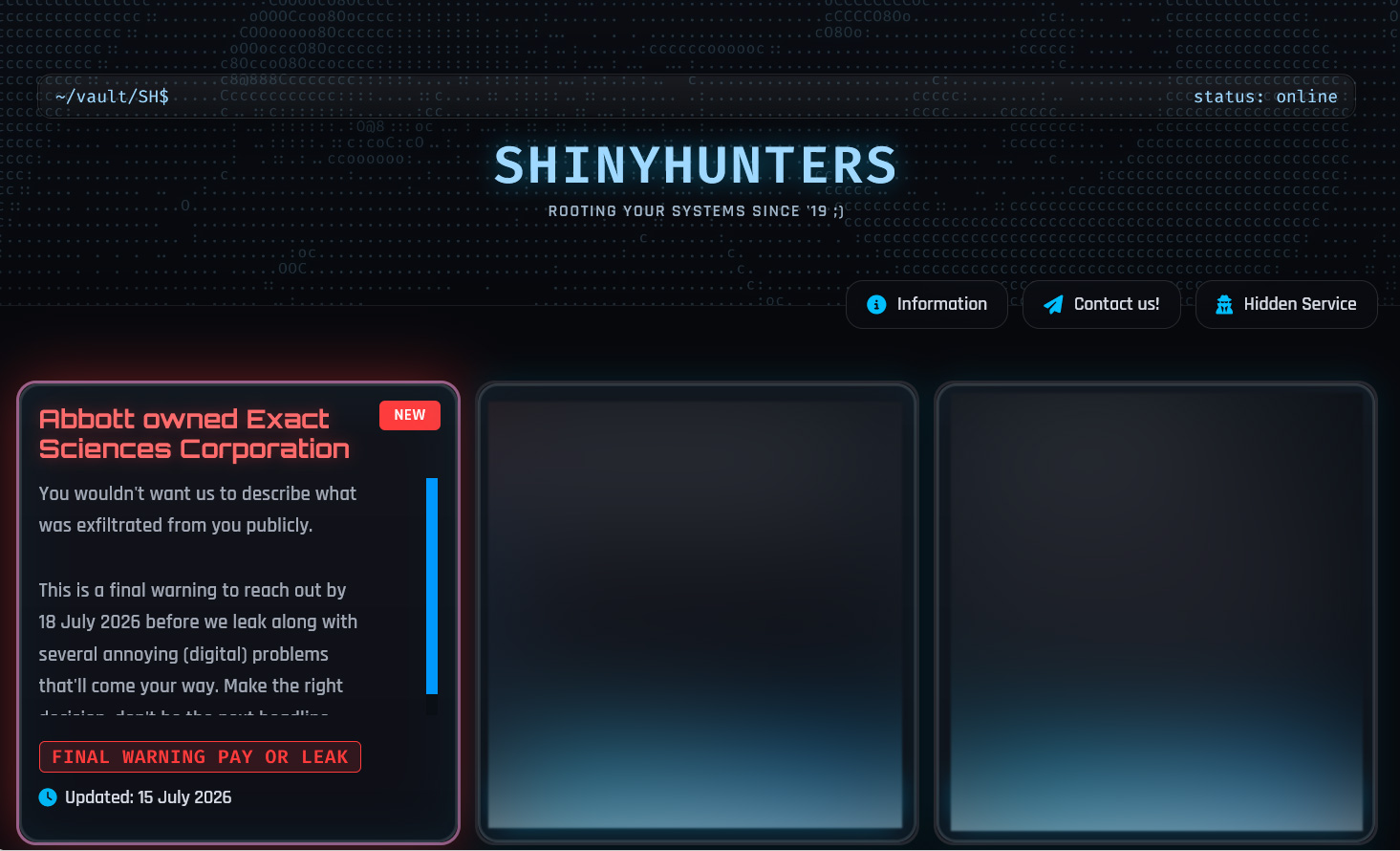
The first and arguably more severe incident involves the notorious extortion group known as ShinyHunters. The group recently added Abbott Laboratories to its public data leak site, an aggressive tactic used to pressure victims into paying a ransom. Initially, the group set a deadline of July 18 for Abbott to enter negotiations, later extending that ultimatum to July 21.
According to ShinyHunters, the breach was not the result of a software vulnerability or a traditional malware infection. Instead, the group claims to have utilized a "vishing" (voice phishing) campaign in mid-June 2026. This social engineering tactic targeted several Abbott employees, eventually allowing the attackers to compromise a Microsoft Entra (formerly Azure AD) single sign-on (SSO) account.
In a modern enterprise environment, an SSO account often serves as a "master key" to a wide array of cloud-based applications. ShinyHunters alleges that by gaining control of this identity-based access point, they were able to pivot into various Software-as-a-Service (SaaS) platforms used by Abbott. The group claims to have exfiltrated data from high-value repositories, including:

- Microsoft Entra and SharePoint: Containing internal documents and collaboration files.
- ServiceNow: Housing IT service management records and potentially internal security protocols.
- Databricks: A data analytics platform that may have contained large-scale datasets.
- Coupa: A spend management platform potentially containing financial contracts and vendor information.
The scale of the data allegedly stolen is staggering. ShinyHunters claims to have exfiltrated over 30 million rows of customer PII. This dataset reportedly includes names, email addresses, phone numbers, physical addresses, and dates of birth. Most concerningly, the group claims the haul includes more than one million Social Security numbers. Furthermore, the attackers allege they have obtained 22 million client notes detailing doctor-patient conversations, 20 million medical orders, and a variety of corporate customer agreements and non-disclosure agreements (NDAs).
Abbott’s official response has been measured. The company confirmed unauthorized access to a "limited number of internal systems" within its Cancer Diagnostics business. Crucially, Abbott clarified that the affected systems are legacy Exact Sciences systems which are maintained separately from Abbott’s primary network infrastructure. The company emphasized that the incident has not impacted other business units or the availability of its medical products.
The LabCentral Incident and ShadowByt3$ Claims
While the ShinyHunters situation unfolded, a second threat actor operating under the pseudonym ShadowByt3$ contacted cybersecurity researchers claiming a separate breach of Abbott’s Core Laboratory diagnostics business. This intrusion allegedly targeted the LabCentral customer portal, an externally facing platform used by clients to access technical documentation and product support.
ShadowByt3$ claims to have gained access to the environment on July 4, 2026, by utilizing compromised customer credentials. The attacker described finding a "weak point" in the portal’s architecture, which allowed them to slowly exfiltrate files by targeting specific API (Application Programming Interface) endpoints.
The data allegedly taken in this second incident includes:
- CE manufacturing certificates.
- Operating manuals and technical specifications.
- Regulatory documentation and product requirement archives.
- Calibrator value assignments and assay files.
Unlike ShinyHunters, ShadowByt3$ stated that no customer PII was targeted or stolen. Instead, the focus appeared to be on sensitive business documents and intellectual property related to Abbott’s laboratory diagnostic systems.
Abbott has acknowledged the "potential" incident at LabCentral but has disputed the attacker’s claims regarding the sensitivity of the data. A spokesperson for the company clarified that LabCentral is a third-party hosted portal designed to house technical product reference documents that are already publicly available. According to Abbott, the portal does not contain proprietary customer data or sensitive business information, effectively categorizing the "theft" as an exfiltration of public-facing manuals and checklists.
Timeline of the Dual Security Events
The chronology of these events suggests a period of sustained pressure on Abbott’s digital perimeter throughout the summer of 2026:
- Mid-June 2026: ShinyHunters begins its vishing campaign, targeting Abbott employees to harvest SSO credentials.
- July 4, 2026: ShadowByt3$ allegedly gains unauthorized access to the LabCentral customer portal via compromised credentials.
- July 17, 2026: Reports of the breaches begin to circulate as ShinyHunters lists Abbott on its extortion site.
- July 18, 2026: The initial ransom negotiation deadline set by ShinyHunters passes.
- July 21, 2026: The extended deadline for ShinyHunters expires; the group threatens the release of 30 million rows of data.
Contextualizing the Threat: The Rise of Identity-Based Attacks
The Abbott incidents reflect a broader trend in the cybersecurity landscape where attackers are moving away from complex "zero-day" exploits in favor of identity-based attacks. By using vishing and social engineering, groups like ShinyHunters can bypass traditional perimeter defenses.
When an attacker successfully compromises an SSO account, they can often bypass Multi-Factor Authentication (MFA) through techniques such as "MFA fatigue" (bombarding a user with push notifications) or by stealing session tokens. This allows them to move laterally through an organization’s cloud environment, accessing everything from Slack communications to Salesforce customer records without ever needing to "hack" the software itself.
ShinyHunters has a well-documented history of such operations. In recent years, the group has claimed responsibility for major data thefts involving companies like Medtronic, OneMedical, and AdaptHealth. Their focus on the MedTech sector is strategic; medical data is highly valued on the dark web because it is permanent—unlike a credit card number, a patient’s medical history and Social Security number cannot be easily changed, making it a "forever" asset for identity thieves.
Corporate and Regulatory Implications
Abbott Laboratories has activated its incident response procedures, which include the engagement of external cybersecurity experts and notification of federal law enforcement. In its public communications, the company stated that it does not expect these incidents to have a material impact on its financial results or overall business operations.

However, the regulatory environment for healthcare data is becoming increasingly stringent. Under the Health Insurance Portability and Accountability Act (HIPAA) in the United States, and the General Data Protection Regulation (GDPR) in Europe, the loss of patient data can result in significant fines and mandatory long-term monitoring for affected individuals. If the ShinyHunters claim regarding the theft of 22 million doctor-patient notes is verified, Abbott could face intense scrutiny from the Department of Health and Human Services (HHS) and other regulatory bodies.
From a financial perspective, while the immediate operational impact may be negligible, the long-term costs of data breach remediation—including legal fees, forensic investigations, and potential settlements—can be substantial. Furthermore, the reputational damage associated with the loss of sensitive medical records can affect trust among healthcare providers and patients who rely on Abbott’s diagnostic tools.
Fact-Based Analysis of the MedTech Security Landscape
The targeting of Abbott is part of a larger, systemic wave of attacks against the medical technology infrastructure. As healthcare becomes more digitized, the "attack surface" for these companies grows. Laboratory systems, diagnostic portals, and remote patient monitoring devices are all potential entry points for cybercriminals.
The incident also highlights the risks associated with "legacy systems." Abbott’s confirmation that the Cancer Diagnostics breach occurred on legacy Exact Sciences systems underscores a common vulnerability: when companies acquire other firms, they often inherit older IT infrastructure that may not meet the parent company’s current security standards. These legacy systems are frequently more difficult to patch and monitor, making them attractive targets for groups like ShinyHunters.
As of late July 2026, neither ShinyHunters nor ShadowByt3$ has released the full datasets they claim to possess. Cybersecurity analysts continue to monitor the situation to determine if the threat actors are bluffing about the volume of data or if a massive leak is imminent. For now, Abbott remains in a state of high alert, reinforcing its defenses and investigating the true extent of the unauthorized access.
The situation serves as a stark reminder to the healthcare industry that identity is the new perimeter. Protecting against social engineering and securing SSO environments is no longer optional; it is a critical component of maintaining patient safety and corporate integrity in an era of sophisticated digital extortion.
