

The vinyl resurgence is no longer a temporary trend but a permanent fixture of the modern music economy. According to year-end reports from the Recording Industry Association of America (RIAA), vinyl records have consistently outsold CDs in units for several consecutive years, with revenues from physical media reaching heights not seen since the 1980s. In this landscape, Sony’s decision to refresh its turntable line is a strategic move to capture a demographic of listeners who value the tactile experience of analog music but demand the seamless integration of modern Bluetooth ecosystems.

The Legacy of the PS-LX310BT and the Transition to 2026
To understand the significance of the PS-LX3BT, one must look at the legacy of its predecessor. The Sony PS-LX310BT became a perennial favorite among consumers due to its "plug-and-play" nature. At a time when many high-end turntables required complex balancing of counterweights and delicate anti-skate adjustments, Sony offered a fully automatic solution. The new PS-LX3BT maintains this philosophy, retaining the same automatic tonearm mechanism that handles the most nerve-wracking part of vinyl playback: placing the needle on the record.
The transition from the 310BT to the 3BT represents what industry analysts call "iterative hardware cycles." While the external aesthetics remain largely unchanged—featuring a sleek, dark gray plinth and a transparent dust cover—the internal upgrades focus on wireless stability. The inclusion of AptX and AptX Adaptive codecs marks a significant step forward, allowing for higher-bitrate audio transmission over Bluetooth, which helps bridge the gap between analog warmth and digital convenience.

Technical Specifications and Assembly
The Sony PS-LX3BT is a belt-drive turntable, a design choice that prioritizes audio fidelity for home listeners. In a belt-drive system, the motor is physically isolated from the platter, connected only by a rubber belt. This separation serves to dampen motor vibrations, preventing mechanical noise from being picked up by the stylus and amplified through the speakers. While direct-drive turntables are preferred by professional DJs for their high torque and quick start times, the belt-drive mechanism of the PS-LX3BT is ideal for the nuanced listening environment of a living room.
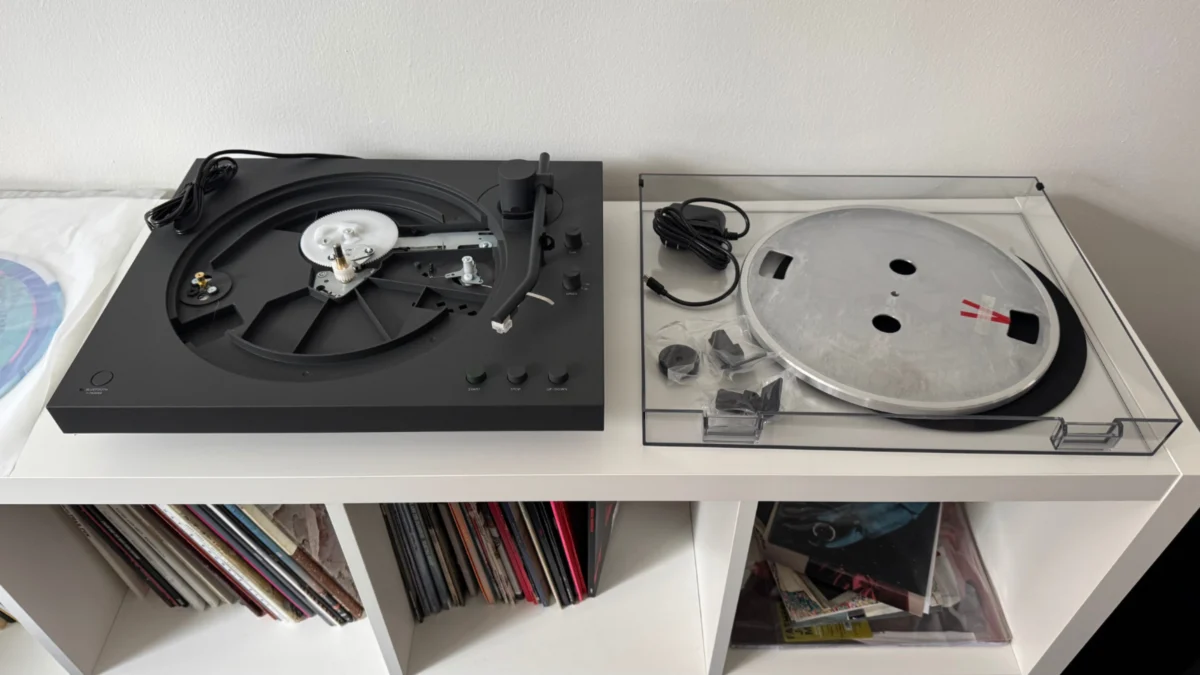
Assembly of the unit is designed to be accessible to those who have never handled a turntable before. The box contains the main plinth, an aluminum platter, a rubber drive belt, and a felt slip mat. The user simply places the platter on the spindle and loops the belt over the motor pulley through a pre-cut window in the platter. Unlike enthusiast-grade players, the PS-LX3BT comes with a pre-mounted cartridge and a factory-set tracking force, eliminating the need for a stylus force gauge or complicated calibration.

The Automation Advantage: Bridging the Gap for Novices
The defining feature of the PS-LX3BT is its fully automatic operation. For the uninitiated, manual turntables require the user to lift the tonearm, position it over the lead-in groove, and lower it using a cueing lever. At the end of the record, a manual player will continue to spin the needle in the run-out groove until the user intervenes.
Sony’s automatic system removes this friction. By pressing the "Start" button, the machine engages a series of gears that lift the tonearm, move it to the edge of the record, and lower it with precision. Once the side is finished, the tonearm automatically returns to its rest, and the motor shuts off. This feature is not just a matter of convenience; it protects the stylus and the vinyl from accidental damage caused by unsteady hands, making it a "fail-safe" option for younger listeners or those new to the hobby.

Connectivity and the Bluetooth Controversy
The inclusion of Bluetooth in a turntable often sparks debate among audiophiles. The primary argument against it is that the process of converting an analog signal to a digital Bluetooth stream—and then compressing it for transmission—negates the "pure" analog benefits of vinyl. However, Sony’s implementation of AptX Adaptive technology in the PS-LX3BT addresses some of these concerns by providing a more robust, low-latency connection that preserves more detail than standard SBC Bluetooth.
For many modern listeners, the trade-off is worth it. The ability to pair a turntable with a pair of Sony WH-1000XM6 headphones or a high-quality soundbar allows for a clutter-free setup. For those who eventually want to transition to a more traditional hi-fi experience, the PS-LX3BT includes a built-in phono preamp and a hardwired RCA cable, allowing it to be plugged directly into powered speakers or a traditional integrated amplifier.

Comparative Analysis: PS-LX3BT vs. PS-LX5BT
For consumers willing to spend an additional $100, the PS-LX5BT offers several "pro-sumer" upgrades. While the two models share the same internal motor and automatic chassis, the PS-LX5BT features:
- A Lighter Cartridge: The PS-LX5BT uses a removable cartridge with a tracking force of 2.0 grams, compared to the 3.5 grams of the PS-LX3BT. A lighter tracking force generally results in less wear on the record grooves over time.
- Gold-Plated Connections: The premium model features a gold-plated audio jack and a detachable RCA cable, providing better durability and the option for users to upgrade their wiring.
- Enhanced Dampening: A slightly thicker slip mat and a heavier plinth finish (in matte black) help further reduce external resonance.
Market data suggests that while the PS-LX3BT will be the volume seller, the PS-LX5BT serves as an important bridge for "aspiring audiophiles" who want the convenience of Sony’s ecosystem but are concerned about the long-term preservation of their growing record collections.

Digital Archiving and USB Connectivity
A standout feature retained from the previous generation is the USB-B port located on the rear of the device. This allows users to connect the turntable to a PC or Mac to "rip" their vinyl into digital files. In an era where streaming services sometimes lose licensing rights to specific albums or "remaster" tracks in ways that fans dislike, the ability to create a high-quality digital backup of a specific vinyl pressing is highly valued. This is particularly relevant for independent releases or physical-only "hidden tracks" that are not available on platforms like Spotify or Apple Music.
Chronology of Sony’s Turntable Development
- 2016: Sony releases the PS-HX500, focusing on high-resolution ripping for audiophiles.
- 2019: The PS-LX310BT is launched, defining the modern Bluetooth beginner category.
- 2020-2024: Supply chain constraints and the global pandemic lead to a surge in vinyl demand, making the 310BT a rare and highly sought-after item.
- Spring 2026: Sony officially announces the PS-LX3BT and PS-LX5BT, incorporating updated Bluetooth standards and refined industrial design.
Market Impact and Broader Implications
Sony’s continued investment in the turntable market signals a belief in the longevity of physical media. By positioning the PS-LX3BT at the $399 price point, Sony is competing directly with established brands like Audio-Technica (with their LP120XBT series) and Pro-Ject (with the T1 BT). Sony’s competitive advantage lies in its brand ecosystem and its superior user interface; while other brands offer more "tweakability," Sony offers the most seamless "out-of-the-box" experience.

The broader impact of these devices is the democratization of the vinyl hobby. For decades, high-fidelity audio was seen as an exclusionary club with a high barrier to entry regarding both cost and technical knowledge. Devices like the PS-LX3BT lower that barrier, allowing a new generation of listeners to discover the joy of album-length listening sessions and the aesthetic beauty of cover art without the intimidation of professional-grade hardware.
In conclusion, while the PS-LX3BT may be a "barely updated" version of its predecessor, it remains a vital product in the consumer electronics landscape. It recognizes that for the average listener, the best technology is often the kind that stays out of the way, allowing the music—and the spinning disc—to take center stage. Whether used wirelessly with headphones or wired into a traditional stereo, it stands as a testament to the enduring appeal of the 12-inch record in a digital world.
