

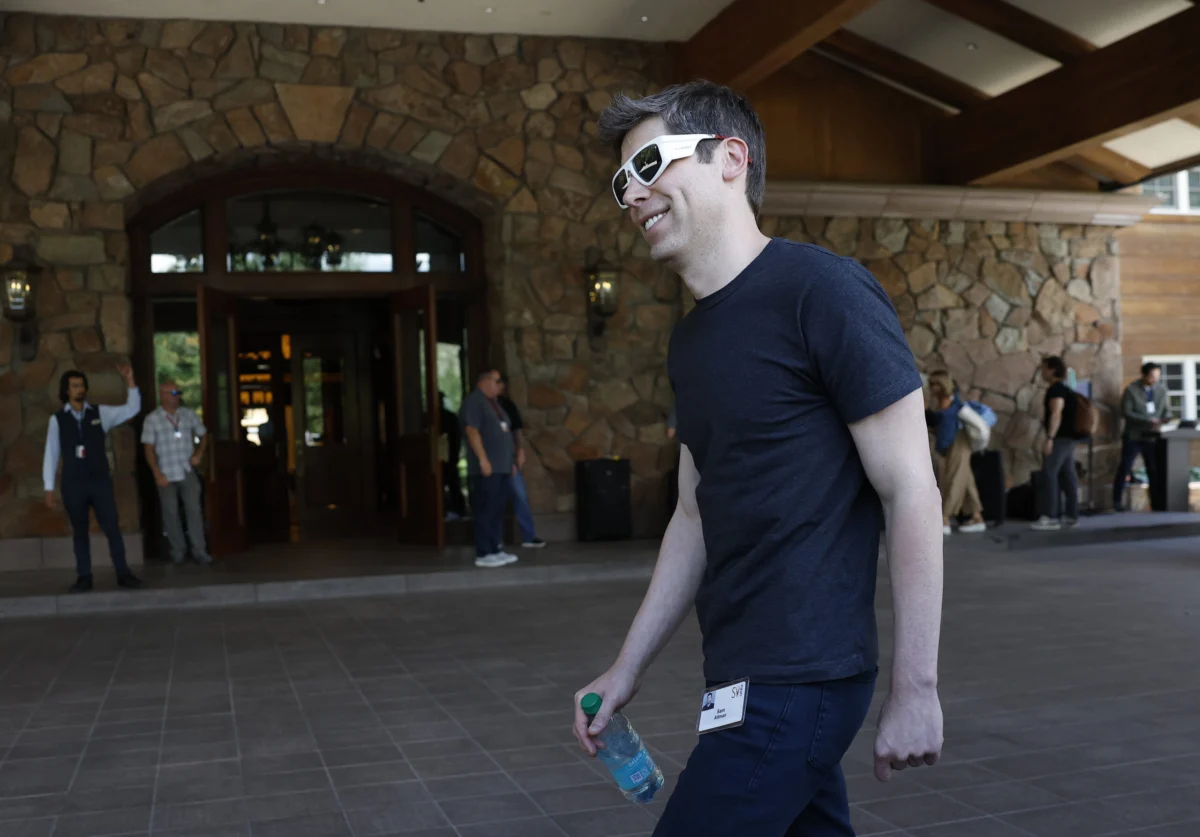
At a high-profile event held at The Midway near San Francisco’s waterfront, Sam Altman and the leadership of World—the identity project formerly known as Worldcoin—announced a significant evolution of their mission to distinguish humans from artificial intelligence in the digital sphere. Tools for Humanity (TFH), the primary developer behind the World project, detailed a series of high-stakes integrations that move the technology beyond its cryptocurrency roots and into the core of everyday public life, including dating, corporate communications, and live entertainment. Speaking before a capacity crowd, Altman, the co-founder of both World and OpenAI, framed the project as a necessary safeguard for a future where generative AI threatens to blur the lines between human and machine interaction.
The centerpiece of the announcement was a strategic expansion into the social and corporate sectors. TFH revealed plans to integrate its verification technology into the global dating app Tinder, concert ticketing systems including Ticketmaster and Eventbrite, and professional tools like Zoom and DocuSign. These partnerships represent a pivot from World’s initial focus on building a global financial network to becoming a fundamental layer of the "agentic web"—an internet increasingly populated by autonomous AI agents.
The Evolution of Proof of Human Technology
The core philosophy of World is centered on the concept of "Proof of Personhood." As large language models (LLMs) and deepfake technologies become more sophisticated, the traditional methods of verifying identity online—such as CAPTCHAs or email verification—are becoming increasingly obsolete. Altman noted that the world is rapidly approaching a threshold where AI-generated content will exceed human-generated content. "I’m sure many of you have had moments where you’re like, ‘Am I interacting with an AI or a person, or how much of each, and how do I know?’" Altman told the audience.
World distinguishes itself from other biometric identification systems through its use of "zero-knowledge proof-based authentication." This cryptographic method allows a service to verify that a user is a real, unique human without requiring the user to share their name, address, or even their raw biometric data with the service provider. The primary tool for this verification is the "Orb," a spherical, chrome-finished device that scans a user’s iris. The device converts the unique patterns of the iris into a cryptographic hash, known as a World ID, which serves as a digital passport. Once the hash is generated, the original images are deleted by default, ensuring that the user’s biological data is not stored in a centralized database.
Strategic Partnership with Tinder and Match Group
One of the most significant announcements of the event was the global rollout of World ID verification on Tinder. This follows a successful pilot program launched last year in Japan, which sought to address the growing problem of bot accounts and "catfishing" on dating platforms. According to TFH, the pilot demonstrated that users were more likely to engage with profiles that carried a "World ID" emblem, signaling a verified human presence.
The integration, which is set to launch in major markets including the United States, allows Tinder users who have undergone Orb verification to display a badge on their profiles. In an industry where trust is a primary commodity, the ability to guarantee that a profile is not a bot or a sophisticated AI persona is seen as a major competitive advantage. While Tinder has existing photo verification features, the World ID integration offers a higher tier of security by linking the account to a physical, biometric check that is significantly harder to spoof than traditional selfie-based systems.

Combatting the Bot Crisis in Live Entertainment
Beyond social networking, World is targeting the multi-billion-dollar live entertainment industry. The company introduced its "Concert Kit," a suite of tools designed to help musical artists and event organizers ensure that tickets are purchased by actual fans rather than automated scalper bots. Bot-driven ticket hoarding has become a major point of contention for artists and fans alike, often leading to inflated secondary market prices and public relations crises for ticketing giants.
The Concert Kit is compatible with major platforms such as Ticketmaster and Eventbrite. Under this system, artists can reserve a specific allocation of tickets exclusively for World ID-verified humans. High-profile acts, including Bruno Mars and the rock band 30 Seconds to Mars, have already signed on to utilize the technology for their upcoming tours. By requiring a "Proof of Human" credential at the point of purchase, the system aims to neutralize the speed and volume advantages that bot networks currently enjoy.
Securing the Professional Sphere: Zoom and DocuSign
The rise of deepfake technology has introduced new vulnerabilities into corporate environments. To address this, World announced partnerships with Zoom and DocuSign. The Zoom integration is designed to combat "deepfake-as-a-service" threats, where bad actors use real-time video manipulation to impersonate executives or employees during confidential meetings. By integrating World ID, participants in a Zoom call can verify their human status in real-time, providing an extra layer of security for sensitive business discussions.
Similarly, the partnership with DocuSign aims to ensure that digital signatures are executed by verified individuals rather than automated scripts or unauthorized parties. As the legal and financial sectors increasingly rely on digital contracts, the need for a non-spoofable identity layer has become paramount. These integrations represent a move toward "biometric legal certainty," where the physical presence of a signer is cryptographically tied to the document.
The Challenge of Scaling: Tiered Verification and Orb Saturation
Despite its ambitious goals, World has faced significant logistical hurdles in its quest for mass adoption. For much of its history, the "gold standard" of verification required users to physically visit an Orb location—a process that is often inconvenient. To mitigate this, TFH is shifting its strategy toward a tiered verification model and increased hardware accessibility.
Tiago Sada, World’s Chief Product Officer, outlined three distinct levels of verification:
- Orb Verification: The highest level of security, requiring an iris scan to prove uniqueness and humanity.
- NFC ID Verification: A mid-tier level that uses the Near Field Communication (NFC) chip found in most modern passports and government IDs.
- Selfie Check: A "low-friction" tier that involves a mobile selfie. While this is the easiest to complete, Sada acknowledged it is also the most vulnerable to fraud, though the company claims its system is among the most robust in the industry.
To increase the availability of Orbs, World is launching a massive expansion in New York, Los Angeles, and San Francisco. The company is also experimenting with "on-demand" Orb delivery, where users can request a device be brought to their location for verification. Additionally, World has begun placing Orbs in high-traffic retail environments, such as coffee shops and shopping malls, to integrate the verification process into daily routines.

Preparing for the Agentic Web
As the technology landscape shifts toward autonomous AI agents—programs that can book flights, manage calendars, and execute financial transactions—World is positioning itself as the intermediary between humans and their digital proxies. The company introduced a feature called "agent delegation," which allows a verified human to delegate their World ID to an AI agent.
In partnership with the authentication firm Okta, World has developed a system (currently in beta) that allows websites to verify if an AI agent is acting on behalf of a specific, verified human. Gareth Davies, Okta’s Chief Product Officer, explained that this creates a chain of accountability. When an agent interacts with a website, the site can confirm that there is a "Human Principal" behind the behavior, which could prevent agents from being used to conduct mass-scale spam or sybil attacks while still allowing them to perform legitimate tasks.
Timeline and Context of the World Project
The World project has undergone a rapid evolution since its inception. Founded in 2019 by Sam Altman, Alex Blania, and Max Novendstern, the project was initially known for its ambitious plan to distribute a universal basic income (UBI) via its cryptocurrency, Worldcoin.
- 2021: The project emerged from a period of stealth, revealing the Orb hardware.
- July 2023: Worldcoin officially launched its global network, sparking both massive sign-ups and intense regulatory scrutiny in Europe and Asia regarding data privacy.
- Late 2024: The project rebranded from Worldcoin to "World," signaling a shift in focus from a pure crypto-asset to a broader identity and infrastructure platform.
- December 2024: The launch of the "World App" as a super-app, integrating encrypted chat and payment features.
- April 2025: The current expansion into mainstream consumer apps like Tinder and Zoom.
Analysis of Implications and Future Outlook
The expansion of the World project reflects a broader philosophical shift in digital security. We are moving away from an era of "shared secrets" (passwords and pins) toward an era of "biological proofs." While the benefits of eliminating bots and securing digital identity are clear, the project continues to face questions regarding the centralization of biometric-linked data and the potential for "function creep," where a system designed for bot detection could eventually be used for more intrusive forms of surveillance.
However, Altman and his team argue that the alternative—a digital world where it is impossible to tell a human from a bot—is a greater threat to the social fabric. By providing a decentralized, privacy-preserving way to prove humanity, World aims to preserve the integrity of the internet in the age of AI. The success of these new integrations with Tinder, Ticketmaster, and Zoom will serve as a critical litmus test for whether the public is willing to embrace biometric verification as a standard requirement for digital life. If successful, World could become the foundational "identity layer" of the internet, fundamentally changing how we interact, work, and socialize online.
