


The cybersecurity landscape has been jolted by the revelation of a highly coordinated zero-day campaign targeting SonicWall Secure Mobile Access (SMA) 1000 series appliances. Recent investigations conducted by SonicWall in collaboration with the cybersecurity firm Volexity have uncovered a complex exploit chain that allowed threat actors to bypass authentication, execute arbitrary commands with root privileges, and install a suite of custom malware designed for long-term persistence and internal network tunneling. These vulnerabilities, identified as CVE-2026-15409 and CVE-2026-15410, represent a significant threat to enterprise perimeters, as they were exploited in the wild for several weeks before a public disclosure was made or patches were available.
The campaign, attributed to a sophisticated threat actor tracked as UTA0533, underscores a growing trend in the threat landscape: the targeting of edge-of-network devices. Because VPN appliances like the SMA1000 sit at the intersection of the public internet and private corporate networks, they are uniquely positioned as high-value targets. Compromising these devices allows attackers to bypass traditional perimeter defenses, intercept encrypted traffic, and establish a foothold that is notoriously difficult for standard endpoint detection and response (EDR) tools to monitor.
The Technical Anatomy of the Exploit Chain
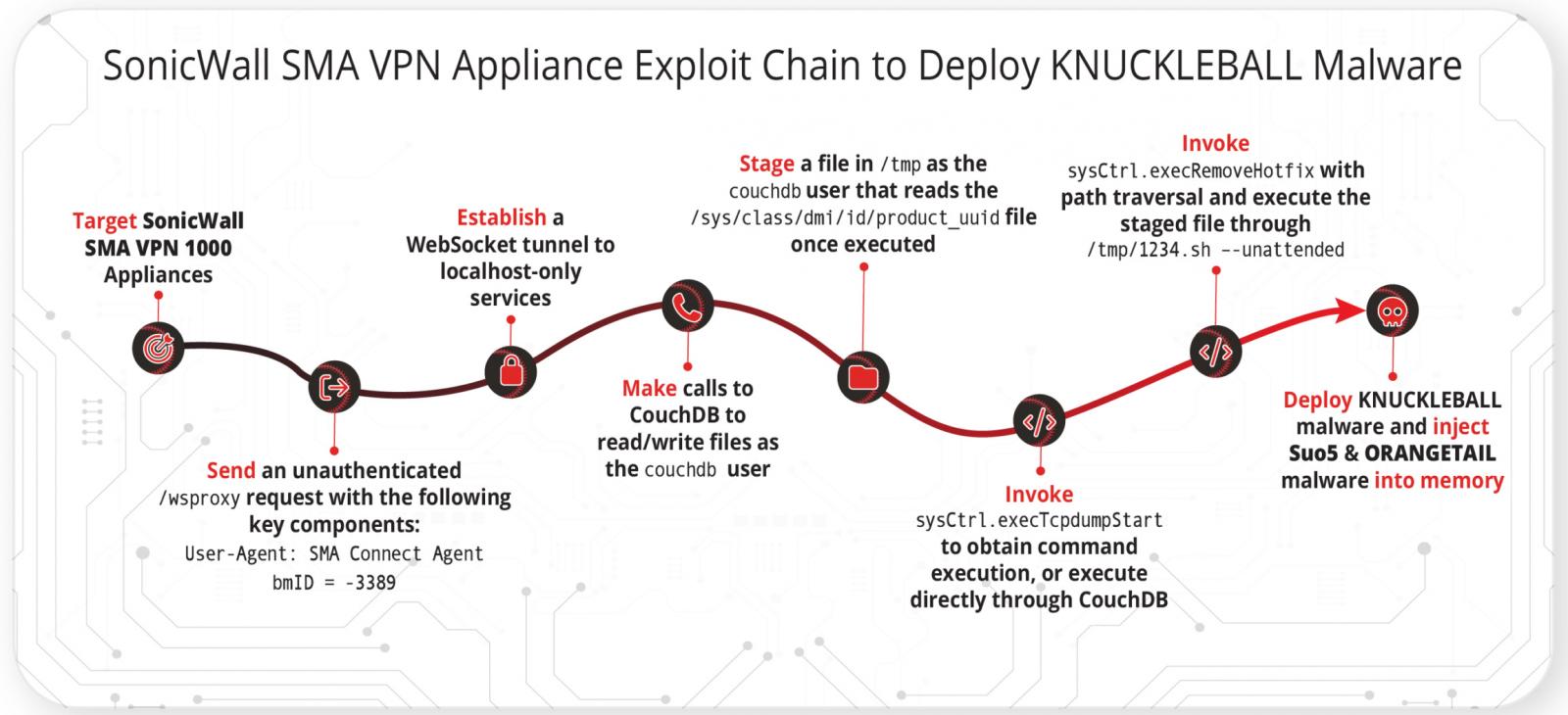
The exploitation of the SMA1000 appliances was not the result of a single flaw but rather the strategic chaining of two distinct vulnerabilities. This multi-stage approach allowed the attackers to move from an unauthenticated external position to full administrative control of the device.
The first stage of the attack utilized CVE-2026-15409, a critical server-side request forgery (SSRF) vulnerability. This flaw resided in the appliance’s /wsproxy endpoint. In a standard configuration, this endpoint is intended to facilitate WebSocket communications for legitimate administrative or user functions. However, UTA0533 discovered that they could abuse this endpoint to establish unauthenticated WebSocket tunnels. These tunnels acted as a bridge, allowing the attackers to reach internal services and applications running on the appliance that were intended to be isolated from the public-facing interface.
One of the primary targets reached through this SSRF tunnel was the appliance’s internal CouchDB instance. CouchDB is a NoSQL database used by the SMA1000 for various configuration and operational tasks. By gaining access to this database, the attackers were able to query sensitive system information. Specifically, they sought the product_uuid, a unique identifier for the specific hardware or virtual instance. While the exact methodology used to extract this data from CouchDB remains under investigation, the acquisition of the product_uuid was a critical "unlock" for the second phase of the attack.

The second stage involved CVE-2026-15410, a high-severity command injection vulnerability found within the Appliance Management Console (AMC). Specifically, the flaw was located in the sysCtrl.execRemoveHotfix Remote Procedure Call (RPC) method. This method, intended for administrative maintenance, did not sufficiently sanitize inputs. By providing the previously stolen product_uuid as part of a malicious request, the attackers were able to bypass security checks and inject arbitrary commands into the system shell. Because the management console operates with elevated permissions, these commands were executed with root-level access, granting the attackers total sovereignty over the compromised appliance.
Deployment of the Custom Malware Ecosystem
Once root access was established, UTA0533 moved swiftly to ensure their presence on the device would survive reboots and remain undetected. Volexity’s forensic analysis revealed the deployment of a specialized malware toolkit tailored specifically for the SMA1000’s Linux-based architecture.
The initial payload was a Python-based dropper dubbed KNUCKLEBALL, which was found on compromised systems under the deceptive filename deploy_new.py. The primary function of KNUCKLEBALL was to orchestrate the installation of two Java-based malware families, which the researchers named Sou5 and ORANGETAIL.
Sou5 is a sophisticated reverse proxy tool. Once active, it allows the attackers to tunnel traffic from their external command-and-control (C2) infrastructure through the SMA1000 and into the victim’s internal network. This effectively turns the VPN appliance—a tool designed for secure remote access—into a gateway for the attackers to explore the internal LAN, scan for further vulnerabilities, and move laterally to other servers.
ORANGETAIL, by contrast, serves as a persistent Java-based webshell. To integrate this tool into the system, the attackers modified the appliance’s nginx configuration files. This modification ensured that requests to a specific, hidden URL would be routed to the ORANGETAIL listener. The webshell allows for the dynamic execution of encrypted Java payloads within an HTTP session, providing the attackers with a flexible and stealthy way to run code on demand without leaving traditional file-based footprints.
To round out their toolkit, the attackers utilized a utility called ROOTRUN. This tool was designed for privilege escalation and ensuring that any subsequent commands or scripts executed by the lower-privileged web services could be elevated to root status, maintaining the attackers’ high-level control even if certain components of the exploit chain were disrupted.

Chronology of the Zero-Day Campaign
The timeline of the attacks suggests a period of "silent" exploitation where the threat actors operated with relative impunity. Forensic evidence gathered by Volexity indicates that the earliest signs of compromise date back to June 22, 2026. This was nearly three weeks before SonicWall issued its initial security advisory.
Between late June and mid-July, UTA0533 systematically targeted SMA1000 models 6210, 7210, and the 8200v virtual appliance. During this window, the attackers were observed conducting reconnaissance, extracting sensitive identifiers, and deploying the KNUCKLEBALL dropper. The fact that the attacks were underway for weeks before detection highlights the difficulty of identifying zero-day exploitation on specialized network hardware.
SonicWall was alerted to the suspicious activity in early July, prompting an immediate internal investigation and the engagement of Volexity for incident response and forensic analysis. On July 10, 2026, SonicWall released an emergency advisory warning customers of active exploitation. This was followed shortly by the release of firmware patches: version 12.4.3-03453 for the 12.4 branch and version 12.5.0-02835 for the 12.5 branch.
Broader Implications for Network Security
The exploitation of the SonicWall SMA1000 is part of a broader, more concerning trend in global cyber espionage. State-sponsored and highly organized threat actors are increasingly moving away from traditional phishing and endpoint-based attacks, which are often thwarted by modern EDR and antivirus solutions. Instead, they are focusing on "edge" devices—firewalls, load balancers, and VPN gateways—that often lack the same level of granular logging and security instrumentation.
Volexity’s report noted that while the technical sophistication of the exploit chain and the custom malware was "significant," the actor UTA0533 appeared to have limited success in moving deeper into the internal networks of the investigated victims. This suggests that while the initial breach was highly successful, the subsequent phases of the attack—lateral movement and data exfiltration—may have been hampered by internal network segmentation or other defensive layers.
However, the risk remains acute. A compromised VPN appliance is a "blind spot" for many organizations. Traditional security monitoring often stops at the edge, and unless an organization is performing rigorous log analysis of their appliance management consoles or monitoring for unusual outbound traffic from their gateway devices, an intrusion like this could go unnoticed for months.
Recommendations and Official Responses
SonicWall has urged all customers using the affected SMA1000 series appliances to update to the latest patched firmware versions immediately. The company emphasized that because the attackers gained root access, simply patching the device may not be sufficient if a compromise has already occurred. Organizations are advised to perform a full factory reset of the appliance, rotate all credentials (including administrative passwords and VPN user secrets), and revoke any certificates stored on the device.
Volexity has also released a set of Indicators of Compromise (IoCs), including specific file paths for the KNUCKLEBALL dropper and the modified nginx configuration patterns used by ORANGETAIL. Security teams are encouraged to hunt for these indicators within their environments.
The incident serves as a stark reminder of the necessity of a "defense-in-depth" strategy. Relying solely on a hardened perimeter is no longer viable when the perimeter devices themselves are the primary targets. Organizations must implement robust internal monitoring, zero-trust architecture, and regular configuration audits of their edge infrastructure to mitigate the impact of the next inevitable zero-day discovery. As the investigation into UTA0533 continues, the cybersecurity community remains on high alert for further developments regarding this actor’s tactics and potential future targets.
