

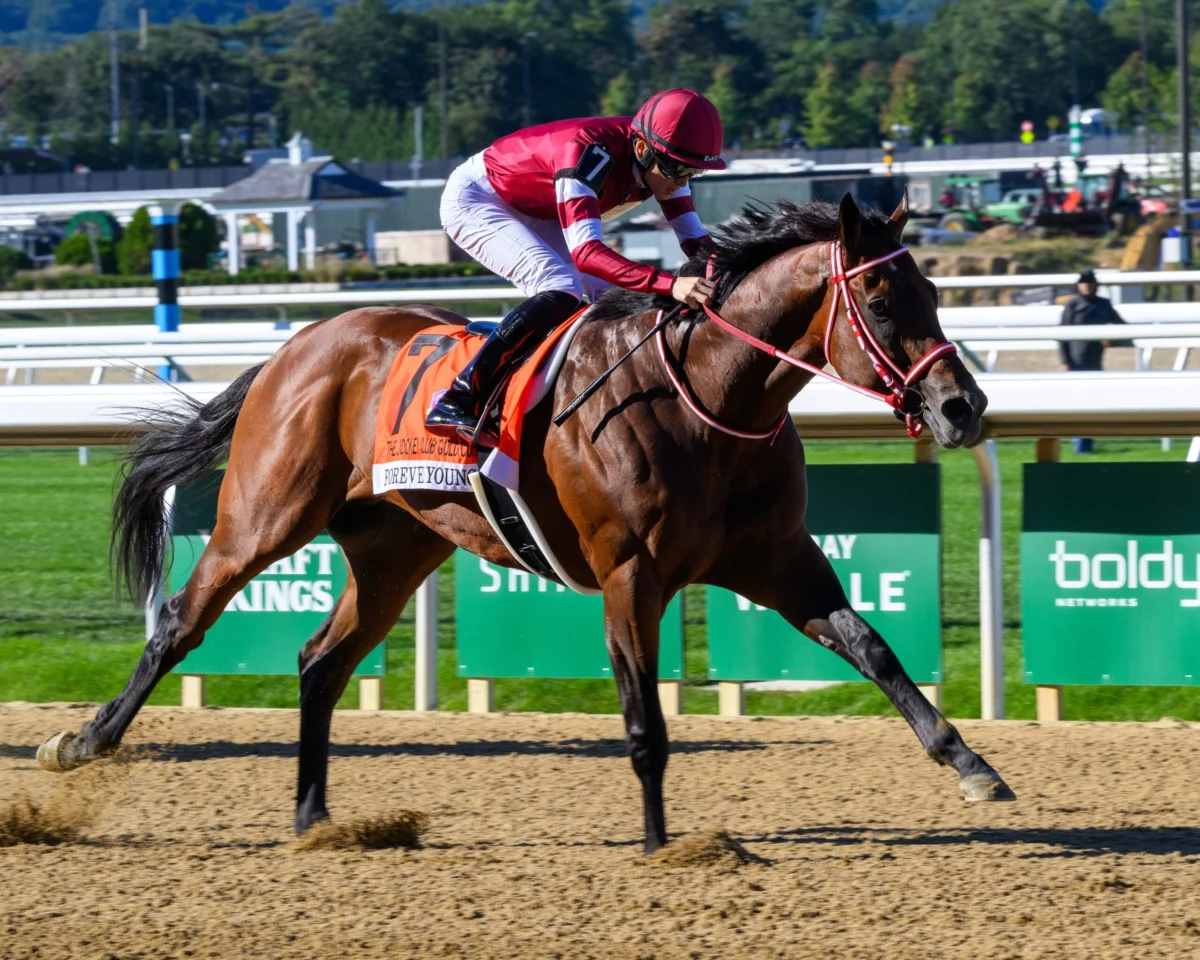
The Japanese sensation Forever Young reaffirmed his status as one of the world’s premier Thoroughbreds on September 18, delivering a commanding performance to capture the $1 million Jockey Club Gold Cup Stakes (G1) at the newly reconstructed Belmont Park. As the heavy favorite in a field diminished by three late scratches, the 5-year-old son of Real Steel navigated the 1 1/4-mile distance with clinical precision, stopping the clock in 2:01.23 over a fast track. This victory serves as a definitive statement of intent as the globetrotting star prepares to return to the Breeders’ Cup Classic (G1) on October 31 at Keeneland, where he will aim to defend the title he captured last year at Del Mar.
The victory, which saw Forever Young return a modest $2.96 to win for a $2 wager, further padded a staggering career earnings total that has now eclipsed $31 million. Under the guidance of his regular pilot, Ryusei Sakai, the bay horse displayed the tactical versatility that has become his hallmark, maintaining a controlled pace before asserting his superiority in the final stages of the contest.
A Chronology of the Race
The Jockey Club Gold Cup was originally slated as a high-stakes test, but the event was shaped significantly by the withdrawal of three entrants, leaving a compact four-horse field. When the starting gate opened, Phileas Fogg immediately moved to the front, establishing a steady tempo that the rest of the field was initially content to follow.
As the horses rounded the second turn, the tactical dynamic shifted. Sakai, sensing the optimal moment to make his move, guided Forever Young off the rail and engaged the leader. The response from the Japanese star was immediate. He moved past Phileas Fogg with fluid ease, establishing a clear advantage that would not be relinquished. While the longshot Stars and Stripes attempted a late rally to secure second place, Forever Young remained untroubled, hand-ridden by Sakai over the final eighth of a mile. Baeza, who suffered from a characteristically slow break, managed to secure third, while the early pace-setter, Phileas Fogg, rounded out the quartet.
Despite the dominance of the performance, observers noted that Forever Young did not switch leads down the stretch, a minor technical point that may be addressed in his final preparations for the rigorous challenge of the Breeders’ Cup Classic.
Pedigree and Professional Background
Forever Young is a product of Northern Racing and represents the pinnacle of international breeding excellence. Sired by the accomplished Real Steel, he is out of the Congrats mare Forever Darling. His career has been defined by a rare combination of durability and brilliance, traits fostered by his trainer, Yoshito Yahagi, and owner, Susumu Fujita.
Yahagi, a globally recognized figure in the sport, has masterfully managed the horse’s schedule, ensuring that his charge arrives at major international races in peak condition. The partnership with Sakai has been equally vital, with the jockey’s intimate knowledge of the horse’s temperament allowing for the calm, calculated rides that have become synonymous with the duo’s success.
Strategic Significance of the Win
The Jockey Club Gold Cup was designated as part of the Breeders’ Cup Challenge Series: Win and You’re In. While the victory provided Forever Young with an automatic, all-expenses-paid entry into the Breeders’ Cup Classic, the horse had already secured his invitation earlier this year with a masterful victory in the Saudi Cup (G1).
The strategic value of this race, therefore, was less about qualifying and more about preparation. Racing at Belmont Park provided the team with an opportunity to acclimatize to North American conditions and distance requirements ahead of the Keeneland finale. The win serves as a crucial "prep" race, confirming that the horse maintains his elite form despite the rigors of international travel and a demanding campaign.
The Reopening of Belmont Park
The event carried additional weight as it marked a historic milestone: the opening day of the fall meet at the reconstructed Belmont Park. The facility, which has undergone significant modernization, welcomed racing fans back to a venue that many consider the cathedral of American dirt racing. The success of the Jockey Club Gold Cup, featuring an international superstar, provided an ideal centerpiece for the facility’s grand return to the racing calendar.
Fact-Based Analysis and Future Implications
The implications of Forever Young’s performance extend far beyond the winner’s circle at Belmont. With earnings exceeding $31 million, the horse has entered rarified air in the history of Thoroughbred racing. His success is a testament to the growing influence of Japanese racing on the global stage, a trend characterized by meticulous training programs and a willingness to compete in the most difficult international races.
From an analytical standpoint, the victory poses a significant challenge to the North American contingent currently pointing toward the Breeders’ Cup Classic. Forever Young has proven he can win on different surfaces, across different time zones, and against the best competition in the world. His ability to navigate the 1 1/4-mile distance—a classic distance that often tests the stamina of even the most talented horses—suggests he is well-prepared for the unique requirements of the Keeneland track.
However, the competition at the Breeders’ Cup will be significantly stiffer than the four-horse field faced at Belmont. The presence of top-tier American dirt specialists will provide the true litmus test for his capacity to repeat as Classic champion. Furthermore, the issue of lead-switching noted during the race is something that Yahagi and his staff will likely review. While it did not hinder his victory on this occasion, the high-pressure environment of a Breeders’ Cup race often punishes even minor technical inefficiencies.
Official Reactions and Future Outlook
While official press conferences following the race focused on the horse’s professionalism, representatives for the stable expressed satisfaction with the horse’s ability to navigate the trip without incident. "He is a horse that knows his job," one source close to the stable noted. "He understands the atmosphere of the big race, and he responds accordingly."
The racing community will now turn its attention to the final entry lists for the Breeders’ Cup, with all eyes fixed on the Japanese camp. If Forever Young can replicate his performance at Belmont on the more demanding Keeneland circuit, he will likely secure his position as the most successful international horse to ever compete in the American autumn championship.
As the industry reflects on the results of the Jockey Club Gold Cup, the consensus is clear: the road to the Breeders’ Cup Classic runs through the Japanese star. Whether his rivals can devise a tactical plan to disrupt his momentum remains the primary narrative as the sport moves toward the year’s definitive showdown. With his fitness confirmed, his ticket to Keeneland punched, and his confidence at an all-time high, Forever Young stands ready to cement his legacy in the annals of Thoroughbred history.
The fall meet at Belmont Park will continue through the coming weeks, but the September 18 performance will undoubtedly remain the highlight of the early season. For fans of the sport, the spectacle of a world-class athlete in peak form is the ultimate draw, and Forever Young has delivered exactly that, keeping the dream of a historic title defense very much alive.
