

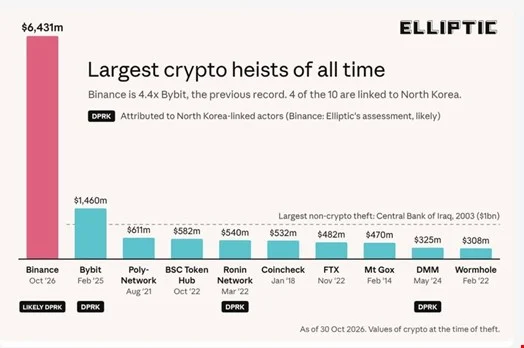
Global cryptocurrency exchange Binance has confirmed that it suffered the largest cyber-incident in digital asset history, resulting in the unauthorized outflow of approximately $6.3bn in cryptocurrency. The massive security breach has sent shockwaves through the decentralized finance (DeFi) and centralized exchange (CEX) ecosystems, prompting an immediate international response involving law enforcement agencies, top-tier blockchain intelligence firms, and token issuers.
Despite the staggering magnitude of the theft—which eclipses all previous records in the crypto-security sector—Binance executive leadership has moved aggressively to reassure its vast global user base. The company has explicitly stated that customer funds remain fully backed, pledging to cover all outstanding user losses through a combination of corporate capital reserves and the Secure Asset Fund for Users (SAFU). Furthermore, the exchange has successfully frozen roughly $3bn of the stolen assets in real-time, working alongside blockchain protocols and stablecoin issuers to blacklist illicit wallet addresses before the funds could be completely laundered through decentralized mixers.
As forensic investigators piece together the anatomy of the exploit, prominent cybersecurity and blockchain analytics organizations have attributed the attack with high confidence to TraderTraitor, a sophisticated, state-sponsored advanced persistent threat (APT) group linked to North Korea. The incident highlights the growing sophistication of nation-state threat actors targeting critical financial infrastructure and underscores the systemic vulnerabilities inherent in global digital asset operations.
An Evolving Anatomy of a Multi-Vector Breach
The incident first came to light following preliminary internal security assessments conducted by Binance engineers and incident response teams. According to initial disclosures published by the company on October 30, the attack vector appeared to stem from a compromised laptop belonging to a Binance development and operations (DevOps) engineer. This initial foothold allegedly allowed unauthorized threat actors to navigate internal networks, gain access to a critical service container, and execute a series of fraudulent withdrawal transactions that bypassed standard security gates.
However, as the forensic investigation widened, Binance acknowledged that the initial assessment only told part of the story. Subsequent reviews revealed a far more complex and multi-layered intrusion pattern. In updated public statements, the exchange characterized the event as a sophisticated, coordinated campaign designed to exploit multiple secondary points of breach simultaneously.
Despite the depth of the penetration, Binance has categorically stated throughout its investigative updates that there is currently no evidence indicating that any core wallet private keys were compromised or leaked. Instead, the attackers appear to have manipulated operational authorization pathways and service privileges to siphon funds out of the platform.

Chronology of the Incident and Operational Response
The timeline of the breach and the subsequent containment efforts reflect a high-stakes, rapid-response operation executed by Binance’s security teams in tandem with external partners:
- Initial Breach and Execution: Unauthorized actors leveraged compromised credentials and operational access points to initiate unauthorized withdrawal transactions, extracting digital assets valued at approximately $6.3bn.
- Detection and Containment (Day One): Binance security systems flagged abnormal transaction volumes. In response, the exchange enacted emergency containment protocols, halting all deposit and withdrawal pathways alongside specific trading products—including Binance Alpha trading activities, CEX Buy Token features, Alpha Instant, and CEX purchase prediction marketing functions tied to spot wallets.
- Asset Freezing and Interception: Working in close coordination with blockchain analytics firms, token issuers, and law enforcement agencies, Binance successfully traced and froze approximately $3bn of the stolen funds, neutralizing a substantial portion of the illicitly transferred capital before it could be fully obscured.
- Partial Service Resumption: Following initial stabilization and verification processes, Binance confirmed that customer deposit channels had resumed normal, unaffected operations.
- Ongoing Remediation and Withdrawal Suspension: To ensure total platform integrity, withdrawals remained temporarily suspended while engineers executed a comprehensive security revamp of the withdrawal architecture, associated server addresses, and authentication checkpoints.
Global Consensus: The Fingerprint of North Korean Threat Actors
The scale, execution strategy, and laundering patterns associated with the Binance exploit have drawn immediate global attention from leading cryptocurrency intelligence and forensics companies. Three prominent industry authorities—TRM Labs, Elliptic, and Chainalysis—independently conducted deep-dive blockchain investigations into the transaction paths. Each firm has concluded with a high degree of confidence that the cyber-attack was orchestrated by TraderTraitor, a North Korean state-sponsored hacking collective also known by aliases such as Lazarus Group.
North Korean cyber-operations have historically targeted the cryptocurrency sector as a primary mechanism for generating illicit revenue to bypass international economic sanctions. Over the past several years, state-backed syndicates have systematically evolved their methodologies, shifting from simple phishing campaigns and exchange assaults to complex supply-chain compromises, social engineering of blockchain developers, and advanced infrastructure intrusions.
The attribution of the Binance incident to TraderTraitor reinforces long-standing warnings from international cybersecurity agencies—including the US Cybersecurity and Infrastructure Security Agency (CISA) and the Federal Bureau of Investigation (FBI)—regarding the severe, systemic threat posed by North Korean cyber-warfare units to global financial systems.
Protecting User Assets and Restoring Market Confidence
In the wake of the breach, Binance has maintained a transparent communication strategy, utilizing its official social media channels and corporate blog to deliver regular updates to its hundreds of millions of registered users. The exchange has repeatedly emphasized that customer balances are safe, reiterating that the platform’s financial cushion—bolstered by the SAFU emergency insurance fund and corporate balance sheet liquidity—is fully capable of absorbing the financial impact without posing a solvency risk to retail or institutional account holders.

To provide verifiable transparency, Binance has committed to publishing an updated, cryptographically verifiable proof of reserves report once the remediation and asset recovery phases are fully completed. This report is intended to give users an independent, auditable view of the exchange’s asset holdings relative to total customer liabilities, thereby restoring market trust following the unprecedented security disruption.
Concurrently, Binance has issued urgent security advisories warning its global community to remain vigilant against opportunistic cybercriminals seeking to exploit the news cycle. Fraudsters have launched various phishing campaigns, fake support accounts, and malicious websites mimicking Binance communications. The exchange has explicitly instructed customers to ignore unofficial links, direct messages, or unsolicited requests for credentials, urging them to rely strictly on verified platform channels for ongoing status reports.
Broader Implications for the Global Cryptocurrency Industry
The record-breaking $6.3bn incident marks a watershed moment for the global digital asset industry, triggering intense scrutiny from regulators, institutional investors, and cybersecurity professionals alike. For years, centralized exchanges have served as attractive honeypots for sophisticated threat actors due to the immense volume of capital aggregated within a single operational architecture.
The sheer scale of the Binance breach is expected to catalyze several profound industry-wide shifts:
- Accelerated Adoption of Decentralized Security Architectures: The incident is likely to accelerate the migration toward advanced zero-trust security models, multi-party computation (MPC) key management systems, and hardware-enforced isolation layers across both centralized and decentralized trading venues.
- Heightened Regulatory Oversight: Financial regulators across major jurisdictions—including the United States, the European Union, and Asia-Pacific markets—are anticipated to intensify compliance audits and operational security mandates for virtual asset service providers (VASPs), placing greater emphasis on mandatory reserve auditing and real-time threat-sharing protocols.
- Enhanced Public-Private Collaboration: The rapid freezing of $3bn in stolen funds demonstrates the growing effectiveness of collaborative frameworks linking private-sector blockchain forensics firms, stablecoin issuers (such as Tether and Circle), and global law enforcement agencies. This cooperative ecosystem will likely become the gold standard for mitigating large-scale crypto thefts in the future.
As Binance finalizes its comprehensive technical post-mortem report—promised for release upon the conclusion of the joint investigation—the global fintech community continues to monitor the fallout closely. While the breach represents the most severe security failure in the history of blockchain technology, the swift containment actions, asset freezes, and explicit guarantees of user protection by exchange leadership have thus far prevented a broader systemic contagion across the wider digital economy.
