

The landscape of artificial intelligence is undergoing a profound structural shift as the performance gap between proprietary, closed-source models and open-weight alternatives narrows to a mere four-month window. For years, the narrative of AI progress was tethered to massive server farms owned by a handful of tech giants. Today, that narrative is being rewritten by a growing ecosystem of high-performance models that can run directly on consumer-grade hardware. This transition is not merely a technical milestone; it represents a fundamental change in how individuals and enterprises approach data privacy, cost management, and technological sovereignty.
The term open-weight refers to models where the company publishes the specific numerical values—the weights—that define the model’s learned intelligence. By making these files public, developers have enabled anyone with a sufficiently capable computer to download, inspect, and run these systems without the need for an active subscription to a cloud-based service like ChatGPT or Claude. Programs such as Ollama and LM Studio have emerged as the primary interfaces for this movement, effectively commoditizing the deployment of advanced AI.
A Chronology of the Local AI Movement
The rapid descent of AI from the cloud to the desktop is a recent phenomenon, driven by the emergence of efficient quantization techniques and the proliferation of high-performance hardware.
In the early stages of the generative AI boom, large language models (LLMs) were exclusive to entities capable of renting thousands of H100 GPUs. The turning point occurred when the open-source community, particularly through initiatives like Meta’s Llama series, began to demonstrate that smaller, highly optimized models could rival the output of their larger counterparts.

By 2024, the industry saw the release of models capable of running on standard gaming laptops. As of late 2026, the arrival of models like Google’s Gemma 4 and OpenAI’s open-weight experiments (gpt-oss) marked a new era. These models are now small enough to fit within 4.6GB to 20GB of storage, making them accessible to a broad demographic of users, from hobbyists to professional software engineers.
The Economics and Privacy of Local Computation
The primary driver for the adoption of local AI is the convergence of cost and privacy. Cloud-based AI subscriptions typically command a $20 monthly fee per user, a recurring expense that can escalate rapidly for businesses or power users. By contrast, running models locally involves no subscription cost, shifting the investment from software-as-a-service (SaaS) fees to one-time hardware purchases.
Privacy, however, is the more significant catalyst. When users interact with a cloud chatbot, every query is sent to a remote server. This creates a permanent digital footprint, which recent legal developments have highlighted as a potential liability. As Decrypt reported, court orders have forced companies like OpenAI to preserve logs, including those intended for deletion. Local models, by definition, never transmit data to an external provider. Using tools like LM Studio, which can operate entirely offline, allows a user to process sensitive documents—legal briefs, medical records, or proprietary code—without them ever leaving the machine.
Technical Foundations: Parameters and Quantization
Understanding why your computer can suddenly run a powerful AI requires a grasp of model architecture. Models are measured in parameters, which are the internal variables adjusted during the training phase. Generally, a higher parameter count correlates with increased reasoning ability, but it also demands more VRAM (Video Random Access Memory) or Unified Memory on platforms like Apple Silicon.
To make these models fit into consumer hardware, the industry relies on quantization. This process involves reducing the precision of the model’s weights from 32-bit floating-point numbers to lower-precision data types, such as 8-bit or 4-bit integers. While this does result in a marginal loss of accuracy, the reduction in memory usage is exponential. A model that would otherwise require 100GB of VRAM can often be "quantized" to fit comfortably within 16GB, making it viable for a high-end desktop GPU or a modern Mac.
Hardware requirements remain the primary bottleneck. While entry-level AI tasks can be performed on 8GB of system memory, those seeking a professional-grade experience are advised to utilize hardware with at least 24GB of VRAM. For many, this necessitates upgrading to specialized gaming GPUs or investing in machines with unified memory architectures, such as the Mac Mini or high-end workstations equipped with NVIDIA’s latest professional cards.
Software Ecosystem: Ollama vs. LM Studio
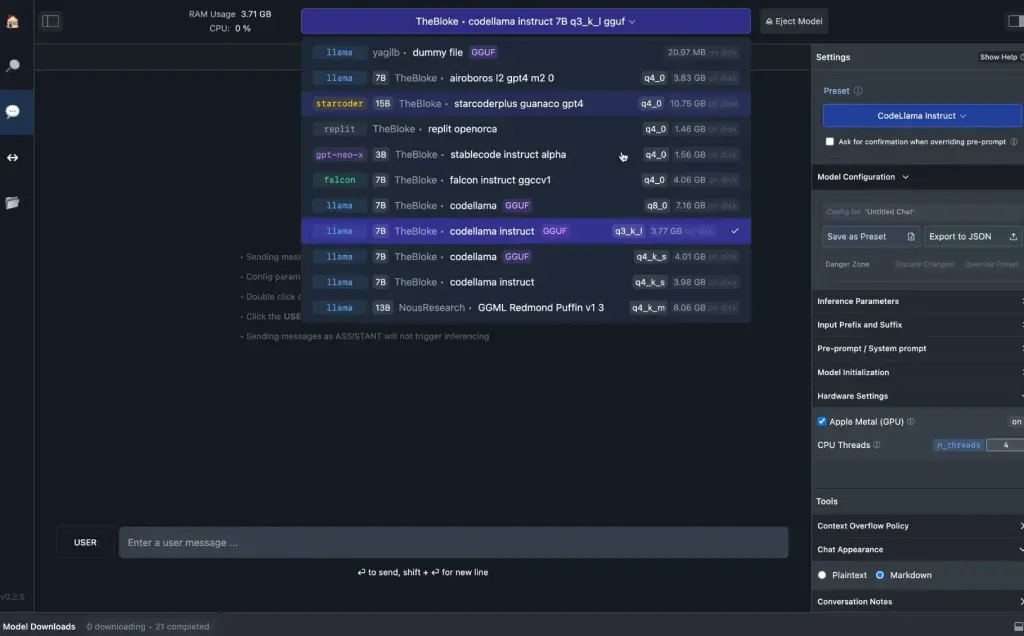
For the end-user, the barrier to entry has been drastically lowered by two primary software suites. LM Studio offers a user-friendly, graphical interface (GUI) that abstracts away the complexities of model management. It serves as a browser for Hugging Face—the industry-standard repository for AI models—allowing users to search, download, and initiate a conversation with a single click.
Ollama, conversely, is favored by the developer community for its command-line interface (CLI) and API-first architecture. It allows users to manage models with simple commands like ollama run gemma4. Furthermore, Ollama exposes a local API at http://localhost:11434, which allows other software applications on the same computer to tap into the model’s capabilities. This integration capability is essential for users who wish to build automated workflows or custom agents that interact with local files or web-browsing tools.
Implications of Licensing and Customization
The legal framework surrounding open-weight models is just as critical as the hardware. Models released under the Apache 2.0 or MIT licenses, such as DeepSeek’s R1 or Google’s Gemma 4, grant users the right to modify and adapt the model for commercial use.
This level of flexibility enables "fine-tuning," where a general-purpose model is trained on a specific dataset—such as medical journals or legal case law—to become an expert in a niche domain. In a cloud-based environment, this level of personalization is often restricted or monetized. In the local-weight ecosystem, the user owns the model, enabling the creation of specialized, highly efficient tools that are unavailable in the public cloud.
Current Limitations and the Future of AI
Despite the rapid progress, local models still face challenges when competing with the "frontier" models hosted in the cloud. Models like Alibaba’s Qwen3.8-Max, which boasts 2.4 trillion parameters, operate at a scale that is currently impossible for any single consumer machine to replicate. When a model’s size exceeds available VRAM, the system must offload data to standard system RAM, which results in a significant performance degradation.
Moreover, cloud services benefit from massive, continuous infrastructure updates that local users must manually manage. Cloud providers also maintain massive "context windows"—the amount of information a model can process at once—which are essential for analyzing large books or extensive codebases. While local models are catching up, with many now offering 128K to 256K token windows, the most advanced analytical tasks still favor the raw, distributed compute power of the cloud.
The emergence of technologies like speculative decoding—where a small model drafts responses that a larger model then verifies—is helping to bridge this gap, promising speed improvements of up to 3x without requiring new hardware. As these techniques evolve, the divide between local and cloud performance will likely continue to blur.
Ultimately, the move toward local AI is a move toward user autonomy. Whether for the sake of data privacy, the ability to build custom, domain-specific tools, or the avoidance of recurring subscription costs, the capability to run a sophisticated AI assistant on a laptop is no longer a futuristic dream. It is a present-day reality, signaling a fundamental shift in the power dynamics between the creators of AI and the people who use it.
