

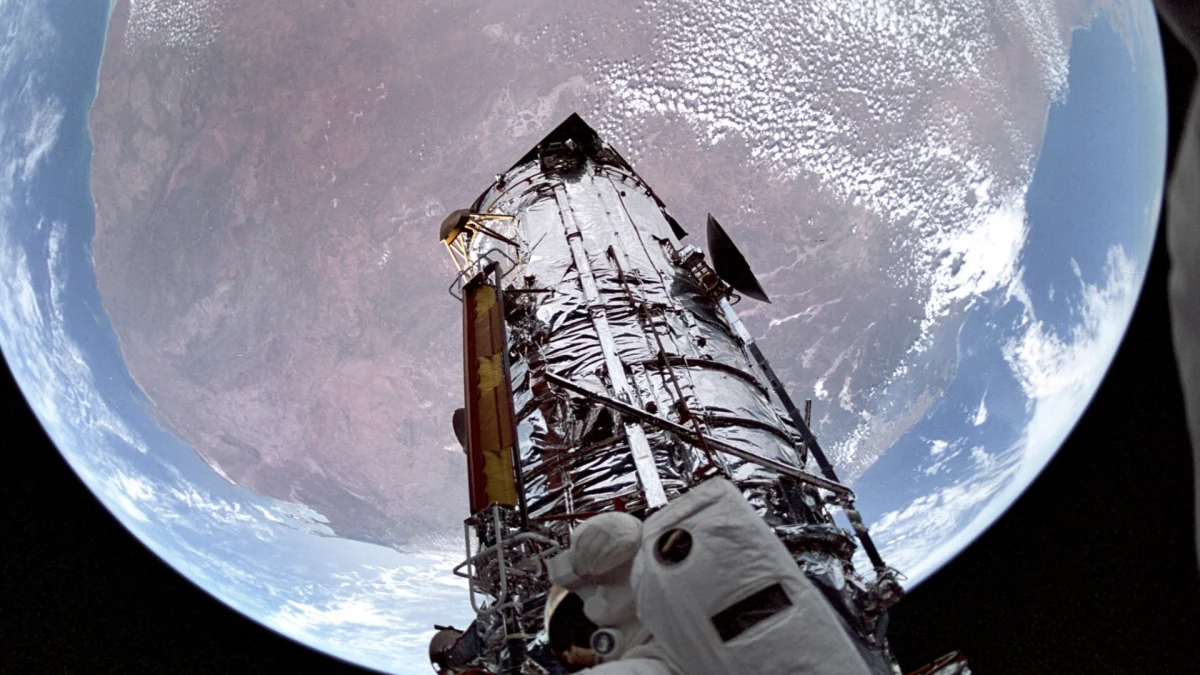
Launched into low-Earth orbit in April 1990 aboard the Space Shuttle Discovery, the Hubble Space Telescope has spent more than thirty-four years serving as humanity’s window to the cosmos. From capturing the breathtaking Pillars of Creation to measuring the accelerating expansion rate of the universe, Hubble fundamentally transformed astrophysics and ignited the public imagination. However, the pioneering observatory is now on a slow, inexorable path toward a fiery end. Affected by residual atmospheric drag at its current orbital altitude, NASA’s most celebrated telescope is projected to re-enter Earth’s atmosphere and disintegrate sometime between 2033 and 2034 if no intervention occurs.
Facing tight federal budgets and technical limitations, the National Aeronautics and Space Administration is turning outward. In a desperate bid to save the aging observatory or, at minimum, orchestrate a controlled disposal, the agency has issued a formal Request for Information (RFI) to the rapidly maturing private aerospace sector. This outreach invites commercial spaceflight companies to propose innovative, cost-effective solutions to either elevate Hubble to a safer, higher orbit—extending its operational lifespan—or safely guide its final descent into an unpopulated ocean zone.
The Orbital Decay Dilemma: Understanding Hubble’s Altitude Loss
To understand why Hubble requires rescue, one must examine the physics of low-Earth orbit (LEO). Situated originally at an altitude of approximately 340 miles (547 kilometers)—and later boosted during servicing missions to around 320 miles (515 kilometers)—Hubble does not exist in a pure vacuum. Even at these heights, the outermost wisps of Earth’s atmosphere exert a persistent drag force on orbiting spacecraft.
Over decades, this atmospheric friction robs a satellite of its orbital energy, causing its altitude to gradually decay. Without active propulsion systems capable of re-boosting, satellites in LEO inevitably fall back toward Earth. While spacecraft like the International Space Station (ISS) feature built-in thrusters and receive regular re-boosts from visiting cargo vehicles, Hubble was designed to rely entirely on the specialized cargo bay of NASA’s now-retired Space Shuttle fleet for maintenance, altitude adjustments, and instrument upgrades.
When the Space Shuttle program was officially retired in 2011, Hubble lost its lifeline. Without a crewed vehicle capable of docking with the telescope and physically pushing it into a higher orbit, scientists and engineers knew that the observatory’s days were ultimately numbered. Solar activity further complicates this decline; during periods of high solar activity, Earth’s atmosphere heats up and expands outward, significantly accelerating the rate of orbital decay for satellites in LEO. Consequently, Hubble’s descent has progressed faster than initially anticipated, bringing the projected timeline for uncontrolled atmospheric re-entry forward to the mid-2030s.
A Storied History: The Legacy of Maintenance and Repair
Hubble’s longevity is a testament to human ingenuity and the unprecedented servicing capabilities once provided by the Space Shuttle program. Unlike ground-based telescopes that must peer through Earth’s turbulent, light-polluting atmosphere, Hubble was envisioned as a permanent, modular observatory designed to be serviced in space. This foresight proved vital almost immediately after its deployment in 1990, when engineers discovered a microscopic flaw in the telescope’s primary mirror, resulting in severely blurred imagery.
In December 1993, NASA launched Space Shuttle Endeavour on mission STS-61, executing one of the most daring and complex repair operations in the history of spaceflight. Spacewalking astronauts successfully installed corrective optics—essentially an optical set of contact lenses—that restored Hubble’s vision and initiated its legendary scientific era.
Over the next decade and a half, NASA conducted four additional crewed servicing missions:
- STS-82 (February 1997): Astronauts replaced aging scientific instruments with advanced infrared and spectrographic tools, expanding the telescope’s observational capabilities.
- STS-103 (December 1999): Following multiple gyroscope failures that threatened to paralyze the observatory, astronauts executed an emergency servicing mission to replace all six gyroscopes and upgrade the central computer.
- STS-109 (March 2002): The mission referenced in modern budget discussions, during which astronauts successfully installed the Advanced Camera for Surveys (ACS) and outfitted Hubble with a new cooling system for its infrared camera, significantly enhancing its observational range and sensitivity.
- STS-125 (May 2009): The final Hubble servicing mission, which installed two brand-new instruments (the Cosmic Origins Spectrograph and Wide Field Camera 3), repaired existing instruments in orbit for the first time, and fitted the telescope with new batteries and insulation blankets.
Each of these missions added years—and in many cases decades—to Hubble’s operational life. However, with the final landing of Space Shuttle Atlantis in July 2011, the era of human-tended satellite maintenance came to an abrupt end, leaving Hubble to operate in isolation until its current predicament.
The Commercial Space Solution: Tapping Private Industry
Recognizing that internal federal funding and traditional procurement methods cannot easily cover the costs of a dedicated robotic servicing mission, NASA is relying on the dynamic capabilities of the modern commercial space industry. The RFI issued by the agency outlines specific technical requirements, chief among them being the challenge of an orbital boost. A successful rescue mission would require a specialized spacecraft to rendezvous with Hubble, dock securely, and propel the observatory upward by more than 370 miles (600 kilometers) to a stable, long-term orbital parking slot.
The sheer technical complexity of this maneuver cannot be overstated. Hubble was never designed for automated robotic docking. It lacks standard grappling fixtures, modern autonomous navigation beacons, and standardized fuel ports. Any commercial vehicle attempting to capture and boost Hubble would need to rely on advanced computer vision, highly specialized robotic arms, and meticulous orbital mechanics to secure the multi-ton telescope without damaging its delicate solar arrays, external shielding, or optical tube assembly.
Despite these hurdles, NASA leadership remains optimistic, buoyed by the exponential growth of private aerospace firms over the past decade.
In a public statement addressing the initiative, Nicky Fox, associate administrator for NASA’s Science Mission Directorate, emphasized the shift in aerospace capabilities: "Commercial industry has rapidly evolved in recent years to offer new capabilities for in-space satellite capture and servicing. Given the time we have until Hubble’s anticipated re-entry, we are eager to explore the breadth of possibilities to boost Hubble to a higher orbit while we develop the flagship mission to follow."
This sentiment was echoed by NASA leadership, who noted the agency’s dual responsibility to fiscal stewardship on behalf of taxpayers and scientific preservation for the global academic community. The project is anticipated to attract substantial interest from heavyweights in the private sector. Companies such as Elon Musk’s SpaceX—which routinely handles complex rendezvous, docking, and cargo delivery operations with the ISS—and Peter Beck’s Rocket Lab, renowned for its innovative small-launch capabilities and mid-air rocket retrieval techniques, are seen as prime candidates to tackle the technological hurdles involved.
Furthermore, commercial entities have already demonstrated their reliability in critical NASA operations. In recent years, private spacecraft have routinely transported cargo and crew to orbit, most notably assisting in the safe return of astronauts stranded aboard the ISS following technical complications with traditional capsule systems. Leveraging this private-sector agility could provide the exact breakthrough Hubble requires.
Broader Implications for Science, Debris Mitigation, and the Future
The fate of the Hubble Space Telescope carries significant implications extending far beyond the preservation of a single scientific instrument.
First, from an economic and operational standpoint, successfully servicing and elevating Hubble would establish a vital commercial precedent. If private industry can master the techniques required to service, refuel, and reposition non-serviceable legacy satellites, a multi-billion-dollar market for in-space servicing, assembly, and manufacturing (ISAM) will officially be born. This capability will become increasingly crucial as low-Earth orbit grows more congested with thousands of commercial communications constellations and scientific payloads.
Second, the management of Hubble’s end-of-life phase highlights growing international concerns regarding space debris and orbital safety. If left unmanaged, an uncontrolled atmospheric re-entry of a massive spacecraft weighing approximately 24,500 pounds (11,110 kilograms) poses distinct risks. While much of the telescope would burn up during its violent descent through the atmosphere, dense components such as the primary mirror made of ultra-low expansion glass, structural titanium fittings, and heavy instrumentation could potentially survive intense frictional heating and impact Earth’s surface, raising safety concerns for inhabited regions. Ensuring a controlled de-orbit into a remote oceanic trench—should an orbital boost prove technically or financially unviable—is viewed by safety experts as an essential mitigation strategy to protect human life and property.
Finally, the scientific implications of extending Hubble’s mission are profound. While the James Webb Space Telescope (JWST) has taken over the mantle of humanity’s premier infrared observatory since its launch in December 2021, Hubble operates primarily in the ultraviolet and optical spectra. Because JWST and Hubble are complementary rather than competing instruments—often observing the same cosmic targets through different wavelengths—astronomers emphasize that maintaining both telescopes simultaneously yields synergistic scientific discoveries that neither observatory could achieve alone. Simultaneous observations provide comprehensive multi-wavelength datasets crucial for studying everything from distant quasars and galaxy clusters to dynamic weather patterns on planets within our own solar system.
As NASA evaluates the responses to its commercial Request for Information, the clock continues to tick. Whether private enterprise rises to the occasion to give Hubble a historic second wind, or whether preparations begin for a controlled, dignified farewell into the Pacific Ocean, the coming years will determine the final chapter of an instrument that permanently expanded humanity’s horizon. For now, space scientists, engineers, and astronomy enthusiasts worldwide are watching closely, hoping that the legacy of the world’s most famous telescope is far from finished.
