

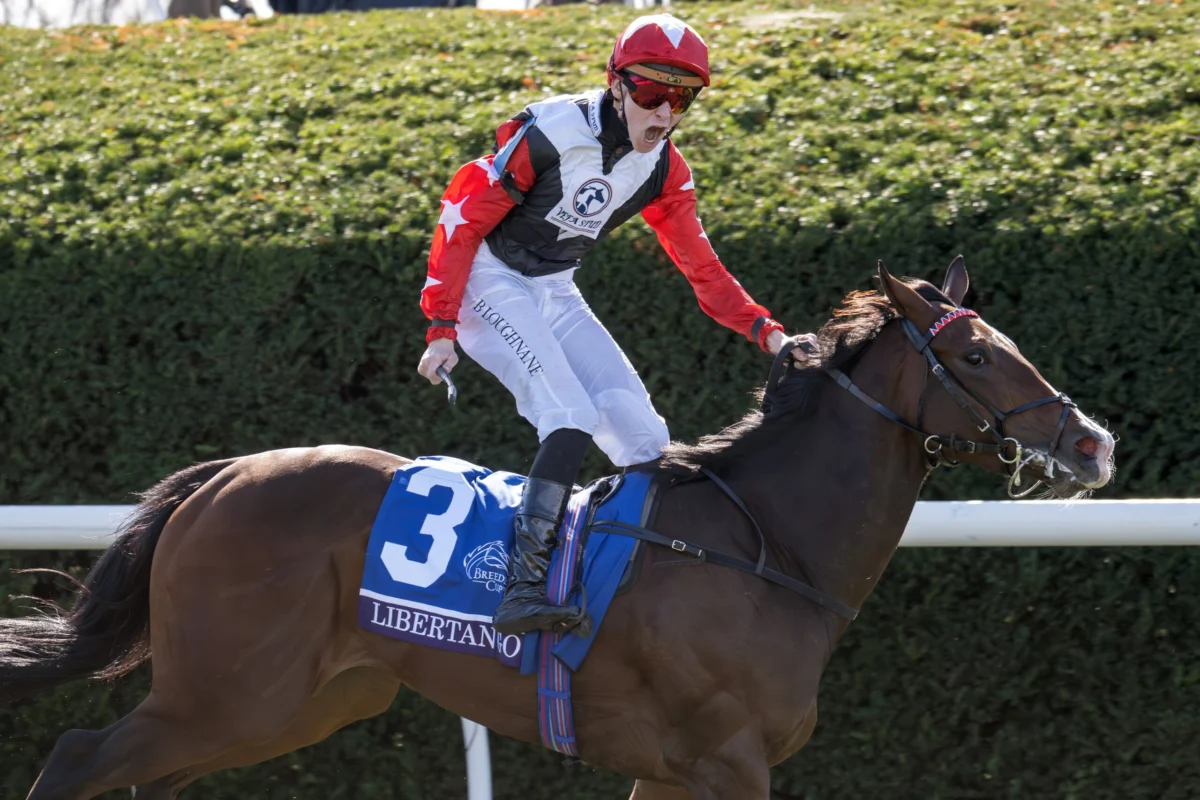
The Oct. 30 running of the Breeders’ Cup Juvenile Turf Sprint (G1T) at Keeneland Racecourse served as a masterclass in both athletic precision and professional endurance. A field of twelve juveniles—eight fillies, three colts, and one gelding—faced the formidable challenge of a 5 1/2-furlong sprint on firm Kentucky turf, a test further complicated by the track’s unique layout, which demands a technical 180-degree switchback. While the race concluded with a decisive victory for the Irish-bred filly Libertango, the event was marked by a tense narrative that unfolded both in the jockeys’ quarters and during the high-speed navigation of the final turn.
The Weight Room Battle and Pre-Race Tension
Before the first horse stepped onto the track, the most compelling drama took place within the confines of the Keeneland jockeys’ room. British champion Billy Loughnane, a rising phenom in the international racing circuit, found himself engaged in a desperate, last-minute struggle to meet the mandatory 119-pound weight requirement. The pressure was palpable; trainer George Boughey had already arranged for standby rider Flavien Prat to take the mount should Loughnane fail to make the scale.
For a 20-year-old rider of Loughnane’s stature, the ability to retain the ride on a horse he had partnered with throughout the season was a matter of professional pride. His success in shedding the final ounces ensured his participation, a development that resonated with both his traveling supporters and a local crowd eager to witness a premier international performance.
A Chronology of the Race
As the starting gates swung open, the competitive field displayed varying degrees of preparedness. Velozee, appearing unsettled by the environment, remained static as the gates opened, effectively forfeiting her chance at contention. Conversely, the globetrotting Ruiva demonstrated immediate, high-octane speed, seizing the lead and dragging the field through a blistering opening quarter-mile of :21.49.
Under the guidance of Juan Hernandez, Ruiva attempted to ration her energy, but the field tightened as they approached the critical far turn. It was at this juncture that the integrity of the race was compromised. Jockey Paco Lopez, aboard Harper’s Corner—a winner of the Schuylerville Stakes at Saratoga—maneuvered his mount aggressively, interfering with Oisin Murphy and his filly, Moonrise. The contact was severe enough to force not only Moonrise but also the trailing Libertango and several other contenders to take significant evasive action, breaking the momentum of the pack.
"It was a very bad bit of riding by Paco," Oisin Murphy remarked following the race. "Not what you’d expect to see at this level."
The stewards acted swiftly to address the infraction. Although Harper’s Corner crossed the wire in a contending position, the interference was deemed a disqualification offense. Harper’s Corner was subsequently demoted to eighth place, behind the impacted Moonrise.
As the field straightened for the run to the wire, Libertango exhibited what observers described as balletic dexterity. Having navigated the traffic caused by the interference, the daughter of No Nay Never surged forward, overtaking the field in the final sixteenth of a mile to secure the victory by 1 1/4 lengths in a final time of 1:02.64. The 50-1 outsider Hell of A Spin capitalized on the chaos to claim second, while Mussab was promoted to third place.
Performance Data and Form Analysis
Libertango’s victory was the culmination of a stellar juvenile campaign. Entering the Breeders’ Cup as the betting favorite at $1.87, she carried the momentum of a narrow defeat in the Cheveley Park Stakes (G1) to Sun Goddess. The validity of that form was confirmed later in the festival when Sun Goddess dominated the Breeders’ Cup Juvenile Fillies Turf (G1T), proving that the caliber of competition Libertango faced in Europe was world-class.
Prior to her Keeneland success, Libertango had established a reputation for consistency, securing wins in the Lowther Stakes (G2) at York and the Albany Stakes (G3) at Royal Ascot. Her transition to American turf—a surface known for being faster and firmer than typical European tracks—suggests a versatility that is highly prized in modern thoroughbred breeding.
Official Perspectives and Trainer Strategy
For trainer George Boughey, the victory represented a milestone as his first Breeders’ Cup triumph. Reflecting on the result, Boughey highlighted the intentional planning behind the filly’s progression. "She’s a filly who’s progressed all year," Boughey noted. "After Royal Ascot, the plan was always to come here. Billy has been on her all along, so I was happy he was able to make the weight, and grateful to Flavien to be standing by."
Loughnane, visibly emotional in the winner’s circle, credited the filly’s intelligence for the recovery from the mid-race interference. "She had a good gate, and I wanted to get on the back of Moonrise, thinking she’d carry me into the race," Loughnane explained. "It got tight there on Oisin—I didn’t see exactly what happened—but it broke the race up a little and I lost about a length. But then she cornered fantastically, which I had every faith she would, and went on with it in the straight."
Broader Implications for the Sport
The Breeders’ Cup Juvenile Turf Sprint is increasingly becoming a litmus test for the globalization of horse racing. The success of Libertango, bred by Lynch Bages and Camas Park Stud and owned by Ibrahim Araci, underscores the continued dominance of Irish and British bloodlines in turf sprints. Araci, who also celebrated a major victory earlier this year with Glacius in the Saratoga Derby Stakes (G1T), continues to build an impressive North American portfolio.
Furthermore, the stewards’ decision to disqualify Harper’s Corner serves as a stern reminder of the officiating standards at the Breeders’ Cup. In a high-stakes environment where margins are measured in fractions of a second, the enforcement of riding standards is critical to maintaining the legitimacy of the sport. The disqualification also highlights the volatility of sprint races; with twelve horses condensed into a short distance, the margin for error is non-existent.
Future Outlook
The implications of this result extend to the 2027 racing season. Libertango, having proven her ability to adapt to the Keeneland track, will likely be a focal point for connections looking to contest major turf events in the United States next year. For George Boughey, the win adds to a landmark season that has seen his stable perform at an elite level, including the success of Bow Echo and the upcoming participation of Survie in the Breeders’ Cup Turf (G1T).
As the dust settles on this year’s Juvenile Turf Sprint, the focus shifts to the long-term career of the young filly. Her combination of early speed, tactical maturity, and durability on firm ground positions her as one of the most promising prospects in international racing. For the industry, the race served as a reminder that while the pedigrees and training regimes are essential, the human element—from the grueling weight cuts of the jockeys to the split-second decisions made in the heat of competition—remains the ultimate variable in the pursuit of championship glory.
