

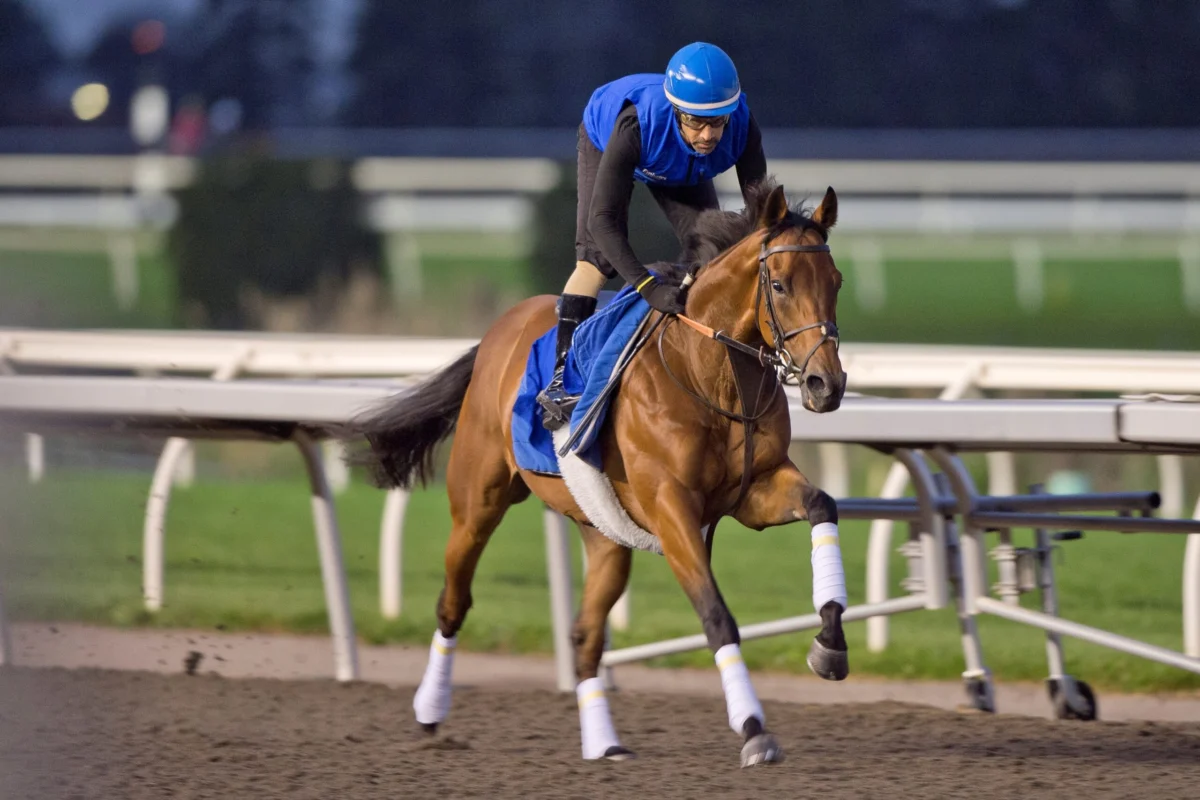
Following a highly successful September campaign that saw trainer Charlie Appleby secure two Grade 1 victories at Woodbine Racetrack, the Godolphin powerhouse is looking to extend its North American momentum. On October 3, the international stable will pin its hopes on Arabian Crown in the CA$750,000 Canadian International Stakes (G1T), a race that historically serves as a pinnacle for middle-distance turf specialists on the continent. As the five-year-old gelding prepares to break from the rail, the racing world turns its attention to a competitive field that blends European tactical prowess with local grit and North American staying power.
A Proven Pedigree Meets Global Ambition
Arabian Crown, a five-year-old gelding by the legendary sire Dubawi, enters the Canadian International with a resume that reflects the high standards of the Godolphin operation. Bred in France by 4 0 Gb Partnership, the horse has demonstrated exceptional durability and class throughout his career. Across 13 lifetime starts, Arabian Crown has secured six victories, including a dominant opening chapter to his racing life where he claimed four wins in his first five outings.
The gelding arrives in Toronto fresh off a significant performance in Ireland. On September 12, at Leopardstown Racecourse, Arabian Crown demonstrated his ability to handle the 1 1/2-mile distance, capturing the Kilternan Stakes (G3). This victory was more than a mere statistics boost; it served as a crucial barometer for his readiness for the rigors of a Grade 1 assignment on foreign soil.
Examining the Opposition: A Truly International Affair
The Canadian International Stakes is defined by its ability to attract high-caliber visitors, and the 2026 edition is no exception. Beyond the Godolphin entry, the field features a robust representation from Europe, including Purview and Ancient Egypt. Purview, representing the esteemed Juddmonte farm under the tutelage of Dermot Weld, arrives with pedigree and momentum. A son of Kingman, Purview finished a respectable third behind Arabian Crown in the Kilternan Stakes after previously securing a win in the June 28 International Stakes (G3) at the Curragh.
Amo Racing’s Ancient Egypt, a son of the prolific Frankel, provides another layer of complexity to the race. Trained by Charlie Johnston, this runner has been tested in top-tier North American company, having finished fourth in the prestigious Christophe Clement Turf Stakes—formerly known as the Sword Dancer—at Saratoga on August 15. His experience navigating North American turns and turf conditions could prove invaluable as he seeks a breakthrough performance in Canada.
Domestic Contenders and the Tactical Landscape
While the European contingent commands significant respect, the domestic entries bring a deep understanding of the Woodbine course, which is notoriously challenging due to its expansive E.P. Taylor Turf Course. Peachtree Stable’s Tawny Port is perhaps the most intriguing local narrative. Initially earmarked for a potential run in Australia’s iconic Melbourne Cup, connections made a late strategic shift to focus on the Canadian International.
Tawny Port’s recent form includes a victory in the September 9 Bowling Green Gold Cup Invitational Stakes at Kentucky Downs, where he navigated an grueling 2 1/16 miles. While he has struggled to find the winner’s circle in limited attempts at the 1 1/2-mile distance—holding a record of 0-3-2 from 11 starts—his stamina is unquestioned. The decision by trainer Miguel Clement to pivot to Woodbine indicates a calculated belief that the Canadian International’s track profile suits the horse’s closing style.
The local Woodbine hierarchy is further represented by Tomasello and Dancin in Da’nile. The duo finished first and second, respectively, in the Singspiel Stakes (G3T) over 1 3/8 miles on September 5. Tomasello, trained by Mark Casse, demonstrated a superior turn of foot to hold off his rival, and his comfort at the venue cannot be understated. Meanwhile, Antonio Sano’s Il Siciliano enters the race following an impressive allowance optional claimer win at Saratoga, suggesting he is prepared for the significant leap into Grade 1 company.
Historical Context and the Appleby Effect
Charlie Appleby’s influence on North American racing has grown exponentially over the last five years. His ability to ship runners across the Atlantic and have them immediately competitive is a testament to the rigorous training protocols and logistical precision of the Godolphin stable. When analyzing the form lines of Arabian Crown, one sees the fingerprints of this elite system.
In the Princess of Wales’s Stakes (G2) at Newmarket on July 9, Arabian Crown finished a mere half-length behind the dual Breeders’ Cup Turf winner Rebel’s Romance. To finish so closely to a horse of that caliber highlights the ceiling of Arabian Crown’s potential. Furthermore, his previous history includes competitive showings against elite turf performers such as El Cordobes and Wimbledon Hawkeye, both of whom have proven their mettle in major North American stakes. The fact that Arabian Crown has consistently squared off against the best in the world provides a degree of confidence that he will not be intimidated by the Grade 1 environment at Woodbine.
Tactical Considerations and Jockey Assignments
The barrier draw has provided Arabian Crown with the rail position (Post 1), a placement that offers both advantages and risks. Jockey Jamie Spencer, known for his patient and tactical approach, will be tasked with managing the gelding’s energy. In a 1 1/2-mile race, the ability to save ground on the inner rail is paramount, but it also leaves a horse susceptible to being "boxed in" if the pace slows or the field bunches up.
The rest of the field is balanced, with Dancin in Da’nile in Post 2, followed by Purview, Il Siciliano, Ancient Egypt, Tomasello, and Tawny Port. The diverse mix of trainers—from the global expertise of Appleby and Weld to the tactical acumen of Casse and Clement—suggests a race that will likely be determined by split-second decisions at the top of the stretch.
Broader Implications for the North American Turf Calendar
The Canadian International Stakes remains one of the most vital end-of-season races for turf stayers. As the calendar shifts toward the Breeders’ Cup, this race serves as a final proving ground for horses looking to solidify their status among the elite. For Godolphin, a win here would not only continue a dominant autumn season but also confirm their horses’ adaptability to varying turf textures across the globe.
The presence of European trainers in North American Grade 1 races has become an increasingly common phenomenon, reshaping the tactical expectations of local racing fans. Horses like Arabian Crown represent a modern era of thoroughbred racing where the world has become significantly smaller, and the "shipping" of top-tier talent is a calculated, year-round strategy. Whether Arabian Crown can replicate the success of his stablemates from earlier in September will ultimately depend on his ability to handle the transition from the Irish turf to the Canadian layout, but the data suggests he possesses the requisite class to triumph.
As the gates open on October 3, the racing community will be watching to see if the European invaders can maintain their recent dominance or if the local contingent, led by the battle-tested Tawny Port and the resilient Tomasello, can keep the prestigious trophy on Canadian soil. Regardless of the outcome, the 2026 Canadian International Stakes stands as a masterclass in global racing, featuring a collection of pedigrees and performances that define the very best of the sport.
