
The contemporary online gambling landscape is increasingly crowded with developers attempting to capture market share through high-volatility math models, reskinned Megaways engines, and familiar intellectual properties. Amid this sea of standardization, newcomer studio DELULU Gaming has carved out a distinct niche by prioritizing subversive aesthetics paired with structured player agency. The company’s latest offering, a cluster-based slot titled Toy Crush, represents its seventh studio title to date. Rather than serving as an isolated experiment, Toy Crush is carefully engineered to reinforce a burgeoning house style that marries innocent, nostalgic visuals with chaotic, high-energy mechanics. As the studio prepares to showcase the title at the upcoming SBC Summit Lisbon, industry observers are closely monitoring how DELULU’s strategic blend of dark humor, visual juxtaposition, and customizable gameplay will resonate with both operators and modern slot enthusiasts.
The Anatomy of Chaos: Inside the World of Toy Crush
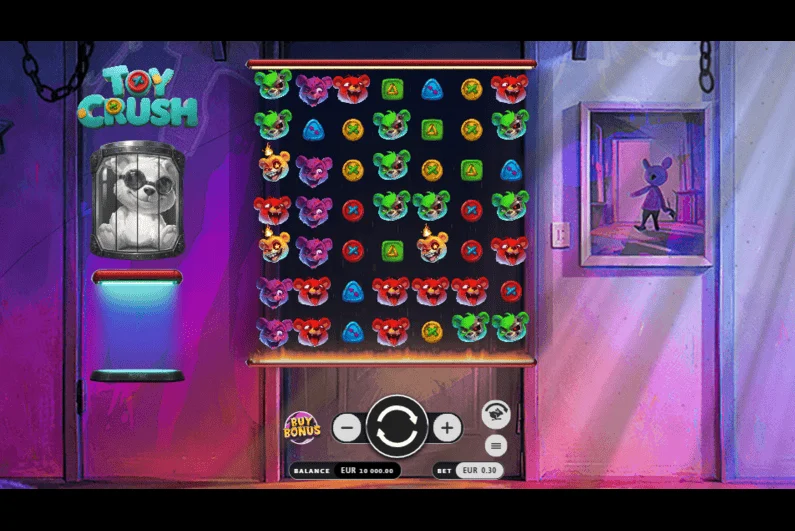
At first glance, Toy Crush presents a deceptive facade. The game is set within a vibrant, highly saturated toy-box environment that immediately evokes childhood memories of stuffed animals, plastic playthings, and cheerful nostalgia. However, this superficial innocence quickly destabilizes as players engage with the core gameplay loop. DELULU Gaming has intentionally designed the world to be populated by a riot of mutated, slightly unhinged toys, transforming a comforting aesthetic into a fast-moving, highly unpredictable theatre of action.
Operating on a cluster-pays grid system rather than traditional paylines, Toy Crush discards conventional win-evaluation methods in favor of cascading cascades and symbol destructions. The narrative arc of every single spin centers on the progressive accumulation of momentum, symbolized visually on screen by a prominent fixture: the Energy Meter. Every time a winning cluster is formed and its constituent symbols are destroyed, the Energy Meter absorbs the remnants, inching closer to a full charge.
This mechanical escalation serves a dual purpose. It provides the player with an immediate, tangible sense of progression while maintaining a high degree of short-term volatility. As the meter climbs through various stages, random Special Features are triggered organically. These dynamic modifiers can spontaneously transform symbols, clear entire sections of the grid to open up new cluster pathways, or inject sudden Wilds into the playfield. The ultimate payoff of this escalating chaos occurs when the meter reaches maximum capacity, summoning the game’s oversized star attraction: the Giant Bear. This colossal 3×3 Wild symbol anchors itself firmly onto the grid, remaining stubbornly in place while subsequent cascades swirl around it, frequently unlocking substantial win multipliers and high-value payouts.
Player Agency and the DELULU Philosophy of Design
What truly separates Toy Crush from standard cluster releases on the market is its unwavering commitment to player choice—a foundational pillar of DELULU Gaming’s corporate philosophy. Modern iGaming consumers increasingly reject passive, purely observational gaming experiences where the outcome of every spin feels entirely divorced from any form of interaction. DELULU has systematically addressed this demand by incorporating multiple entry points and feature-buying mechanics across its portfolio.
In Toy Crush, players are not merely at the mercy of organic symbol drops. The studio has implemented an Ante Bet option alongside three distinct Full Charge bonus modes. This architecture allows users to tailor their session volatility and pacing to their personal preferences. A player can choose the traditional route of building the Energy Meter naturally through standard base game spins, opt to increase their stake incrementally via the Ante Bet to accelerate feature triggers, or bypass the build-up entirely by purchasing direct entry into a Full Charge mode.
This mechanical philosophy is not entirely new for the studio; it represents a refined continuation of the ethos established in earlier titles such as Candy Chaos. While Candy Chaos utilized a different thematic backdrop and a distinct suite of modifiers, it shared the exact same underlying core: granting the user functional influence over how they interact with the volatility of the math model. By providing structured predictability wrapped in short-term chaotic uncertainty, DELULU has managed to create a gameplay loop that feels both empowering and deeply engaging.
Strategic Implications for Online Casino Operators
For B2B industry stakeholders and online casino operators, the release of Toy Crush carries commercial implications that extend far beyond its playful toy-box theme. In a B2B market saturated with thousands of monthly game releases, operators face severe challenges regarding game discovery, lobby fatigue, and player retention. Young studios often struggle to gain traction because their early titles lack a cohesive identity, leaving casino portfolio managers unsure of where a new provider fits within their existing lobby ecosystem.
DELULU Gaming has bypassed this common pitfall by focusing relentlessly on a recognizable house style. Even as the studio shifts themes—traversing from sugary confectionery madness in Candy Chaos to mutated playtime anarchy in Toy Crush—the underlying engine architecture, commitment to player agency, and subversive artistic direction remain constant. This consistency allows operators to market a DELULU game with a clear understanding of its target demographic: digital-native players who appreciate high-intensity cluster mechanics, self-directed bonus pacing, and visually rich, slightly irreverent storytelling.
Alina Avekse Mathiasen, Chief Product Officer at DELULU Gaming, articulated this exact strategic vision during the lead-up to the game’s launch. Emphasizing the studio’s core tenets, Mathiasen noted that every release is engineered to expand into entirely new thematic worlds while preserving a unified mechanical soul. According to leadership, the primary objective is to deliver experiences defined by active interaction and player influence, ensuring that no two titles feel like mere reskins of an identical template.
Roadmap and the Upcoming SBC Summit Lisbon Showcase
The launch of Toy Crush is merely the latest milestone in an aggressive rollout schedule mapped out by DELULU Gaming’s executive team. Having recently established its footprint in the competitive iGaming sector, the studio has confirmed that a robust pipeline of subsequent titles is already deep in development. Rather than leaning on a single successful template, future product iterations will continue to introduce completely new universes, original characters, and experimental mechanical variations, all while maintaining the studio’s signature emphasis on player agency.
The industry will have its next major opportunity to evaluate DELULU’s trajectory firsthand during the upcoming SBC Summit Lisbon, scheduled to run from September 29 to October 1. The high-profile conference and exhibition will serve as the global stage for the official live showcase of Toy Crush, alongside the rest of the studio’s rapidly expanding catalog.
For DELULU Gaming, the Lisbon summit is much more than a consumer-facing product demonstration; it functions as a critical business development vehicle. By placing Toy Crush at the center of their exhibition strategy, studio executives intend to leverage the game’s distinct market positioning to court tier-one operators, forge new distribution partnerships, and solidify their reputation as an innovative force in contemporary slot development. As the event approaches, the industry will be watching to see if DELULU’s calculated blend of chaotic design and player empowerment can successfully translate into long-term commercial dominance across regulated global markets.
