

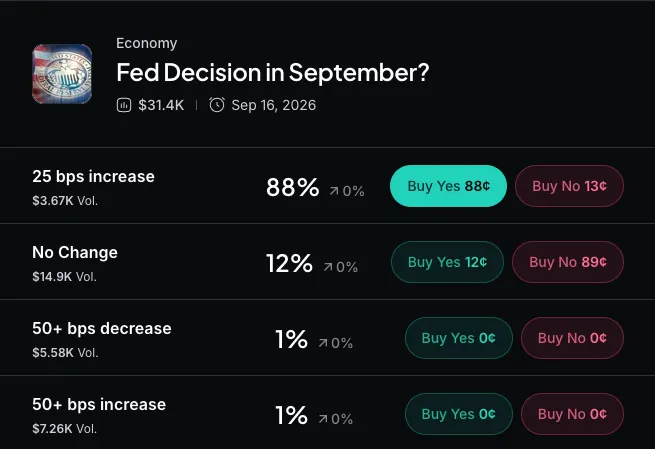
Wall Street is bracing for the Federal Reserve to do something it hasn’t done since 2023: raise interest rates. As the Federal Open Market Committee (FOMC) concludes its high-stakes two-day meeting this Wednesday, the financial world is operating under the near-certainty of a policy shift. According to the CME’s FedWatch tool, the probability of a 25-basis-point interest rate hike has surged to 94.5%, a dramatic climb from the sub-50% estimates recorded just one month ago. This anticipated tightening marks a pivotal moment in the current economic cycle, signaling that the central bank’s cooling-off period has reached a definitive end.
The consensus among major financial institutions has crystallized with remarkable speed. A recent survey conducted by the Wall Street Journal confirms that nearly every major investment bank, including JPMorgan, Citigroup, Morgan Stanley, UBS, and Barclays, now anticipates an immediate rate increase. Furthermore, these institutions are preparing for a broader tightening cycle, with many forecasting a total of 50 basis points in hikes before the end of the year. Some, including Bank of America, Deutsche Bank, and RBC, hold a more hawkish outlook, projecting 75 basis points of cumulative tightening by year-end. Conversely, Goldman Sachs adopts a more moderate stance, expecting only the initial quarter-point hike, while a small minority of economists at firms like Jefferies continue to forecast potential rate cuts as early as December.
The Macroeconomic Drivers of Tightening
The primary catalyst for this shift in monetary policy is the persistence of inflation, which has proven more stubborn than initial models suggested. As of August 2026, the headline Consumer Price Index (CPI) hovered at 3.4% on an annual basis, while core inflation—a metric favored by the Fed for its ability to strip out volatile food and energy costs—remained elevated at 2.5%. Both figures remain significantly above the Federal Reserve’s long-standing 2% inflation target.
Several external factors have complicated the economic landscape. Persistent geopolitical tensions, specifically the ongoing conflict involving Iran, have exerted upward pressure on global oil prices. These energy costs act as a tax on the broader economy, complicating the Fed’s efforts to manage price stability. Additionally, the impact of protectionist trade policies and tariffs has introduced new variables that traditional interest rate adjustments are ill-equipped to address. The Fed’s dilemma is clear: the need to combat inflation must be balanced against the risk of stifling a labor market that, despite its occasional volatility, has shown unexpected resilience, particularly following the stronger-than-expected jobs report for August.
The Warsh-Trump Dynamic: A Test of Institutional Autonomy
This week’s meeting represents a delicate political moment for Federal Reserve Chair Kevin Warsh. Appointed by President Donald Trump in January and officially sworn in this past May, Warsh has found himself in the crosshairs of a White House that is increasingly vocal about its preference for lower borrowing costs. During his inauguration, President Trump publicly emphasized the importance of Fed independence while simultaneously articulating an expectation that the administration’s policies would be supported by a more accommodative monetary stance.
The current situation has created a visible friction between the White House and the central bank. Over the past fortnight, President Trump, Vice President JD Vance, and Treasury Secretary Scott Bessent have engaged in a coordinated effort to lobby for rate cuts, with the President going so far as to suggest that trade relations with surplus-heavy nations could be contingent upon domestic rate policies. Chair Warsh has consistently maintained a stance of institutional neutrality, asserting that the Federal Reserve’s decisions remain insulated from political pressure. However, the optics of a rate hike occurring just two months before the midterm elections, amid widespread voter frustration regarding the cost of living, add a layer of complexity to the committee’s internal deliberations.
Market Repricing and the Bond Yield Surge
Bond markets have acted as a lead indicator for the Fed’s impending move, experiencing significant volatility over the past several days. The 10-year Treasury yield, a benchmark for global borrowing costs, touched 5.04% this week—reaching its highest level since July 2007. Simultaneously, the two-year Treasury yield, which is highly sensitive to shifts in federal funds rate expectations, climbed to levels not seen since July 2024.
This repricing reflects a fundamental shift in investor sentiment regarding the "higher for longer" narrative. When government bonds offer higher, safer yields, capital tends to rotate away from risk-on assets, such as equities and digital currencies. This movement is not merely a reaction to the expected 25-basis-point hike, but a broader recalibration of risk as investors account for the possibility that the current tightening cycle could be more aggressive than initially anticipated. Markets are currently pricing in a scenario where interest rates remain elevated well into 2027, forcing a revaluation of growth-oriented stocks and speculative assets that thrived during the era of near-zero interest rates.
Implications for Digital Assets and Bitcoin
The cryptocurrency market has approached this week’s Fed decision with evident caution. Bitcoin, often viewed as a "risk-on" asset, has faced downward pressure, recently trading around $75,700—a decline of more than 3% following the legislative setback of the Clarity Act in the U.S. Senate. This failure to secure a clear regulatory framework has compounded the uncertainty brought on by the Fed’s hawkish turn.
Technical analysts are closely monitoring the $73,200 level for Bitcoin, viewing it as a critical support threshold. A daily close below this mark could signal a deeper retracement toward the $71,000 or even the $66,900 level. Such a decline would effectively nullify the recent positive technical momentum, including the "golden cross" pattern that had previously sparked optimism among retail and institutional investors.
However, some market observers remain measured. They argue that if the Fed’s move is intended primarily to anchor long-term yields rather than to aggressively restrict credit, the damage to crypto markets might be contained. The ultimate impact will depend less on the hike itself—which is already largely priced in—and more on the "dot plot" of future rate projections and Chair Warsh’s tone during his Wednesday press conference. If the Fed signals that this move is a one-off adjustment, volatility may subside. If, however, the central bank signals that the 75-basis-point tightening scenario is on the table, crypto assets—particularly high-beta altcoins with lower liquidity—could face significant downward volatility.
Conclusion: A Pivotal Press Conference
As the clock ticks toward the 2:00 p.m. ET announcement on Wednesday, the global financial community is focused on the specifics of the FOMC statement. The official language regarding future inflation risks and the economic outlook will be scrutinized for any hint of a shift in the committee’s terminal rate expectations. Following the statement, Chair Warsh’s 2:30 p.m. ET press conference will serve as the definitive window into the committee’s collective mindset.
The Fed is attempting to thread a needle: managing inflation that refuses to return to target while navigating a volatile political environment and an increasingly skeptical bond market. Whether this week’s action is viewed as a necessary step to secure price stability or a policy error that risks a premature economic slowdown remains the subject of intense debate. For investors, the takeaway is clear: the era of speculative liquidity is giving way to a period defined by higher cost-of-capital, forcing a fundamental reassessment of value across all asset classes.
