

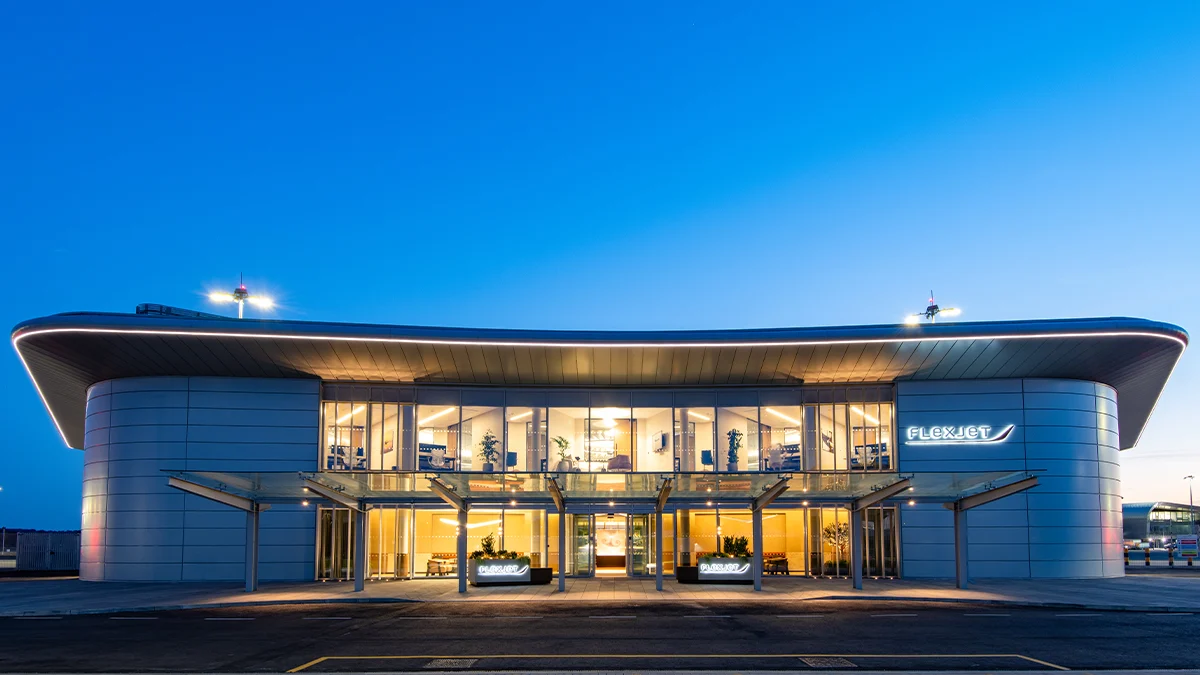
Fractional jet provider Flexjet has officially cemented its physical footprint in Europe with the opening of a state-of-the-art private terminal at Farnborough Airport, just outside London. Valued at $34 million, the sprawling 22,600-square-foot facility serves as the company’s first dedicated private space in Europe and acts as the new European operational headquarters for its extensive network of private aircraft and helicopters.
The unveiling of the Farnborough facility represents the latest milestone in an aggressive expansion period for the company. Over the preceding two years, Flexjet has secured a landmark $800 million strategic investment from LVMH’s L Catterton, forged a nautical-inspired interior collaboration with legendary boatbuilder Riva, and secured a multiyear official partnership status with Formula 1. By combining high-end hospitality, tactical flight operations, and bespoke client amenities under one roof, the company aims to redefine the Fixed-Base Operator (FBO) experience for international travelers.

Architectural Design and Interior Highlights
Designed in collaboration with Carber Hain Art + Design, the Farnborough facility moves away from the sterile, industrial aesthetic traditionally associated with private aviation terminals. Instead, the interior draws inspiration from contemporary boutique hospitality, featuring warm hexagonal wood flooring complemented by rich accents of rusty orange and deep navy blue.
At the center of the terminal sits a swanky, airfield-facing bar offering specialty cocktails alongside rare vintage selections, including fine wines from Cheval Blanc. The space also houses private, acoustically treated meeting rooms, a tactical control center, and an expanded training hub for the company’s Red Label Academy, which standardizes and elevates crew service protocols.
The undisputed centerpiece of the terminal, however, is a full-scale physical mockup of a Gulfstream G700 cabin interior. Finished in sophisticated blue and neutral colorways, the installation allows prospective and current fractional owners to step inside and evaluate the exact spatial layout, seating configurations, and ultra-long-range amenities of the flagship jet before stepping onto an active tarmac.

According to Flexjet Chairman Kenn Ricci, the intentional departure from standardized terminal design is central to the company’s brand identity. Rather than rolling out a uniform template across international airports, Flexjet intends for every proprietary terminal to reflect the architectural sensibilities of its host city while maintaining consistent luxury standards.
A Transatlantic Journey Aboard the Flagship Fleet
To fully understand the operational ecosystem supporting the new London gateway, industry analysts and media representatives recently traced the company’s transatlantic transit corridor. The journey commenced at the West Side Heliport in Manhattan during the early morning hours, utilizing Flexjet’s Sikorsky S-76 helicopter for a swift, 15-minute transfer to New Jersey’s Teterboro Airport—widely recognized as the busiest private aviation hub in the United States.
From Teterboro, passengers boarded a Gulfstream G700, an ultra-long-range aircraft added to the Flexjet fleet. The aircraft features an exceptionally quiet cabin environment and an advanced environmental control system maintaining a cabin altitude equivalent to 2,840 feet—significantly lower than standard commercial airliners. This engineering spec is designed to minimize the physiological impacts of dehydration and fatigue associated with intercontinental travel.

With a capacity of up to 15 passengers, the G700 interior includes flexible seating arrangements, a fully enclosed lavatory, and a dedicated permanent bed in the rear cabin. Culinary service during the flight mirrored high-end dining establishments, featuring freshly prepared hot breakfasts and destination-themed refreshments, serviced by two dedicated cabin attendants.
Strategic Context and Corporate Growth
The establishment of the Farnborough terminal aligns with a broader industry trend identified by Flexjet leadership: the evolution toward younger clientele, longer flight distances, and larger-cabin aircraft. As the global private aviation sector navigates shifting demographics, high-net-worth travelers are increasingly demanding seamless, end-to-end ground and air integration.
Flexjet CEO Michael Silvestro noted that the company plans to establish a network of 12 to 15 branded FBO terminals globally, positioning London as the primary European gateway. With approximately six additional international locations currently under development or evaluation, the strategy aims to mirror existing domestic private terminals located in major U.S. markets such as Dallas and White Plains.

This infrastructure expansion is heavily supported by the company’s fleet composition, which boasts one of the industry’s highest concentrations of large-cabin, long-range aircraft. Flexjet remains the largest global operator of Gulfstream aircraft, a distinction that underpins its capability to service non-stop intercontinental routes for its fractional owners.
The LVMH Partnership and Bespoke Client Integration
The company’s rapid ascent has been heavily reinforced by its high-profile alliance with LVMH and its investment arm, L Catterton. This partnership extends far beyond capital investment, influencing physical design choices and customer acquisition experiences.
Ricci noted that the collaboration required a careful balancing act between haute couture aesthetics and strict aviation regulatory compliance, humorously recalling having to convince design partners that chandeliers cannot be installed inside an aircraft cabin due to safety mandates.

The synergy between the two luxury entities is further manifested in an upcoming line of exclusive Louis Vuitton luggage engineered specifically for Flexjet owners. Rather than relying on traditional courier shipping—which executive leadership deemed insufficient for a true luxury experience—newly enrolled clients will receive personal invitations to closed-door boutique appointments. During these private sessions, clients can select their custom travel pieces in an environment tailored to individual preference.
Market Implications and Future Outlook
The opening of the Farnborough facility serves as a case study in how modern fractional jet providers are attempting to secure long-term client retention through vertically integrated infrastructure. By controlling the entire passenger journey—from urban helicopter transfers and proprietary ground terminals to long-haul flight execution and customized post-flight services—Flexjet aims to insulate its business model against broader economic volatility.
Industry observers note that as commercial airline disruptions persist and the ultra-wealthy segment continues to expand globally, investments in dedicated FBO infrastructure will likely become a primary competitive differentiator. By planting its flag firmly at one of Europe’s premier business aviation airports, Flexjet has signaled its intention to capture a dominant share of the lucrative transatlantic private travel market for the foreseeable future.
