

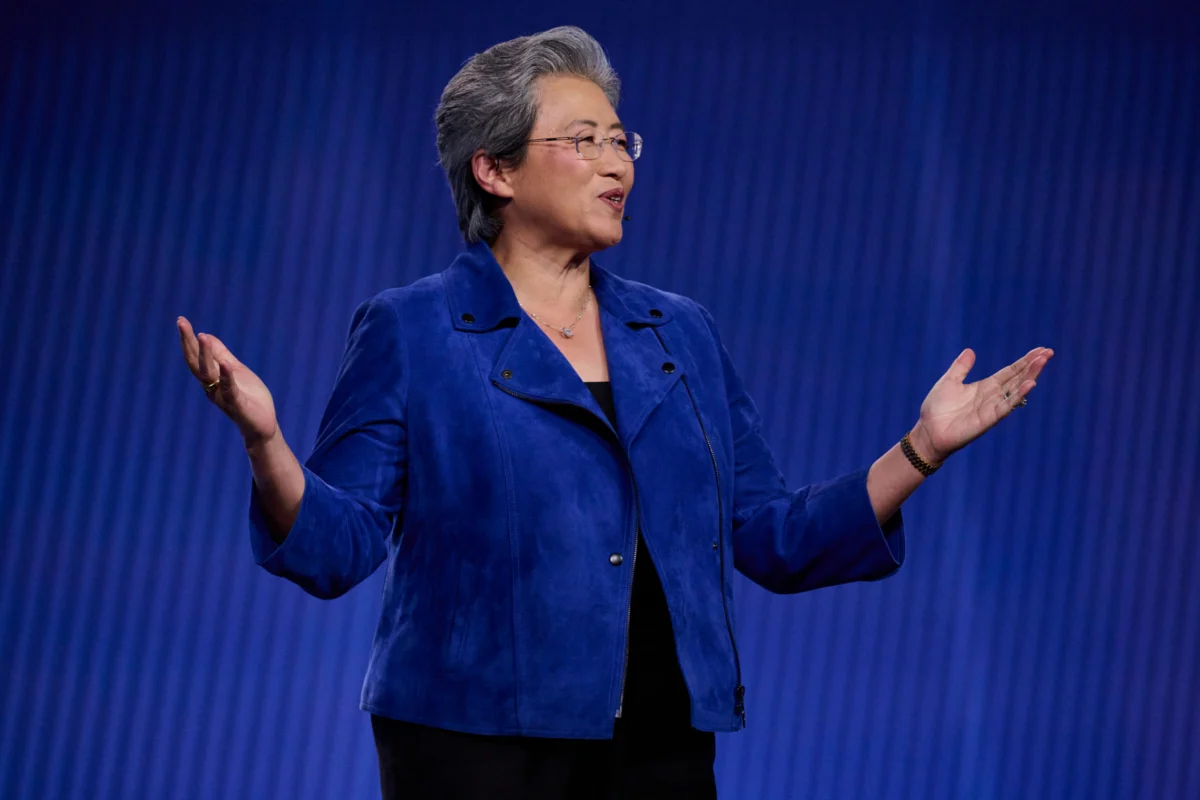
AMD has officially intensified its campaign to capture the high-stakes artificial intelligence infrastructure market, unveiling a suite of hardware solutions designed to challenge Nvidia’s long-standing hegemony in the data center. At the company’s sold-out Advancing AI conference held in San Francisco, AMD Chair and CEO Dr. Lisa Su introduced the Helios rack-scale system, a high-performance computing architecture engineered specifically to meet the escalating demands of the world’s most sophisticated AI laboratories. As the industry pivots toward "agentic AI"—systems capable of autonomous reasoning and complex task execution—AMD is positioning its latest silicon and integrated systems as the necessary backbone for the next generation of digital intelligence.
The centerpiece of the announcement, the Helios system, represents a strategic shift for AMD from providing individual components to delivering fully integrated, "rack-scale" solutions. This approach mimics the successful strategy employed by Nvidia with its Grace Blackwell and Vera Rubin platforms, which integrate GPUs, CPUs, and networking into a single, cohesive unit to maximize throughput and energy efficiency. By offering a pre-configured, high-density environment, AMD aims to reduce the friction for hyperscalers and enterprises looking to deploy massive clusters of compute power.
The Engineering of Helios: A Rack-Scale Powerhouse
The Helios system is not merely a collection of servers but a vertically integrated computing environment designed for gigawatt-scale deployments. Rack systems like Helios are critical for modern data centers because they solve the physical and thermal challenges associated with housing thousands of high-powered processors. By consolidating compute, memory, and high-speed interconnects into a unified rack, AMD can optimize the communication between individual GPUs, which is essential for training large language models (LLMs) and running frontier-level inference tasks.
According to Dr. Su, Helios is the tech industry’s "highest-performance AI rack," built to handle the most demanding frontier models currently in development. Industry analysis suggests that Helios is designed to compete directly with Nvidia’s upcoming Vera Rubin architecture. Reports from the event indicate that Helios matches or exceeds several of Nvidia’s performance benchmarks, particularly in memory bandwidth and total compute density. This performance leap is attributed to the integration of AMD’s Instinct MI450 series GPUs, which utilize advanced packaging techniques and high-bandwidth memory to eliminate the bottlenecks that often plague large-scale AI training.
The physical scale of these systems is equally impressive. Earlier previews of the Helios rack at CES 2026 revealed that a single fully loaded unit can weigh as much as two compact cars, a testament to the density of the liquid-cooling systems and power delivery components required to keep the processors operational. This level of hardware complexity underscores the "arms race" currently taking place in the semiconductor industry, where physical infrastructure is becoming as important as the code it runs.
Strategic Partnerships and Market Adoption
The success of any new hardware platform is predicated on its adoption by "hyperscalers"—the massive cloud providers and AI developers that purchase chips by the tens of thousands. AMD’s conference featured a "who’s who" of the technology sector, confirming that the industry’s largest players are diversifying their supply chains away from a total reliance on Nvidia.
Microsoft CEO Satya Nadella confirmed via a video statement that the tech giant would significantly expand its Azure infrastructure with the Helios system. This move is a major win for AMD, as Microsoft has been the primary driver of the current AI boom through its partnership with OpenAI. By integrating Helios into Azure, Microsoft provides a massive, ready-made market for AMD’s hardware, allowing developers to rent Helios-powered compute cycles through the cloud.
Furthermore, AMD announced a landmark strategic partnership with Anthropic, the developer of the Claude AI models. Under this agreement, Anthropic plans to deploy up to two gigawatts of AMD Instinct MI450 series GPUs. To put this into perspective, two gigawatts is enough power to support roughly 1.5 million homes, indicating the unprecedented scale of compute required for future AI models. Other major players, including Meta, Oracle, and OpenAI, have also signaled their intent to incorporate Helios into their respective data center roadmaps.
Venice-X and the Future of the Data Center CPU
While GPUs are the stars of the AI era, the central processing unit (CPU) remains the "brain" that manages data flow and general-purpose workloads within the server. To address this, AMD introduced the Venice-X CPU, based on the Zen 6 architecture. Scheduled for a 2027 launch, the Venice-X is a specialized processor designed for high-performance computing (HPC) and data center environments.
The Venice-X is a technological marvel in its own right, featuring a boost clock of up to 5.15 GHz and an unprecedented 1152 MB of 3D V-Cache across 96 cores. This massive cache is particularly useful for AI workloads that require frequent access to large datasets, as it allows the processor to store more information closer to the cores, drastically reducing latency. By pairing Venice-X CPUs with Helios rack systems, AMD is creating a "full-stack" hardware ecosystem that can manage everything from the initial data processing to the final model inference.
The Shift Toward Agentic AI and the $1.4 Trillion Market
A significant portion of Dr. Su’s keynote was dedicated to the changing nature of AI workloads. She argued that the industry is entering the era of "agentic AI," which differs fundamentally from the simple chatbots of the past two years. While early AI models were largely reactive, agentic AI is proactive—it can reason through multi-step problems, access external tools, and autonomously refine its output until a goal is achieved.
"When you ask the agent to do something, it actually has dozens of steps," Su explained. "It has to reason, and it has to call tools, and it has to access data, and it has to keep doing it over and over until it solves the problem, and so you need lots of GPUs to do all that."
This shift in how AI operates is driving a "step change" in compute demand. Because agentic AI requires continuous "thinking" time (often referred to as "test-time compute"), the volume of chips needed to support these agents is expected to grow exponentially. Consequently, AMD has revised its market forecasts upward. The company now expects the AI accelerator market to reach approximately $1.4 trillion by 2030.
This figure is staggering; it suggests that by the end of the decade, the market for AI-specific chips will be roughly equivalent to the size of the entire global semiconductor market today. Su emphasized that GPUs will continue to make up the "vast majority" of this market because their programmability allows them to adapt to rapidly changing algorithms. Unlike fixed-function chips, GPUs can be updated via software to handle new types of AI architectures, a flexibility that is essential in an industry that is still, in Su’s words, "in its infancy."
Analysis: Implications for the Semiconductor Landscape
AMD’s latest announcements signal a maturing of the AI hardware market. For the past several years, Nvidia has enjoyed a near-monopoly on high-end AI training hardware, largely due to its proprietary CUDA software stack, which became the industry standard for AI development. However, AMD has made significant strides with its ROCm open software platform, making it easier for developers to port their code from Nvidia systems to AMD hardware.
The introduction of Helios suggests that AMD is no longer content being the "value alternative" to Nvidia. By competing on raw performance and offering a complete rack-scale solution, AMD is positioning itself as a primary architect of the AI era. This competition is likely to drive down costs for AI developers and accelerate the pace of innovation, as both companies strive to outdo each other in terms of energy efficiency and compute density.
Moreover, the focus on gigawatt-scale deployments highlights a looming challenge for the industry: power consumption. As AI labs move toward deployments that require the energy equivalent of mid-sized cities, the efficiency of the underlying hardware becomes the most critical metric. AMD’s Venice-X and Helios systems are designed with this constraint in mind, utilizing advanced liquid cooling and optimized power delivery to ensure that the massive increase in compute does not lead to an unsustainable surge in energy costs.
Timeline of AMD’s AI Evolution
The journey to Helios and Venice-X has been a multi-year progression for AMD:
- 2023-2024: AMD establishes its presence in the AI market with the Instinct MI300 series, proving it can compete with Nvidia’s H100 in specific workloads.
- 2025: Initial reveal of the Helios concept, signaling AMD’s intent to move into rack-scale systems.
- January 2026: AMD showcases the physical Helios rack at CES, demonstrating its massive scale and cooling requirements.
- July 2026: At the Advancing AI conference, AMD confirms major customers like Microsoft and Anthropic and provides performance metrics comparing Helios to Nvidia’s Rubin.
- Late 2026: Planned initial shipping of Helios systems to lead customers.
- 2027: Expected launch of the Venice-X CPU, completing the next-generation data center stack.
- 2030: AMD’s target date for the AI accelerator market to hit $1.4 trillion.
Conclusion
The Advancing AI conference has solidified AMD’s status as a formidable challenger in the AI infrastructure space. By delivering the Helios rack-scale system and the Venice-X CPU, AMD is addressing the two most critical needs of the modern data center: massive compute density and efficient data management. With the backing of industry titans like Microsoft and Anthropic, AMD is well-positioned to capitalize on the $1.4 trillion opportunity that lies ahead. As the world moves toward an economy powered by agentic AI, the silicon battle between AMD and Nvidia will remain the most important story in the technology sector, determining not just which companies thrive, but how quickly the promise of artificial intelligence can be realized at a global scale.
