

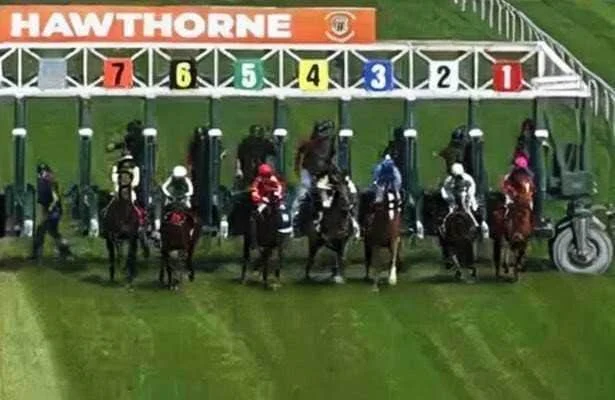
The 136-year-old Hawthorne Race Course, a cornerstone of Illinois sporting history, reached a somber crossroads this week as a federal bankruptcy judge delivered a stinging rebuke to track executives. In a Chicago courtroom on Wednesday, U.S. Bankruptcy Judge Timothy Barnes questioned the ethical and financial priorities of the track’s management, which has continued to draw executive salaries while leaving horsemen with over $1$ million in unpaid purses. The hearing, which lasted 40 minutes, underscored the dire state of the Cicero landmark as it moves toward a $90 million sale that will likely see the property converted from a historic racing venue into a data center or other industrial use.
The proceedings centered on the track’s status as a "debtor in possession," a legal standing that allows a company to continue operations while under bankruptcy protection. However, Judge Barnes expressed significant concern over how Hawthorne has managed its "administrative expenses"—the costs necessary to keep the business running during the legal process.
"How is the debtor in possession prioritizing its administrative expenses?" Judge Barnes asked, his voice echoing through the courtroom. "Why are the horsemen at the bottom of the waterfall here for the payment of administrative expenses?"
The judge’s inquiry was sparked by revelations that while owners, trainers, jockeys, and stable workers have gone unpaid for weeks, the track’s top-tier employees have faced no such interruptions in their compensation. Hawthorne’s attorney, David Golin, argued that the track needed to prioritize certain costs to maintain the facility and prepare it for sale. Golin suggested that the primary focus was to "keep the lights on" and maintain the infrastructure necessary to eventually upgrade the track, pending the finalization of the sale.
Judge Barnes was not persuaded by the "lights on" defense. Drawing on testimony provided earlier in the week by Kevin Morse, an attorney for the Illinois Thoroughbred Horsemen’s Association (ITHA), the judge noted that executive salaries and car payments are not essential for maintaining basic utilities. "Executives getting their salaries is not necessary to keep the lights on," Barnes remarked. "You’re running operations, and if top-half employees are getting paid, and people at the bottom of the chain are not, there’s problems."
A Century of History Facing a Rapid Collapse
Hawthorne Race Course is one of the oldest continually operating sporting venues in the United States. Founded in 1891 and owned by the Carey family since 1909, it has survived the Great Depression, two World Wars, and several fires. For decades, it served as the gritty, year-round counterpart to the more glamorous Arlington Park. However, the decline of the Illinois racing industry, accelerated by the 2021 closure of Arlington Park and the slow rollout of "racino" legislation intended to allow tracks to operate slot machines and table games, has left Hawthorne in a state of terminal insolvency.
The current bankruptcy filing reveals a staggering financial hole. Hawthorne reportedly owes between $100 million and $500 million to a list of more than 3,000 creditors. Some of these debts date back more than 20 years, illustrating a long-term pattern of financial instability that has finally reached a breaking point.
The immediate crisis for the horsemen began this month when Hawthorne, struggling with cash flow, reduced its racing schedule from two days a week to one. Over the course of three consecutive Sundays, the track held races with total purses amounting to $584,000. To date, not a single cent of that money has been distributed to the winners.
Kevin Morse, representing the horsemen, painted a grim picture of the human and animal toll this financial negligence has taken. He highlighted the case of "Last Minute," a five-year-old gelding that once sold for $475,000. Following a race last Sunday, the horse suffered from what was reported as heat exhaustion and had to be euthanized.
"That money is coming in due to my clients running and risking their lives," Morse told the court. "Executives are being paid. Car payments for executives are being paid. What’s happening here is being run on the back of my clients."
The Human and Equine Displacement Crisis
Beyond the unpaid purses, a humanitarian crisis is looming at the Cicero property. Hawthorne has requested that the "backside"—the stable area and housing for workers—be completely vacated by August 31. This move would involve the relocation of more than 500 workers and their families, many of whom live in onsite dormitories, as well as approximately 500 horses.
The logistics of such a mass exodus are daunting. Hawthorne’s legal team estimated the cost of the relocation at $900,000—funds the track currently does not have. This lack of liquidity is the primary reason the track is petitioning the court for an additional $5 million to be added to its debtor-in-possession credit line.
Attorneys representing the creditors’ committee, specifically a group known as 180 Hawthorne Holdings, pushed for a strict enforcement of the August 31 deadline. Bill Thorsness, an attorney for the committee, suggested that if occupants had not left by early September, the court order should be executable by the U.S. Marshal’s office to forcibly remove them.
Judge Barnes, however, showed a measure of restraint regarding the use of force. "I’m generally very hesitant to do that," the judge said. "It’s never a good idea to send out the muscle. It just doesn’t work well." He expressed a desire to hold another hearing closer to the deadline to address these issues more humanely, rather than authorizing an immediate eviction by law enforcement.
The Role of the Illinois Department of Agriculture
A complicating factor in Hawthorne’s financial distress is a dispute with the Illinois Department of Agriculture (IDOA). Both the track and the ITHA agree that the IDOA is currently withholding a "bridge payment" of $1.125 million from the state’s purse-reserve budget.
Hawthorne’s attorney, David Golin, expressed frustration with the state agency, claiming the money is available on the state’s balance sheet but remains inaccessible. "We have a receivable from the Department of Agriculture, which we are not happy about, and we have been working very hard to extract that money," Golin stated.
Industry sources suggest that the IDOA’s reluctance to release the funds stems from a profound lack of trust in Hawthorne’s management and the shadowy nature of the track’s prospective buyer. There are concerns within the state government that if the money is released, it will be used to pay off administrative debts or executive bonuses rather than being funneled to the horsemen as intended. One source indicated that the department believes it is exerting necessary pressure on Hawthorne by withholding the funds, though the collateral damage is being felt by the trainers and jockeys who are currently unable to pay their bills.
The $90 Million Sale to Allimac 2023
The future of the 108-acre site currently rests on a $90 million bid from Allimac 2023, a Delaware-based corporation that was formed shortly before the auction. Allimac was the sole bidder for the property, raising questions about the transparency and competitiveness of the sale process.
While Allimac’s attorneys have remained tight-lipped in court regarding their specific intentions for the land, rumors have swirled among racing insiders and local real estate analysts. One prevailing theory is that the property will be repurposed as a massive data center, a move that would capitalize on the site’s proximity to Chicago’s fiber-optic infrastructure and power grid.
The transition from a labor-intensive horse racing track to a capital-intensive data center would represent a significant shift for the Cicero community. While a data center would likely generate substantial tax revenue, it would provide far fewer jobs than the hundreds of positions currently supported by the racing industry, from grooms and exercise riders to concessions staff and security.
Legal Warnings and the Road Ahead
As the proceedings drew to a close on Wednesday, Judge Barnes issued a stern warning to Hawthorne’s legal team regarding the potential for "insider relationships" to influence which creditors get paid.
"If I discover that the debtor in possession is preferring some administrative expenses over others because of insider relationships, everyone will pay a price for that," Barnes told Golin. "So I’m telling you now as counsel for the debtor. Get that under control."
The judge’s warning reflects a broader skepticism regarding the Carey family’s management of the track in its final days. The perception that the "top-half" of the company is shielding itself from the financial fallout while the "bottom-half" suffers has become the central tension of the bankruptcy case.
For the horse racing community in Illinois, the collapse of Hawthorne is the latest in a series of devastating blows. With Arlington Park gone and Hawthorne in bankruptcy, the state’s thoroughbred racing circuit has effectively disintegrated. The cancellation of Sunday’s races was confirmed by Hawthorne’s racing director, Jim Miller, who stated simply that the track is no longer taking entries.
The legal battle is set to resume on Friday morning. While the court will continue to deliberate on the terms of the $90 million sale and the extension of credit lines, the era of live racing at Hawthorne appears to have reached its definitive end. The 500 horses and 500 workers facing displacement now look toward an uncertain future, as the state’s once-vibrant racing industry is reduced to a series of balance sheets and courtroom arguments.
