


Abbott Laboratories, a global leader in medical devices and healthcare diagnostics, is currently navigating a complex cybersecurity landscape as it investigates two distinct security incidents affecting different segments of its sprawling business operations. The Chicago-based multinational confirmed that it has been looking into unauthorized access to internal legacy systems within its Cancer Diagnostics business, while simultaneously addressing claims of a secondary breach involving its LabCentral customer portal. These incidents, attributed to different threat actors with varying motives, highlight the persistent vulnerabilities within the global healthcare infrastructure and the aggressive tactics employed by modern cyber-extortion groups.
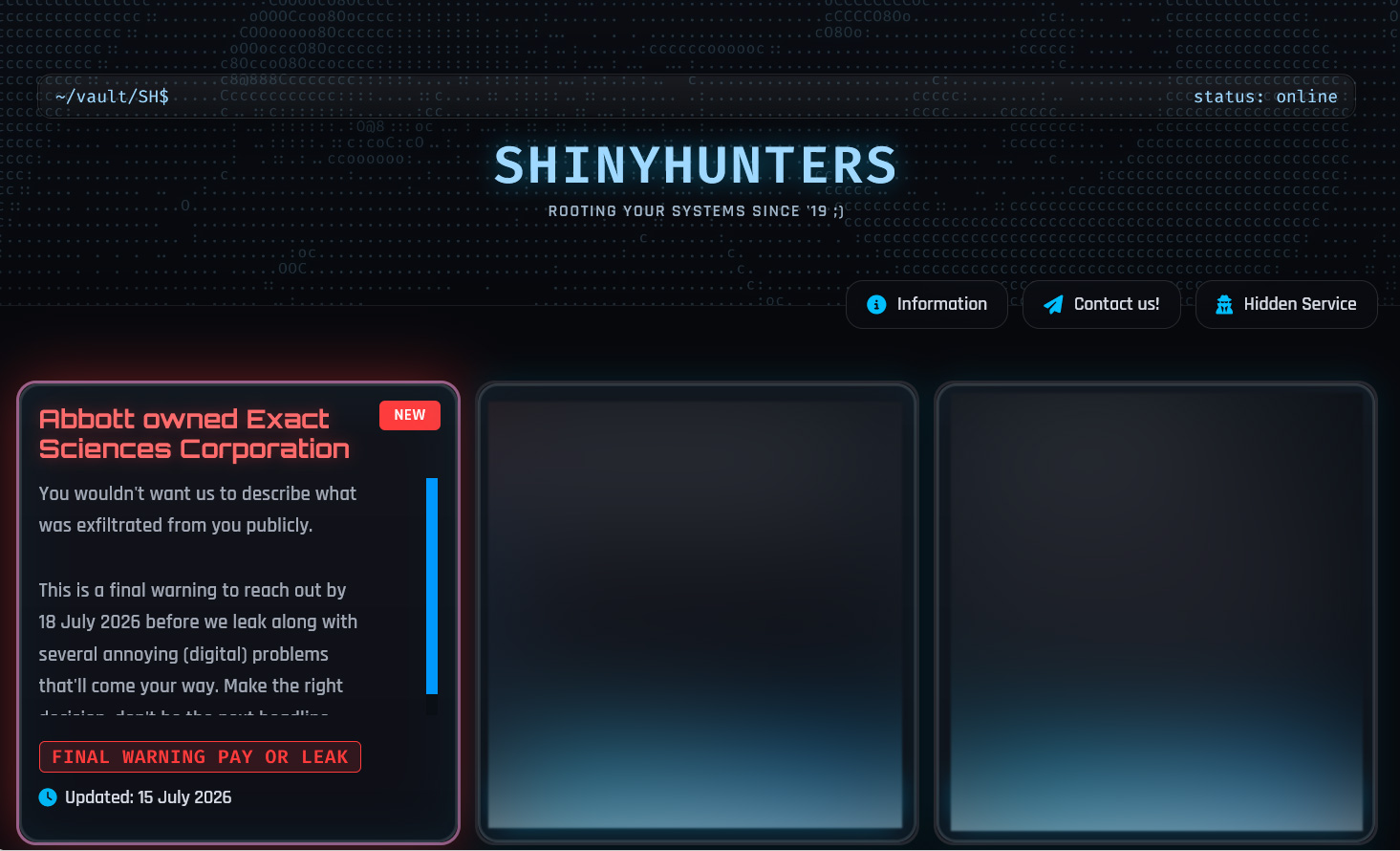
The first and more significant of the two incidents involves the notorious cybercriminal organization known as ShinyHunters. This group recently added Abbott Laboratories to its public data leak site, an online platform used to pressure victims into paying ransoms by threatening to release stolen information. According to the threat actors, the breach targeted legacy systems formerly associated with Exact Sciences, a business segment integrated into Abbott’s Cancer Diagnostics division. The group initially set a deadline of July 18 for the company to enter negotiations, later extending the ultimatum to July 21.
The ShinyHunters Incident: Vishing and SSO Compromise
According to claims made by ShinyHunters to cybersecurity researchers, the breach was not the result of a sophisticated software exploit but rather a targeted social engineering campaign. The group asserts that in mid-June 2026, they executed a "vishing" (voice phishing) attack against several Abbott employees. By posing as IT support or other trusted personnel, the attackers successfully manipulated employees into providing credentials or multi-factor authentication (MFA) codes.
This access allowed the threat actors to compromise a Microsoft Entra (formerly Azure AD) single sign-on (SSO) account. In modern corporate environments, SSO accounts serve as the "master key" to a vast array of cloud-based services and Software-as-a-Service (SaaS) applications. Once the attackers gained a foothold through Entra ID, they reportedly moved laterally through Abbott’s interconnected environment, exfiltrating data from several high-value platforms, including ServiceNow, SharePoint, Databricks, and Coupa.
The scope of the data allegedly stolen by ShinyHunters is staggering. The group claims to have exfiltrated over 30 million rows of customer personally identifiable information (PII). This dataset reportedly includes full names, email addresses, phone numbers, physical addresses, and dates of birth. Most concerningly, the group alleges that the haul contains more than one million Social Security numbers. Beyond standard PII, the attackers claim to possess over 22 million client notes detailing sensitive doctor-patient conversations and more than 20 million medical orders. If verified, this would represent one of the largest medical data thefts in recent history.

Abbott’s Response and Risk Assessment
In an official statement addressing the Cancer Diagnostics incident, Abbott Laboratories attempted to mitigate concerns regarding the operational impact of the breach. The company confirmed unauthorized access to a "limited number of internal systems" but emphasized that the affected systems were legacy environments inherited from Exact Sciences and were functionally separate from Abbott’s primary corporate infrastructure.
"This does not impact any business operations, product or product availability, manufacturing or lab operations, or our ability to serve patients," the company stated. Abbott further clarified that the security incident has not migrated to other business units. Upon discovering the intrusion, the company activated its internal incident response protocols, engaged external cybersecurity experts for a forensic investigation, and notified relevant law enforcement agencies.
From a financial perspective, Abbott indicated that it does not currently expect the incident to have a material impact on its business operations or overall financial results. This assessment is critical for investors, as the Securities and Exchange Commission (SEC) now requires public companies to disclose "material" cybersecurity incidents within four business days of determining their significance. By labeling the incident as non-material, Abbott suggests that the costs of remediation, potential legal fees, and regulatory fines are not expected to significantly alter the company’s financial health.
The Second Front: ShadowByt3$ and the LabCentral Breach
While the ShinyHunters situation unfolded, a second threat actor operating under the pseudonym ShadowByt3$ surfaced with claims of a separate intrusion. This breach allegedly targeted Abbott’s Core Laboratory diagnostics business through its LabCentral customer portal. ShadowByt3$ claims to have gained access on July 4, 2026, utilizing compromised customer credentials to find a "weak point" in the web environment.
The attacker’s methodology involved the slow exfiltration of files via API (Application Programming Interface) endpoints, a tactic designed to bypass traditional volume-based data loss prevention (DLP) alerts. The data allegedly taken from LabCentral includes technical and regulatory documentation, such as CE manufacturing certificates, operation manuals, technical specifications, and assay files related to Abbott’s laboratory diagnostic systems.
However, a significant discrepancy exists between the threat actor’s claims and Abbott’s characterization of the event. While ShadowByt3$ claims to have stolen "sensitive business documents and intellectual property," Abbott has dismissed the sensitivity of the data. A company spokesperson clarified that LabCentral is an externally facing, third-party hosted portal specifically designed to house publicly available technical product reference documents. According to the company, the portal does not contain proprietary customer data or sensitive business information, effectively rendering the "stolen" data already accessible to the public.
Timeline of the Dual Cyber Incidents
The chronology of these events paints a picture of a prolonged period of unauthorized access:
- Mid-June 2026: ShinyHunters begins a vishing campaign targeting Abbott employees, successfully compromising Microsoft Entra SSO accounts.
- Late June 2026: Attackers move through SaaS applications (SharePoint, ServiceNow, etc.) to exfiltrate patient records and PII.
- July 4, 2026: ShadowByt3$ allegedly gains access to the LabCentral portal via compromised customer credentials.
- Mid-July 2026: ShinyHunters lists Abbott on its extortion site, demanding a ransom and setting an initial deadline of July 18.
- July 17, 2026: Abbott issues an official statement confirming the Cancer Diagnostics incident but downplaying the operational impact.
- July 18, 2026: ShinyHunters extends the negotiation deadline to July 21.
- Late July 2026: ShadowByt3$ contacts media outlets with purported proof of the LabCentral breach.
Contextualizing the Threat: The Rise of ShinyHunters in MedTech
The targeting of Abbott Laboratories is not an isolated event but part of a broader trend where cyber-extortion groups focus on the healthcare and medical technology (MedTech) sectors. ShinyHunters, in particular, has a long history of high-profile breaches, including past attacks on Microsoft, Wattpad, and more recently, involvement in the massive data thefts associated with the Snowflake cloud environment.
In the last year, the group has shifted its focus toward MedTech giants, including Medtronic, OneMedical, and AdaptHealth. They were also identified as the force behind the iRhythm data breach. The group’s preference for SSO account compromise reflects a shift in the cybercrime ecosystem. Rather than battling sophisticated firewalls, attackers find it more efficient to "log in" using stolen or socially engineered credentials. This "living off the land" approach makes detection difficult, as the malicious activity often mimics legitimate user behavior.
Technical Analysis: The Vulnerability of SSO and API Endpoints
The Abbott incidents highlight two critical areas of modern cybersecurity vulnerability: Identity and Access Management (IAM) and API security.
The use of Microsoft Entra SSO is standard for large enterprises to manage thousands of users. However, if an attacker can bypass MFA—either through "MFA fatigue" attacks or vishing—the entire suite of connected applications becomes vulnerable. In Abbott’s case, the alleged theft of data from Salesforce, Slack, and Microsoft 365 suggests that the attackers utilized the broad permissions often granted to corporate SSO profiles.
Furthermore, the LabCentral incident underscores the risks associated with API endpoints. As companies move toward digital-first customer portals, APIs become the primary method for data exchange. If these endpoints are not properly secured or rate-limited, they can be abused to "scrape" or exfiltrate data systematically. Even if the data is public, as Abbott claims, the ability of an attacker to move through an environment undetected for weeks remains a significant security concern.

Broader Implications for the Healthcare Industry
The potential exposure of 30 million rows of data and 20 million medical orders has profound implications for patient privacy and corporate liability. Medical data is highly prized on the dark web because, unlike credit card numbers, medical histories and Social Security numbers cannot be changed. This data can be used for insurance fraud, targeted phishing, or identity theft for decades.
For Abbott, the legal and regulatory fallout could be extensive. Under the Health Insurance Portability and Accountability Act (HIPAA) in the United States and the General Data Protection Regulation (GDPR) in Europe, healthcare entities are required to maintain strict safeguards for patient data. If the investigation reveals that the legacy Exact Sciences systems lacked adequate security controls, Abbott could face significant fines and class-action lawsuits from affected patients and customers.
Moreover, the incident serves as a warning for the MedTech industry regarding Mergers and Acquisitions (M&A). Legacy systems from acquired companies are often the weakest link in a corporation’s security posture. These systems may run on outdated software, lack modern monitoring tools, or possess undocumented vulnerabilities that attackers can exploit to gain a foothold in the larger parent organization.
Conclusion and Future Outlook
As of late July 2026, the situation remains fluid. While Abbott Laboratories maintains that its core operations and patient services remain unaffected, the claims made by ShinyHunters regarding the volume of stolen sensitive data present a looming crisis. The company’s focus will now likely turn to a comprehensive audit of all legacy systems and a reinforcement of its identity security protocols to prevent future vishing-based compromises.
The dual nature of these attacks—one a high-stakes extortion attempt involving sensitive patient data and the other a lower-level breach of a technical portal—demonstrates that large-scale organizations are under constant, multi-vector assault. For the healthcare sector, the Abbott incidents are a stark reminder that in the age of digital medicine, cybersecurity is as critical to patient safety as the efficacy of the medical devices and diagnostics they produce. Whether the data is eventually leaked or a settlement is reached, the reputational and regulatory ripples of these breaches will likely be felt by Abbott for years to come.
